







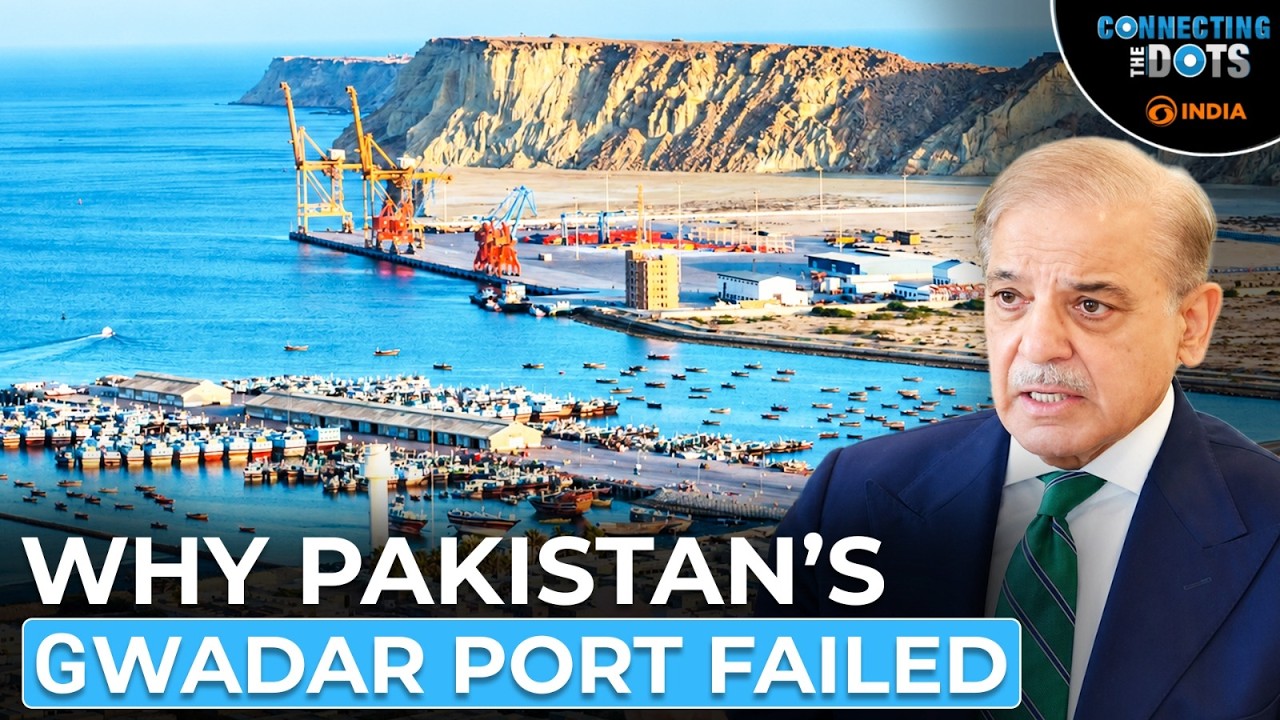
A Port With No Ships
According to official data, Gwadar has only three berths, while Karachi Port has 33. In its best year, Gwadar saw barely 22 ships. Other Chinese-built ports around the world handle hundreds of vessels annually. The new Gwadar airport, built with over $200 million of Chinese money, runs only a handful of flights a week in a city that still does not have reliable water or electricity.
China’s Strategic Interest in Gwadar
So why did China want this coastline in the first place?
Around 80% of China’s oil passes through the Malacca Strait, a narrow and crowded waterway that Beijing cannot fully control. China calls this vulnerability the “Malacca Dilemma.” Gwadar offered a shortcut — a direct line from Xinjiang province to the Arabian Sea. For Beijing, the port was always about strategic access, not charity for Pakistan.
Who Killed The Gwadar Dream?
On paper, the answer points to both Islamabad and Beijing. The one project that could have connected Gwadar to the rest of the country, the ML-1 railway upgrade from Karachi to Peshawar, was left to rot for years. While the corridor stalled, the Pakistani government poured funds into showcase projects like a metro train in Lahore, aimed at winning votes in Punjab, while Balochistan was left in the dark. Then there is the revenue deal.
Gwadar Revenue Share
- China takes 90% of port earnings
- Pakistan keeps 10%
- Balochistan gets zero
China takes 90 percent of what the port earns. Pakistan keeps 10 percent. Balochistan, the province that actually owns the coastline, gets nothing.
Richest Province, Poorest People
Balochistan is Pakistan’s richest province in terms of natural resources, with reserves of oil, gold, copper and gas. Yet it remains the poorest province in the country. The reason, critics say, is that Islamabad and Beijing are extracting that wealth together, while the Baloch population is cut out of the deal entirely.
Gwadar Employment Reality
- Promised 2 million jobs
- Less than 250,000 delivered
- Most jobs went to outsiders, not locals
- Local fishermen banned from fishing near their own port
- Chinese trawlers operate freely offshore
The government had promised two million jobs from Gwadar and CPEC. Fewer than 250,000 have materialized, and locals say most went to workers brought in from outside the province. Fishermen who lived off the Arabian Sea for generations have been banned from fishing near the port, while Chinese trawlers operate freely just offshore.
Crackdown On Dissent
When the Baloch protested peacefully, the response was not dialogue but force. Fences went up around Chinese compounds. Surveillance cameras were installed to monitor Baloch families in their own homeland. Rights groups documented a sharp rise in security operations.
According to the Human Rights Council of Balochistan, in February 2026 alone, more than 200 enforced disappearances and 87 killings were documented in Balochistan, most allegedly carried out by the Frontier Corps. Increasingly, activists say, the targets are women.
A 22-year-old woman was dragged out of her home in Kech. A nursing student was pulled from her hostel in Quetta. Hundreds of women who marched peacefully to Islamabad were arrested and held for over a day, including activist Mahrang Baloch. Rights groups allege that a pregnant woman and a 15-year-old girl are among those who disappeared this year.
Even Beijing Is Losing Patience
Even China appears to be running out of patience. Chinese engineers have been killed in attacks near Gwadar and Karachi. Beijing itself has admitted that without security, the business environment cannot improve. Total investment in Gwadar remains a tiny fraction of what was originally promised.
When the Gwadar airport was finally inaugurated, Chinese President Xi Jinping did not attend in person. It was even inaugurated via video link from Islamabad, over a thousand kilometers away.
The question being asked in Balochistan is stark: What kind of crown jewel is too dangerous for its own owner to visit?
For many locals, the conclusion is clear. Gwadar was never built for the Baloch people. It was built so that generals in Rawalpindi could sell Baloch land and resources to Beijing in exchange for loans, commissions and strategic leverage that nobody in Balochistan ever asked for. Pakistan wanted to be Dubai without doing the work. The people paying the price for that failure are the fishermen, the mothers and the missing sons of Balochistan.


