







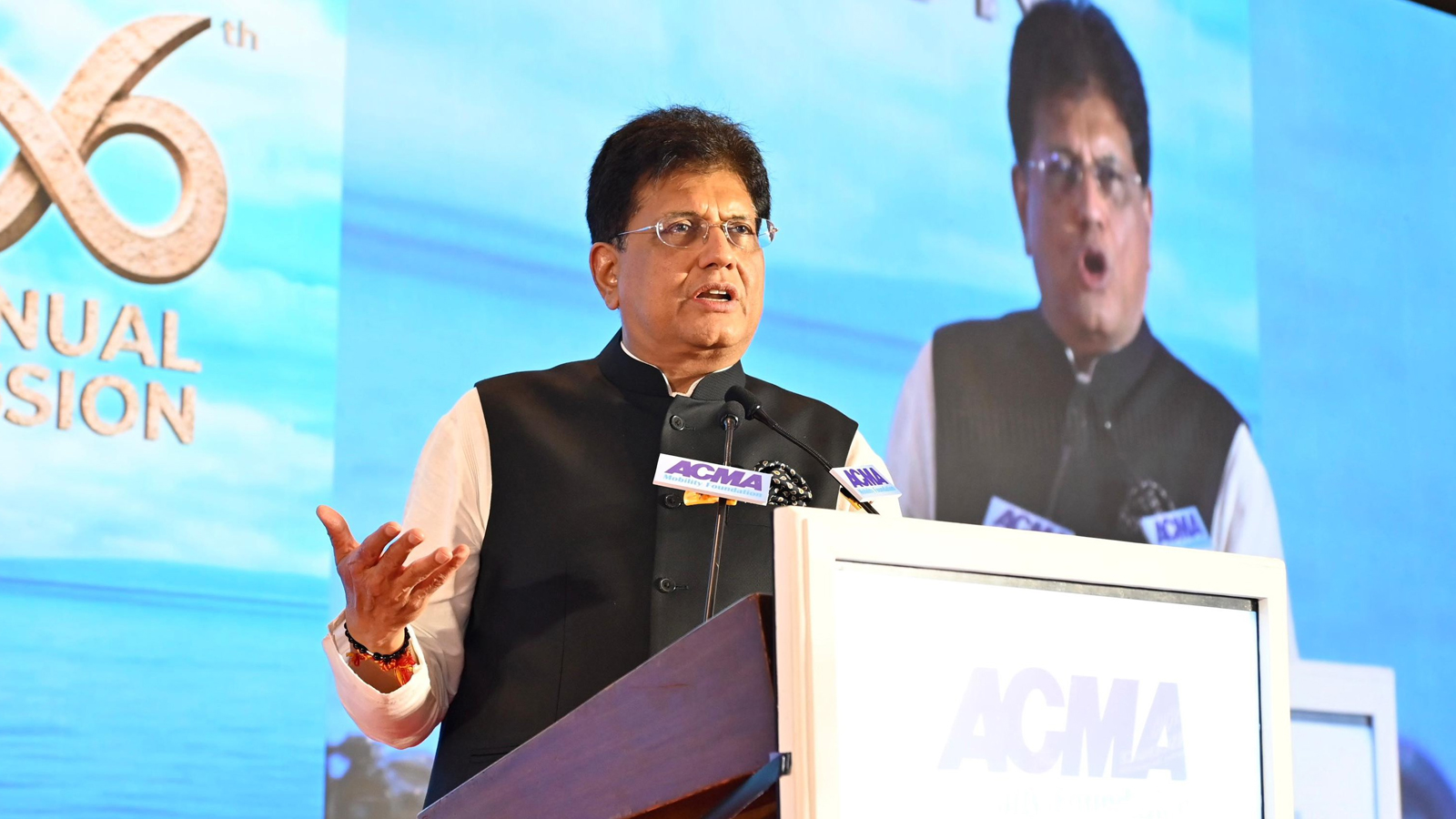
Union Commerce and Industry Minister Piyush Goyal on Wednesday called upon India’s auto component industry to expand its global footprint, strengthen supply chains and move up the value chain as the country seeks deeper integration with global markets.
Addressing the 66th Annual Session of the Automotive Component Manufacturers Association (ACMA) in New Delhi, Goyal said the industry’s international trade was currently close to USD 50 billion, with imports and exports almost evenly balanced.
He urged auto component manufacturers to increase exports, undertake greater international investment and establish manufacturing operations in developed markets.
“The naysayers can say what they want, but 7.8 per cent growth is a reality,” Goyal said, referring to India’s continued growth amid global economic uncertainty. He noted that the auto component industry was recording double-digit growth and the broader automobile sector was also growing at a high double-digit rate.
The Minister said around five million passenger cars were expected to be sold in India this year and highlighted the growing demand for electric vehicles, with some models reportedly having waiting periods of up to six months.
Goyal said India’s growing network of trade agreements was creating new opportunities for domestic manufacturers. He noted that nine trade agreements concluded over the last four to five years provided two-way market access to economies representing a combined GDP of around USD 60 trillion.
He said these agreements with developed and prosperous economies offered Indian companies opportunities in markets where competition was comparatively lower and complementarity with Indian industry was higher.
Goyal credited ACMA for its contribution to India’s trade negotiations, particularly its efforts to secure zero-duty market access for Indian auto components while seeking reciprocal opening of the domestic market.
Focus on resilient supply chains
The Minister highlighted several government initiatives aimed at strengthening the auto sector and its supply chains, including support for speciality steel manufacturing, technical textiles and semiconductor production.
He said these initiatives were intended to help the industry achieve scale, reduce supply-chain vulnerabilities and strengthen domestic manufacturing capabilities.
Goyal also invited auto component manufacturers to participate in new industrial parks being developed by the government. He said 20 smart and industrial cities were already underway and suggested that dedicated parks or enclaves could be created for auto component manufacturing in partnership with countries such as the US.
Calling for continued industry-government dialogue, Goyal said the government needed inputs from industry on challenges and areas where further reforms were required.
“We are a listening government. We want you to be talking,” he said.
Critical minerals, US partnership
Goyal also highlighted the India-US critical minerals partnership as an important step towards building resilient supply chains for industries such as automobiles.
Referring to the Pax Silica initiative launched by the US, he said like-minded countries could work together to ensure that no single geography could weaponise trade.
He said India was also pursuing trade agreements with countries that could provide greater access to critical minerals needed for resilient supply chains.
These initiatives, Goyal said, would help the auto component industry move towards its ambition of becoming a USD 500 billion global industry.
Focus on technology, safety and scrappage
Goyal called upon manufacturers to transform local businesses into global enterprises, establish active indigenisation programmes for products vulnerable to supply disruptions and move towards higher-value integrated solutions.
He also stressed the need for greater attention to vehicle safety, saying the industry should not leave safety concerns entirely to the government.
The Minister called for wider adoption of technologies such as artificial intelligence for quality control and understanding customer requirements. He also highlighted the growing demand for customised vehicles in the US and Europe and urged Indian manufacturers to focus on advanced safety features.
On vehicle scrappage, Goyal said the government and industry should work together to make scrapping old vehicles financially attractive for consumers. He called upon manufacturers to offer fair value for scrapped vehicles to create a larger market for new-generation automobiles.
US invites Indian auto component makers
US Ambassador to India Sergio Gor, who was also present at the event, said India-US cooperation in the automotive sector was at a “historic high point” and described the two countries as partners in shaping the future of mobility.
Gor said India’s auto component industry had emerged as a reliable and increasingly sophisticated partner in strengthening global supply chains. He invited Indian manufacturers to explore investments in the US, including greenfield assembly facilities, research and development centres and distribution networks.
He also highlighted the growing presence of US companies in India’s automotive ecosystem and Indian companies such as Bharat Forge, Sundaram Clayton and Mahindra in the US market.
Gor said the two governments were working towards a fair, reciprocal and mutually beneficial trade relationship and referred to the trade understanding reached between the two countries.
India-UK automotive partnership
British Deputy High Commissioner for Western India and Trade Commissioner for South Asia Harjinder Kang highlighted the growing India-UK partnership and said automotive and future mobility were central to the UK’s advanced manufacturing capabilities.
He referred to the India-UK Vision 2035, the UK’s modern industrial strategy and the India-UK Comprehensive Economic and Trade Agreement (CETA), which came into force on July 15, 2026.
Kang said 99 per cent of UK tariff lines and 90 per cent of Indian tariff lines had been reduced to zero or very low duties, alongside streamlined customs and border procedures.
He said CETA would help deepen automotive supply chains and facilitate joint ventures and partnerships, with auto component manufacturers gaining tariff-free access to each other’s markets.
Kang also highlighted UK capabilities in advanced engineering, innovation and zero-emission vehicle technologies, including electric motors, batteries, hydrogen solutions, lightweight composites and software-defined vehicle systems.


