







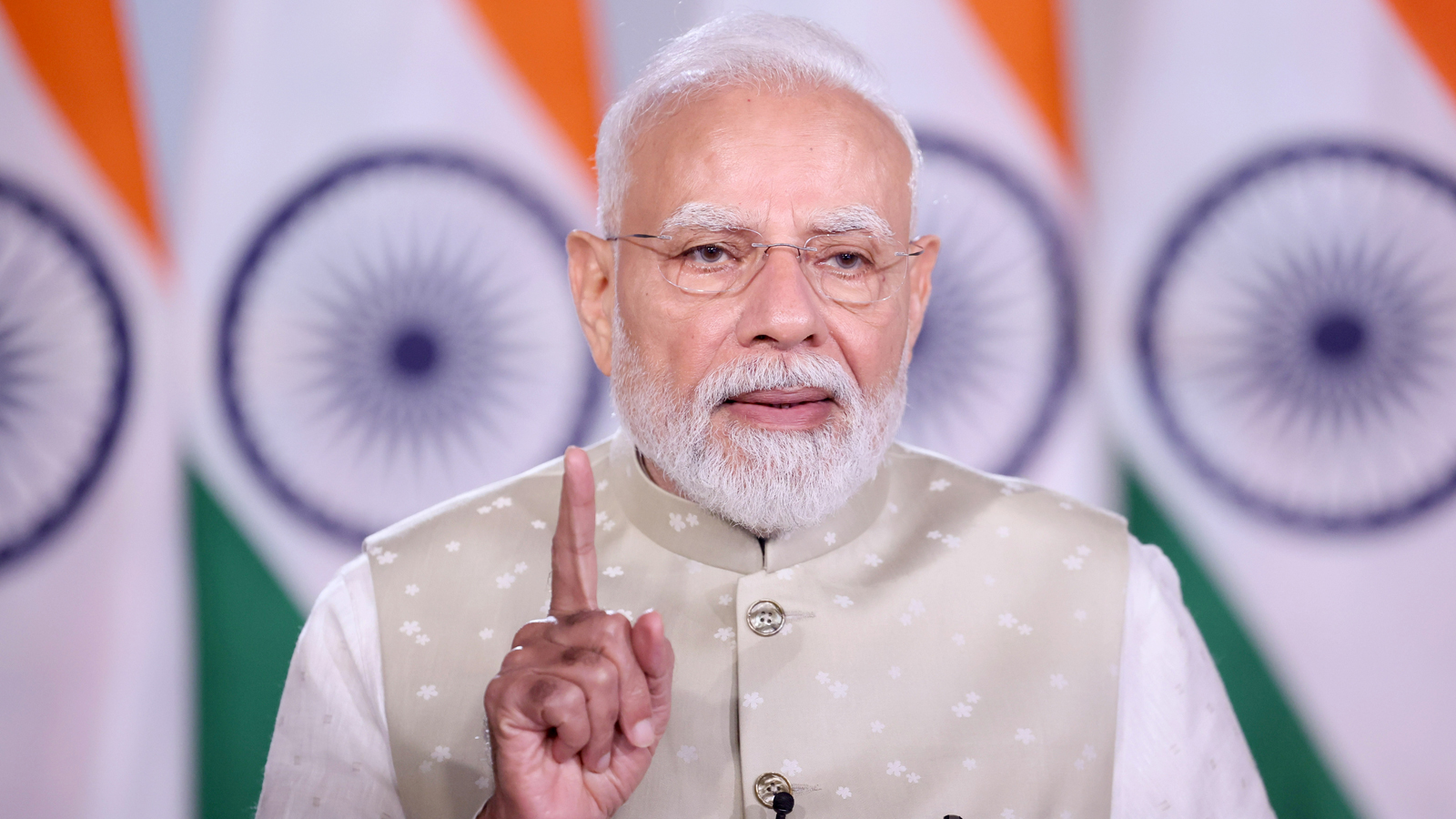
Prime Minister Narendra Modi on Thursday shared an article by Rajiv Gauba, Member, NITI Aayog, highlighting governance model centred on technology, trust and citizen engagement.
A post shared by the Prime Minister’s Office (PMO) on X said, “Shri Rajiv Gauba, Member, NITI Aayog, writes that PM Narendra Modi’s governance model is making technology, trust and citizen engagement central to delivering programmes at India’s scale. He highlights how digital systems, direct transfers, simpler regulations and transparent procurement are improving efficiency and access, making governance an economic asset for India’s growth.”
The X post and the shared article can be accessed at this link: https://x.com/PMOIndia/status/2100475038403330341.
In his article, Gauba said India’s scale requires governance systems capable of delivering programmes to crores of citizens with speed, efficiency and predictability. He identified technology as a key component, citing digital identity, Direct Benefit Transfers (DBT), standardised processes, dashboards, digital procurement and grievance platforms.
Gauba said more than ₹53 lakh crore has reached beneficiary accounts through DBT mechanisms, with estimated savings of ₹5.14 lakh crore to the exchequer. He also cited a 2025 assessment that put the welfare efficiency index at 0.91 in 2023, compared with 0.32 in 2014.
Gauba highlighted the Jan Vishwas Act 2023, which decriminalised 183 provisions across 42 central Acts, and subsequent 2026 legislation covering 79 Acts. He also noted that more than 47,000 regulatory compliances had been reduced by November 2025.
Gauba cited the Government e-Marketplace (GeM) as another example of technology-enabled transparency in public procurement. By July-end, GeM had 11.75 lakh MSMEs, 37,758 startups and 2.17 lakh women entrepreneurs registered.
He also highlighted faster grievance redressal through CPGRAMS, arguing that governance is increasingly becoming an economic asset as India scales towards a developed economy.


