







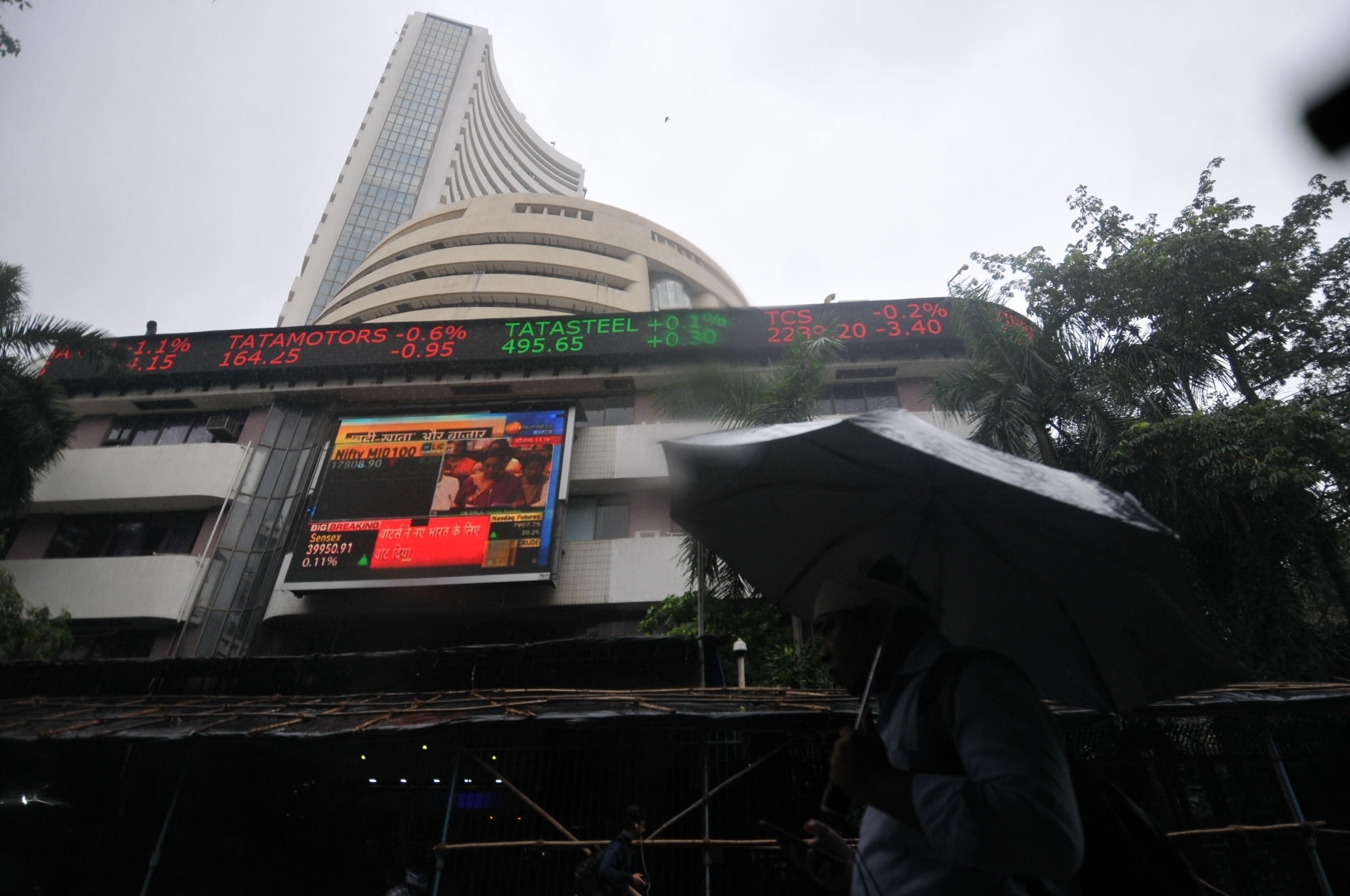
Indian markets fell sharply on Wednesday amid escalating geopolitical tensions in West Asia and rising global crude oil prices, overshadowing strong macroeconomic indicators and GDP growth.
The benchmark BSE Sensex fell 713.42 points, or 0.93 per cent, to 76,230.86, while the broader NSE Nifty 50 declined 197.80 points, or 0.82 per cent, to 23,858.00.
“Indian markets are pointing to a weak open as per the futures. Despite the strong macro and GDP print, the Iran war disruption is keeping Indian markets challenged. Global factors are dominating the strong domestic picture, unfortunately,” Ajay Bagga, banking and market expert, said.
“Risk-off globally, with renewed escalation in the Iran war leading to a sharp spike in crude oil prices, points to inflation staying higher for longer. Bond yields are flashing danger signals. ECB, BOJ are slated to raise rates this month. Inflation across most of the world is above central bank targets, which is a pointer to higher rates in the future,” he added.
Wall Street ended lower, with the Nasdaq leading the decline. It closed 1.03 per cent lower, down 271.11 points, at 26,099.77, while the broader S&P 500 slipped 0.71 per cent, or 54.67 points, to settle at 7,631.47. Dow Jones futures were also down 6.22 points, or 0.01 per cent, at 52,760.66.
Bagga further said, “Taking a cue from weak US markets, Asian markets are a splash of red this morning as Brent moved to USD 96 levels and New Zealand became the latest central bank to raise rates to tame entrenched inflation.”
Broader Asian markets traded predominantly lower, with Japan’s Nikkei 225 slipping 2.81 per cent, South Korea’s KOSPI falling 3.44 per cent and Hong Kong’s Hang Seng declining 1.17 per cent. GIFT Nifty also traded 122.50 points lower at 23,928.50.
V K Vijayakumar, Chief Investment Strategist at Geojit Investments Limited, said the market remains caught between conflicting drivers.
“The market is delicately poised between domestic tailwinds and external headwinds. The domestic tailwinds from impressive Q1 GDP numbers, excellent high-frequency data from GST collections, credit growth and automobile numbers, and improving prospects for earnings growth are big positives for the market,” Vijayakumar said.
“Unfortunately, the headwinds also are equally strong. The escalation of the US-Iran conflict and the consequent 5 per cent spurt in Brent crude overnight to USD 96 is a sentiment negative. However, this is not a big threat since our CAD is running at only 0.5 per cent and forex reserves are ample at USD 730 billion,” he stated.
At the time of reporting, most commodities were trading higher. Brent crude advanced 0.72 per cent, or USD 0.68, to USD 95.33 per barrel, while WTI crude oil rose 0.52 per cent, or USD 0.47, to USD 90.69 per barrel. Meanwhile, gold declined 0.86 per cent, or USD 37.37, to USD 4,291.35.
Vijayakumar cautioned that rising US bond yields remained a key risk.
“The macro construct in the US indicates further hardening of the bond yields. If the 10-year yield touches 5 per cent, that has the potential to trigger a big correction in equity markets globally. Therefore, this is the macro indicator to watch closely. The near-term market trend will depend on which of these forces — the tailwinds or headwinds — will emerge stronger,” he said.
-ANI


