







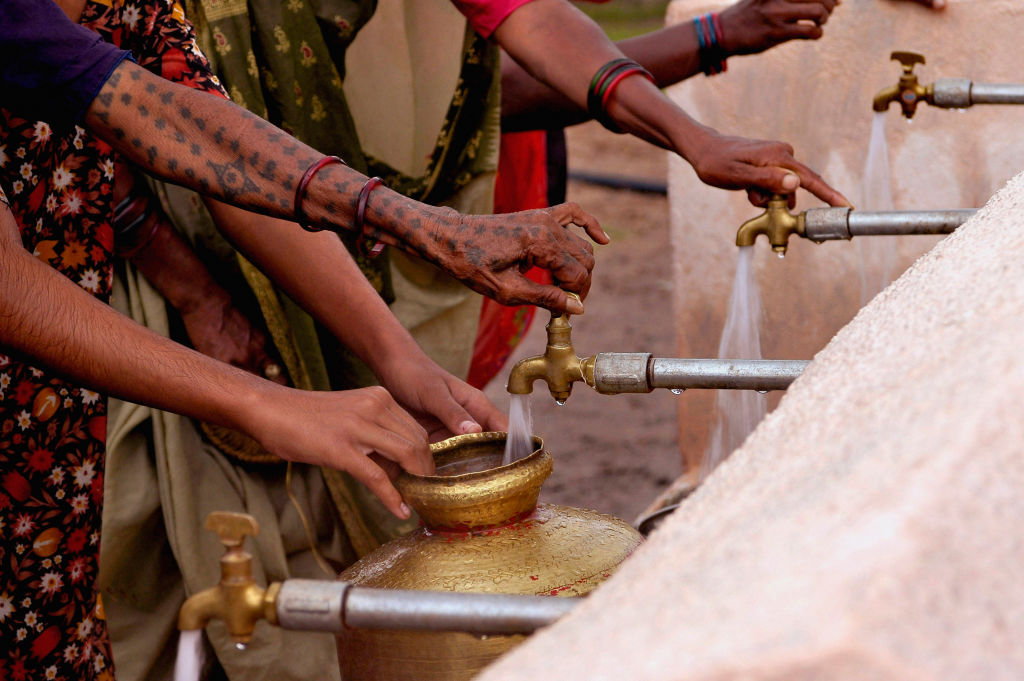
States and Union Territories have been advised to commence geo-tagging of rural water supply sources and post-monsoon testing of water supply sources from October 2, while also organising ‘Jal Arpan’ activities across the maximum possible number of Gram Panchayats on the same day.
The directions were issued at the 12th District Collectors’ Peyjal Samvad organised by the Department of Drinking Water and Sanitation (DDWS), Ministry of Jal Shakti, on Tuesday through video conferencing to review the implementation of Jal Jeevan Mission (JJM) 2.0 and facilitate cross-learning through district-level best practices.
The Samvad was chaired by DDWS Secretary Ashok K.K. Meena and attended by Additional Secretary and Mission Director, National Jal Jeevan Mission (NJJM), Kamal Kishore Soan, along with senior officials from DDWS and State Water and Sanitation Missions (SWSMs).
During the meeting, the States and UTs have also been asked to share details of Gram Panchayats participating in the ‘Jal Arpan’ activities with the Department by September 20, ahead of the October 2 programme.
‘Jal Arpan’ symbolises the handing over of drinking water assets to Gram Panchayats, aimed at strengthening community ownership and sustainable management of rural drinking water systems.
Regular Reviews, Community Ownership and Timely Fund Utilisation
Addressing the Samvad, Meena emphasised the need for regular monthly meetings of District Water and Sanitation Missions (DWSMs) to review scheme progress, service delivery, water quality and source sustainability under JJM 2.0. He stressed that completed schemes should be formally handed over to Gram Panchayats under the Jal Arpan programme after the prescribed trial run and completion of proper documentation, strengthening community ownership and sustainable operation and maintenance.
He also called for greater participation of MPs, MLAs and other public representatives through Jal Arpan ceremonies, DISHA meetings and DWSM reviews to improve transparency and public confidence in rural drinking water systems. He underlined the need for timely utilisation of JJM 2.0 funds, accurate reporting of physical and financial progress, and preparation of District and State Improvement Plans to identify and address service gaps.
Focus on Source Sustainability, Water Quality and Scheme Functionality
Meena encouraged districts to make greater use of the Decision Support System (DSS) to plan and implement source sustainability measures, including rainwater harvesting and groundwater recharge. He stressed that regular monitoring of scheme functionality, water quality and sustainability interventions is essential for ensuring reliable and long-term drinking water services to rural households.
Six Districts Showcase Innovative Practices for Cross-Learning
The progress and innovative practices of six districts — Shahdol (Madhya Pradesh), Samba (Jammu & Kashmir), Hooghly (West Bengal), Dhamtari (Chhattisgarh), Fatehgarh Sahib (Punjab), and North & Middle Andaman (Andaman & Nicobar Islands) — were presented by the respective District Collectors/ District Magistrates/Deputy Commissioners. The presentations highlighted district-level approaches to source sustainability, behaviour change through Information, Education and Communication (IEC) activities, grievance redressal mechanisms and convergence, providing an opportunity for other districts to draw lessons and strengthen JJM 2.0 implementation.
In his concluding remarks, Soan appreciated the presentations by the participating districts and urged Mission Directors of States and UTs to actively participate in upcoming discussions on the Skilling and Nal Jal Mitra Programme. He called for coordination with State Skill Development Departments and submission of inputs ahead of the virtual meeting scheduled for September 21.
Jal Jeevan Mission (JJM), the flagship rural drinking water programme of the Government of India, launched by Prime Minister Narendra Modi on 15 August 2019, aims to provide every rural household with safe and adequate drinking water through a Functional Household Tap Connection (FHTC) on a regular and long-term basis.


