







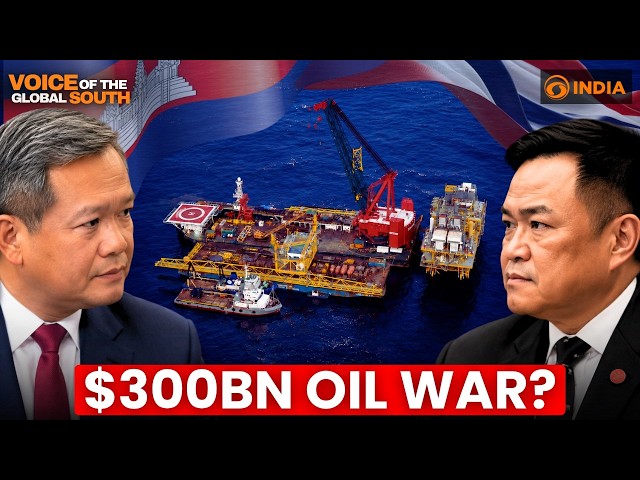
A volatile territorial feud between Thailand and Cambodia has spilled over from their bloodied land borders and into the lucrative waters of the Gulf of Thailand.
WATCH YOUTUBE VIDEO: youtu.be/7zzfgqbMPOk
At the heart of the latest standoff is a 27,000-square-kilometre overlapping maritime zone rumoured to sit atop a staggering $300 billion energy jackpot.
Seeking to avert another military escalation, the two South-East Asian neighbours formally entered a U.N.-backed conciliation process in Singapore on 15th September. However, early diplomatic exchanges reveal deep-seated animosity that could derail the talks.
For two rapidly developing nations facing soaring energy demands, the contested seabed represents total economic transformation. Geologists estimate that the area contains 12 trillion cubic feet of natural gas and 700 million barrels of crude oil. These reserves could guarantee long-term energy security, draw massive foreign investment and create thousands of jobs. Yet, exploitation remains completely stalled because neither country can agree on who owns the rights to extract them.
The legal friction dates back decades. In 2001, Bangkok and Phnom Penh signed a framework agreement known as M.O.U.-44 to pursue joint energy development. After more than 20 years of diplomatic gridlock, Thailand officially terminated the M.O.U. in May 2026, citing a total lack of progress. In response, Cambodia forced Thailand to the negotiating table by triggering a compulsory conciliation clause under the U.N. Convention on the Law of the Sea or UNCLOS.
The opening session highlighted a stark contrast in diplomatic strategies. Cambodia’s Foreign Minister Prak Sokhonn traced centuries of Cambodian trauma — from the Khmer Empire to the brutal Khmer Rouge era — to frame his nation as a peaceful, reluctant participant seeking regional stability and generational wealth.
Minister Sokhonn said: “A peaceful resolution is in the shared interests of both countries and will contribute to peace and stability in the region. It will protect sovereignty, strengthen confidence, unlock energy resources, support development, and create new job opportunities, not only for now, but also for the future generation of the Cambodian and the Thai people[.] Cambodia sees this conciliation process as a means to rebuild trust, not as a form of escalation. Cambodia sincerely hopes that Thailand will engage constructively in this process.”
For his part, Thailand’s Foreign Minister Sihasak Phuangketkeow launched a sharp counter-offensive, accusing Cambodia of playing the victim and manufacturing allegedly false narratives to claim the moral high ground internationally.
Minister Phuangketkeow said: “Instead of engaging fully and sincerely through bilateral dialogue, Cambodia has repeatedly vilified Thailand through false narratives, distortion of facts, and unfounded accusations against us almost on a daily basis, including at international forums. And it does this by playing the role of a victim with a sense of self-righteousness aimed at claiming the moral high ground. So for Cambodia to claim that it had no other option but to initiate these proceedings after Thailand terminated the M.O.U. was an outright distortion of the facts. Cambodia was indeed presented with an option, but Cambodia disregarded this option for reasons which we find difficult to comprehend. The door for dialogue is open. In the end, the honour still rests on our two countries to find the way forward together in earnest and in good faith.”
Thailand also drew a hard line at Koh Kood, a popular tourist island sitting directly above the energy reserves. Koh Kood lies in Thailand’s Trat province, close to the Cambodian coast. Hundreds of thousands of tourists travel to the island of Koh Kood, in the Gulf of Thailand, every year. Cambodia has claimed the island as part of its continental shelf since 1972 but Bangkok insists that its land sovereignty over Koh Kood is non-negotiable and outside the scope of the U.N. talks.
This U.N.-backed intervention is not a court case. The five-member Conciliation Commission cannot issue a binding ruling; it can only guide both nations toward a voluntary compromise.
A successful blueprint does exist: A similar UNCLOS process successfully resolved a complex maritime border treaty between Australia and Timor-Leste in 2018. However, the shadow of the 2025 border war, which killed dozens and displaced hundreds of thousands, still looms large over Thailand and Cambodia. Whether they can transform these volatile waters from a flashpoint into a joint economic victory remains to be seen.
Ramesh Ramachandran is a senior consulting editor with D.D. India


