







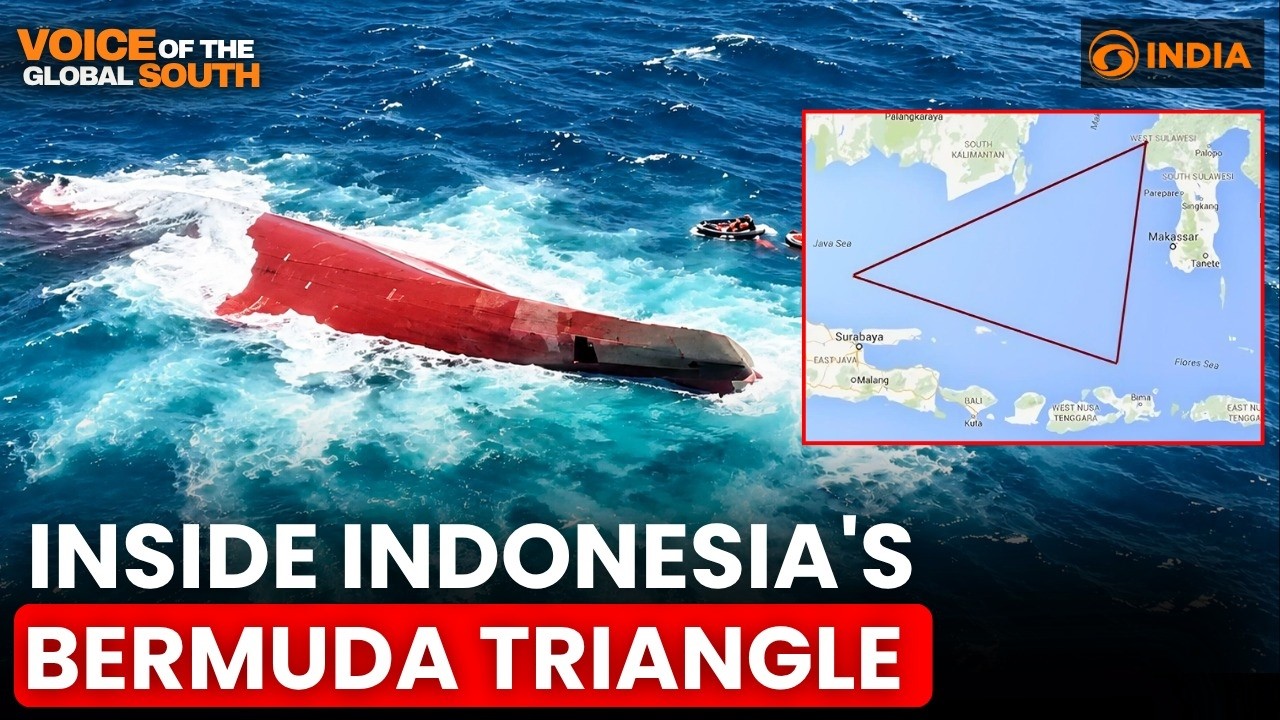
It’s a desperate race against time in South-East Asia as an environmental and human tragedy unfolds in the heart of Indonesia’s maritime grid.
WATCH YOUTUBE VIDEO: 🔗 youtu.be/-IUgBB1FQL8
A massive international search and rescue operation is underway in the Java Sea after a passenger ferry capsized during a violent storm.
The numbers are staggering. 243 people were onboard when the vessel went down. At least six are confirmed dead. 108 have been rescued. However, 129 people remain missing.
As the search enters its defining hours, the focus turns to a notorious stretch of water known to locals as Indonesia’s Bermuda Triangle — a geographical enigma that mariners speak of only in hushed tones. This is not an official designation on any modern nautical chart but rather a legendary, triangle-shaped area responsible for some of the most catastrophic maritime- and aviation-disasters in South-East Asian history.
It’s literally an aquatic graveyard. Located in the Java Sea, it forms a triangular boundary between Bawean Island in East Java, Majene city in West Sulawesi and the Tengah Islands in West Nusa Tenggara. The most perilous zone within this triangle is a tiny, isolated cluster of land known as the Masalembo Islands. They sit directly in the centre of this triangular zone. Therefore, the area is sometimes also known as the Masalembo Triangle.
This triangle spans the high-traffic shipping lanes connecting Surabaya, the bustling port city on the eastern tip of Java, to Banjarmasin, the industrial gateway on the rugged southern coast of Borneo. For centuries, this 20-hour transit has served as a vital economic artery for Indonesia’s 17,000 islands. Yet, crossing it means playing a high-stakes game of roulette with nature.
To understand why the Masalembo waters are so notorious, one must look beneath the surface. This is not merely a place of bad weather; it is an atmospheric and oceanic battleground. The waters between Surabaya and Banjarmasin form a bottleneck where three monumental oceanic currents slam into one another. A massive rush of water, travelling from the Pacific Ocean to the Indian Ocean, collides violently with the seasonal monsoon currents of the Java Sea and the Flores Sea. When these mega-currents crash in the shallow waters surrounding the Masalembo Islands, they create massive, invisible underwater vortexes and deadly air-pocket turbulence above the waves.
Local lore frequently mentions sudden magnetic compass failures in the area alongside claims of naturally-escaping methane-gas pockets from the seafloor that can instantaneously drop a ship’s buoyancy, causing it to drop like a stone.
The notoriety of the Masalembo Islands is cemented by a chilling timeline of tragedy. It is the exact location where a passenger ferry caught fire and sank in 1981, claiming hundreds of lives. Decades later, in January 2007, a passenger plane was flying over these exact coordinates when it suddenly suffered catastrophic instrument failure and plummeted from the sky into the deep waters off Majene, leaving no survivors.
The latest disaster struck in the early hours of 13th September local time. The ferry had departed the bustling port city of Surabaya in East Java, embarking on what should have been a routine 20-hour voyage north to Banjarmasin on Borneo Island. However, the waters connecting these two economic hubs are notoriously volatile. At around 2 a.m. local time, the captain sent a frantic distress call, warning that the ferry was listing heavily under the battering force of three-to-four-metre waves. Then, total silence. What happened next was a terrifying, rapid descent. According to survivors, the ferry — which was also carrying 89 vehicles — capsized in less than 10 minutes, leaving almost no time to deploy lifeboats.
The stories of survival emerging from the Java Sea are nothing short of miraculous. Reuters news agency reported on the astonishing ordeal of Rizky Apriansyah, a young waiter onboard. Woken up just minutes before the flip, Rizky was thrown into the freezing, turbulent ocean. He and four friends managed to grab hold of a floating, 12-kilogram cooking-gas cylinder. Clinging to the metal tank for 10 agonising hours in pitch darkness, they managed to stay afloat until a passing vessel spotted them.
Indonesia’s National Search and Rescue Agency, working alongside the Indonesian Navy, has deployed over 600 personnel, Naval ships and helicopters. They are deploying advanced underwater thermal drones to scan the overturned hull.
Between 2020 and 2026 alone, the Indonesian Government recorded 111 major ship accidents. Experts attribute this frequency to a deadly cocktail of lax safety enforcement and sudden tropical weather shifts. There’s also the recurring issue of overcrowding, with actual passenger manifests rarely matching the number of people packed onto the decks. In this case though, overcrowding has been ruled out.
As families gather at the ports of Surabaya and Banjarmasin, praying for a miracle, the Indonesian Ministry of Transportation has launched a full forensic investigation. However, for the 129 souls still lost in Indonesia’s Bermuda Triangle, time is rapidly running out.
The Masalembo Triangle, or Indonesia’s Bermuda Triangle, has once again reminded the world why it remains one of the most feared marine corridors on earth.
Ramesh Ramachandran is a senior consulting editor with D.D. India


