







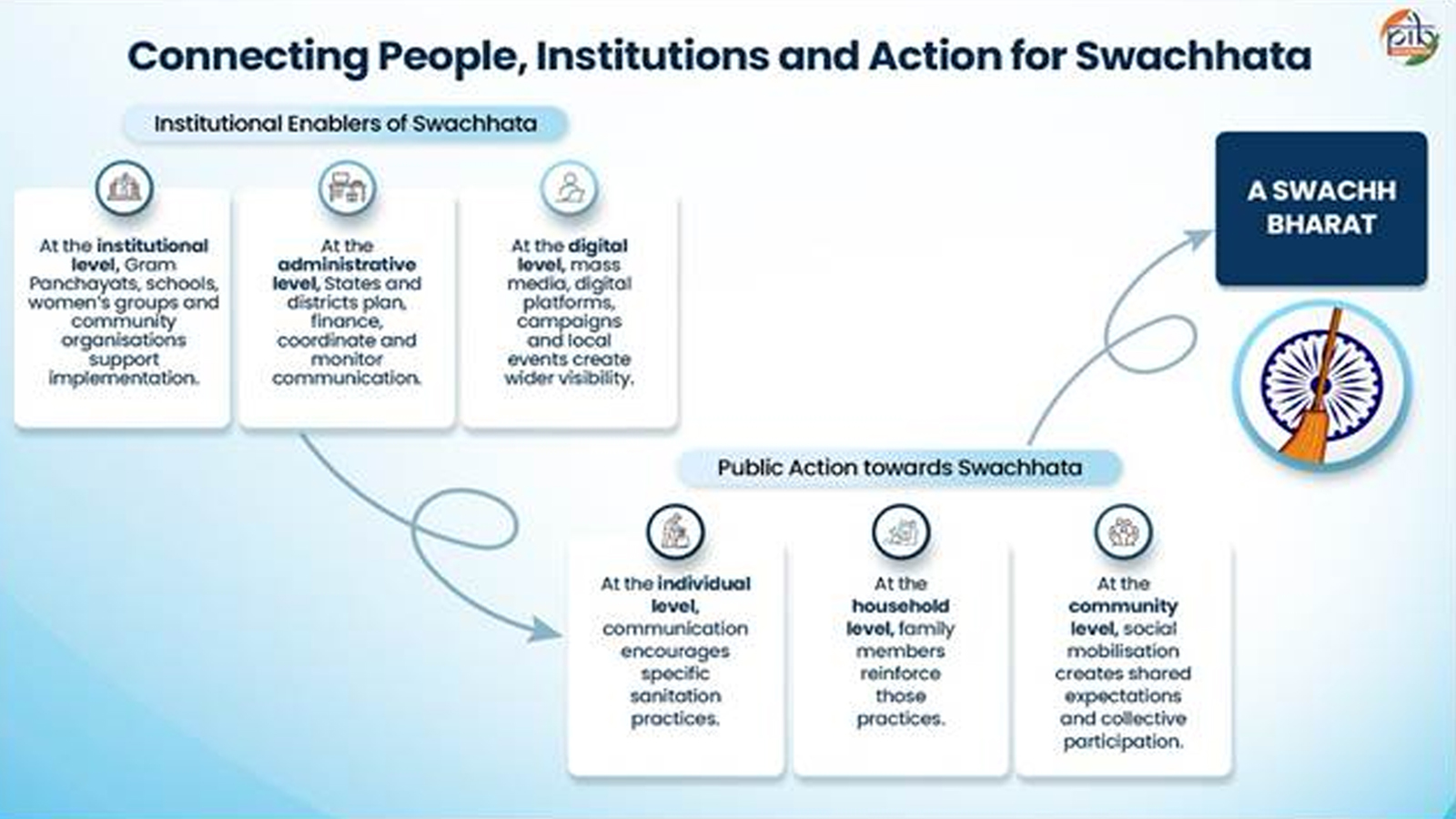
A household visit by a Swachhagrahi, a village discussion at a Ratri Chaupal, a school cleanliness activity and a complaint registered through the Swachhata App serve a common purpose: making sanitation part of everyday behaviour.
Since its launch on October 2, 2014, the Swachh Bharat Mission (SBM) has placed behaviour change at the centre of its approach. Building toilets and waste management facilities created essential infrastructure, but sustaining their use required dialogue, participation and a sense of collective responsibility.
Social and Behaviour Change Communication (SBCC) became the link between these assets and the people using them. Through household conversations, community mobilisation, popular culture, digital platforms and recognition of local champions, the mission has sought to turn individual sanitation practices into shared social norms.
From infrastructure to everyday practice
The mission operates through two components. SBM-Grameen focuses on rural sanitation, toilet access and usage, and waste management. SBM-Urban addresses urban sanitation, waste management and clean public spaces.
In rural areas, the communication challenge extended beyond generating demand for toilets to encouraging regular use and sustaining safe sanitation practices. In cities, it included making waste segregation at source a public habit and promoting total urban sanitation and cleanliness.
Information, Education and Communication strategies, behaviour reinforcement and monitoring became integral to implementation. SBCC broadened this work by addressing the knowledge, attitudes, relationships and social norms that influence daily choices.
The approach recognises that families, neighbours, trusted leaders and local institutions can encourage or discourage particular practices. Communication therefore involves more than delivering a message: it creates opportunities for people to discuss concerns, address practical barriers and agree on collective action.
Gandhi’s legacy gives the movement its identity
Mahatma Gandhi’s emphasis on cleanliness and self-service provided the mission with its guiding principles. SBM was launched with the objective of achieving a Swachh Bharat by his 150th birth anniversary in 2019. Rural India was declared open defecation free on October 2 that year.
The mission’s logo, depicting Gandhi’s spectacles, gave the campaign a recognisable identity and helped people associate themselves with its cleanliness message.
Gandhi’s sanitation work began in Champaran during the Satyagraha movement. His vision of an ideal village included proper sanitation and lanes and streets free of avoidable dust. In Ashram Observances in Action, he described sanitary service as essential and sacred.
At Sevagram Ashram, members took turns cleaning the premises instead of engaging outside labour. Ashram rules also required residents to wash their hands and wipe them with a clean napkin.
SBM drew on this emphasis on personal responsibility and participation. The term “Swachhagrahi”, inspired by Satyagraha, positioned sanitation volunteers and citizens as participants in a collective movement for cleanliness.
Taking the conversation to households
Interpersonal communication became a central means of translating the mission’s objectives into local action.
Frontline workers, Swachhagrahis, community leaders, self-help groups and existing social networks engaged people through home visits, face-to-face counselling, small-group sessions and peer discussions. Conversations took place in homes, health centres, community settings and religious gatherings.
These exchanges allowed families to discuss perceptions and practical difficulties within their own circumstances.
Under SBM-Grameen, Swachhagrahis became grassroots motivators whose responsibilities extended beyond promoting toilet construction. They conducted household visits, facilitated sanitation discussions and community mobilisation, and supported local nudging and triggering activities. Their engagement continued after villages were declared open defecation free to reinforce sanitation practices.
Nigrani Samitis brought community participation into monitoring. Their regular morning and evening rounds focused particularly on common open defecation sites. Village meetings, Nigrani drives and Ratri Chaupals helped maintain attention on toilet use and sustain open defecation free behaviour.
Swachhagrahis received toolkits containing a torch and whistle to support field-level vigilance. Through continued engagement, sanitation became a concern that communities themselves helped address.
Local forums turn awareness into collective action
Gram Sabhas, chaupals and community meetings provided spaces to discuss sanitation concerns, exchange experiences and identify common priorities.
Panchayati Raj Institutions, community and religious leaders, volunteers and women’s groups helped bring different sections of society into these discussions. Household practices were connected to the cleanliness and well-being of the wider community.
Campaigns such as Chalo Champaran, Swachh Shakti, Swachh Sundar Sauchalaya, Swachhata Hi Seva, Swachh Sundar Samudayik Sauchalaya, Swachh Bharat Diwas, Swachhata Mahotsav and Swachhata Pakhwada provided platforms for collective participation.
Local communication formats reinforced these efforts. Puppet shows, magic shows, drama and street theatre carried sanitation messages into community gatherings. Billboards, paintings on authorised public walls and graffiti art made cleanliness messages visible in everyday surroundings, often reflecting local identity while supporting city beautification.
Digital tools widen access and participation
Under SBM-Urban, digital platforms have helped citizens locate facilities, raise complaints and exchange experiences.
More than 67,000 public toilet blocks across over 3,300 cities were uploaded to Google Maps, making sanitation facilities easier to locate. The Swachhata App provides a single platform for citizens to register complaints about cleanliness.
Television, radio, print and online media added further layers of communication. Community radio carried discussions, testimonials, stories and public service announcements. Twitter, Facebook, YouTube and Instagram helped disseminate messages and build online communities, while bulk SMS, WhatsApp and podcasts supported outreach through mobile phones.
Swachh Talks, a peer-learning webinar series under SBM-Urban, offers a platform for sharing field experiences and best practices. Its discussions extend to plastic waste management and the promotion of a circular economy.
Together, these channels reinforce local conversations and give citizens additional ways to participate in sanitation services.
Popular culture brings sanitation into public discussion
Celebrity campaigns helped carry sanitation messages to wider audiences.
In 2016, Amitabh Bachchan and Sachin Tendulkar featured in national audio-visual campaigns for SBM-Grameen. They also participated in Swachh Bharat events to encourage grassroots workers and sanitation champions.
Bachchan subsequently led the “Darwaza Band” campaign in 2017, encouraging toilet use among people who continued to practise open defecation despite having toilets. Anushka Sharma also featured in the campaign, urging women to take leadership on sanitation in their villages. The mass-media outreach complemented local communication by Swachhagrahis.
Cinema offered another route into discussions about sanitation norms. Toilet – Ek Prem Katha, starring Akshay Kumar and Bhumi Pednekar, brought toilet use into mainstream popular culture. State and district SBM-Grameen teams were able to organise non-commercial screenings in villages.
In 2018, Kumar and Pednekar featured in a campaign promoting twin-pit toilet technology. Celebrity outreach also addressed the stigma associated with emptying toilet pits and encouraged sustained toilet use.
Vidya Balan appeared in a video promoting the slogan “jaha soch, vaha shauchalaya”, highlighting the health benefits of toilets and encouraging women-led toilet-building initiatives in rural households.
Women and children help sustain the change
For women, the mission connects sanitation with Suraksha, Suvidha and Swabhimaan – safety, convenience and self-respect.
A study conducted in collaboration with the Ministry of Jal Shakti found that 93 per cent of women reported no longer fearing harm from people or animals while defecating. Another 91 per cent reported saving up to an hour and avoiding travel of up to a kilometre, while 93 per cent said they no longer restricted food or water intake to manage sanitation needs.
In Bihar, toilets have come to be called “Izzatghars”, reflecting their association with women’s dignity. Alongside these benefits, women’s groups and self-help groups have contributed to sanitation communication through established community networks.
Children have also become participants and agents of change. School-based efforts include curriculum integration, awareness campaigns, shramdaan, mobile-van education and visits to waste management facilities.
Educational videos, flipcharts and small-group activities combine learning with participation. Traditional formats such as puppet shows, magic shows, drama and street theatre offer further ways to engage children.
Women and children thus both experience improvements in sanitation and help spread practices through households, schools and communities.
Standards, recognition and incentives reinforce behaviour
Sustaining cleanliness requires continued encouragement after initial awareness campaigns.
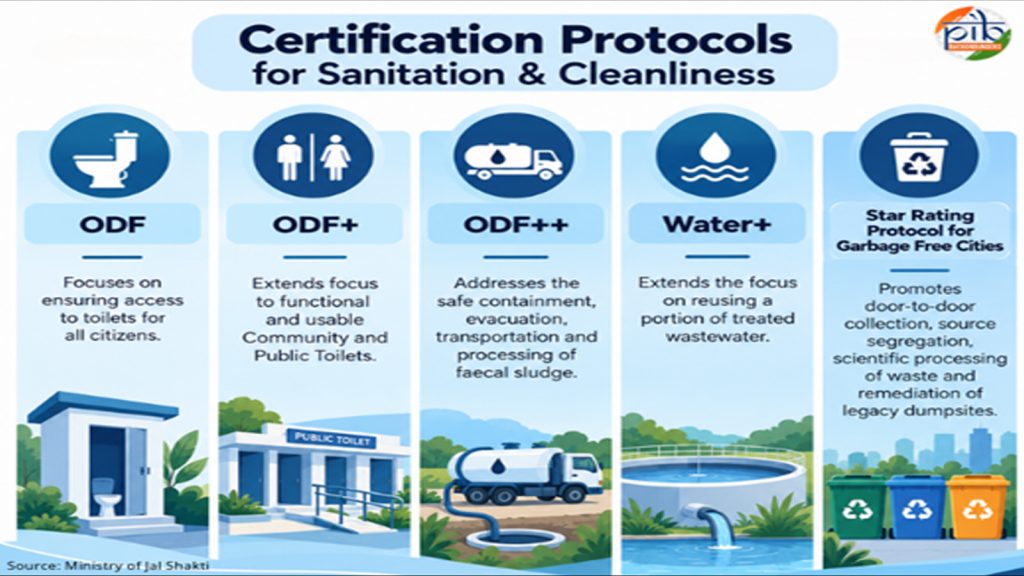
SBM uses certification protocols, recognition, nudges and community incentives to reinforce participation. ODF, ODF+, ODF++, Water+ and the Star Rating Protocol for Garbage Free Cities establish benchmarks for sanitation outcomes.
The ODF protocol focuses on toilet access for all citizens. ODF+ extends attention to functional and usable community and public toilets, including their operation and maintenance.
ODF++ addresses the safe containment, evacuation, transportation and processing of faecal sludge to prevent untreated sludge from entering drains, water bodies or fields. Water+ addresses untreated black and grey water and promotes the reuse of a portion of treated wastewater.
The Star Rating Protocol assesses solid waste management through parameters including door-to-door collection, source segregation, scientific processing and remediation of legacy dumpsites.
Recognition adds a community dimension to these standards. Best-performing workers, peer leaders and local champions are felicitated through peer appreciation and government letters, making their contributions visible and offering examples for others to follow.
Local incentives can also encourage action. In Panchayat Halqa Hiller in Jammu and Kashmir, the “Give Polythene Get Gold” initiative offered two gold coins against specified quantities of collected plastic waste.
Supported by youth and women, the campaign combined plastic collection with awareness activities, cloth bags for households and community shramdaan drives.
Citizen feedback keeps sanitation in focus
Monitoring under SBM extends beyond counting infrastructure to assessing services and identifying areas needing improvement.
Swachh Survekshan, world’s largest urban sanitation survey, evaluates cities and states on sanitation and cleanliness. It encourages competition among local administrations while providing a structured channel for citizen feedback.
Participation grew from around one lakh citizens in the first survey in 2016 to nearly five crore in its sixth round in 2021.
In rural areas, SBM-Grameen guidelines provide for continued engagement by Nigrani Samitis, community leaders and Panchayat representatives after open defecation free status is achieved.
The mission’s communication priorities have evolved alongside its sanitation goals – from creating awareness and demand for household toilets to encouraging regular use, sustaining open defecation free status and strengthening solid and liquid waste management.
Across these stages, the central task remains making cleanliness a practice that people sustain together. Household dialogue, local leadership, public recognition and citizen feedback connect sanitation infrastructure with community ownership, helping Swachhata become part of everyday life.


