







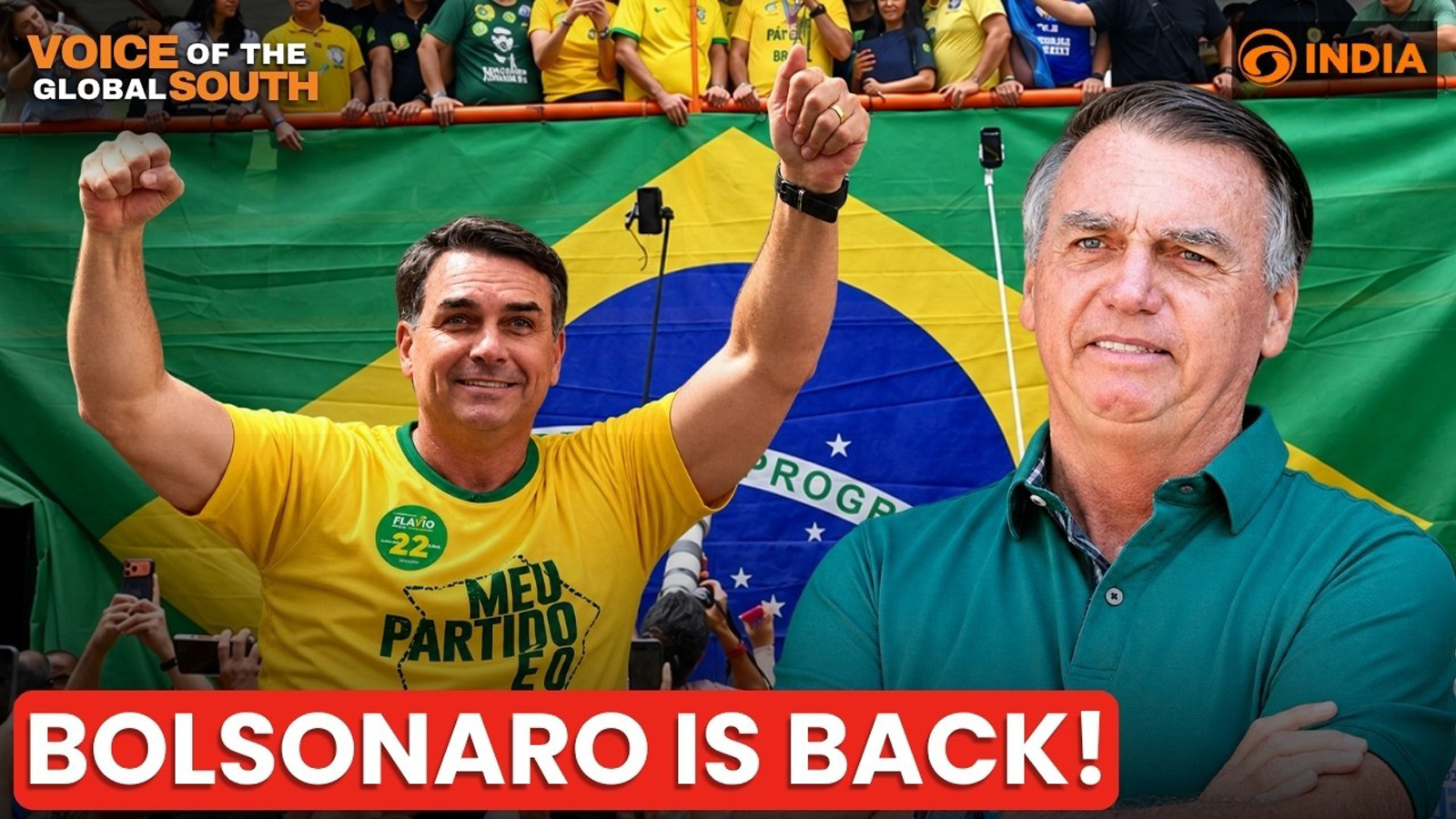
The biggest winner in Brazil’s blockbuster weekend election did not even appear on the ballot!
Banned from public office and under house arrest, former President Jair Bolsonaro is currently serving a 27-year sentence for a coup plot following his 2022 election defeat. Yet, from confinement, the 71-year-old watched a stunning political resurrection unfold.
His eldest son, 45-year-old lawmaker Flavio Bolsonaro, has scored a massive, upset victory over leftist President Lula da Silva in the first round of the presidential race.
International reactions were immediate. In the U.S., President Donald Trump hailed the result as an “amazing, very, very big victory.” In Israel, Prime Minister Benjamin Netanyahu posted his congratulations on X, saying that he looks forward to “restoring the extraordinary friendship between Israel and Brazil.”
The result instantly makes Flavio Bolsonaro the favourite heading into the decisive runoff on 25th October. For Bolsonaro Senior though, who is currently serving a 27-year sentence under house arrest for a coup plot, the celebrations are just beginning. Four more members of the Bolsonaro family swept into public office. The former President’s wife, Michelle Bolsonaro, and his second son, Carlos, secured seats in the upper House of Brazil’s parliament. His youngest son, Jair Renan, and his brother, Renato, took seats in the lower House. Analysts say that in Brazilian history, no political clan has ever managed to elect so many members all at once.
That’s not all. Bolsonaro’s right-wing Liberal Party completely redrew the map of Brazil’s parliament, emerging as the largest single-party representation in both Houses. In the 81-seat Senate, the party nearly doubled its footprint — surging from 15 to 28 seats. This marks the strongest performance by any single party since Brazil returned to democracy and enacted its Constitution in the late 1980s. In the lower House, they climbed to 121 seats. Combined with allied centre-to-right blocs, Conservatives now hold a crushing working majority of nearly 250 seats in the lower House and over 30 in the upper House.
Most importantly for Bolsonaro Senior, this legislative fortress could secure him much-needed amnesty. An allied Parliament gives Flavio Bolsonaro the power to erase his father’s legal woes. Flavio’s ultimate campaign promise has been to walk up the ramp of the Presidential compound next year shoulder-to-shoulder with his father. And an amnesty for Bolsonaro Senior could become a reality even sooner if the current Parliament decides to curry favour with the incoming Government. The Senate’s pro-Bolsonaro bloc is even creeping close to the 54-vote threshold required to impeach the very Supreme Court justices who convicted the far-right patriarch.
So, how did a candidate once mocked by Centre-Right allies as a less charismatic shadow of his father pull this off?
First, voter fatigue and an intense thirst for change. With Lula’s disapproval ratings hovering near 50 per cent amid rising prices and security fears, ordinary citizens revolted at the ballot box. Even traditional Lula voters admitted to switching sides at the last second just to see something change.
Second, a perfectly timed corruption crisis. A massive campaign scandal centred on a disgraced banker charged with fraud, awkwardly entangled both Flavio’s campaign and the Brazilian top court judge who presided over Jair Bolsonaro’s trial. It allowed the Right-wing movement to weaponise anti-corruption sentiment once again. Flavio successfully shifted the spotlight away from his own ties, turning the election into a referendum on the establishment.
And third, a massive consolidation of the Right. Immediately following the first-round triumph, two high-profile conservative rivals handed Flavio their official endorsements, leaving Lula facing a mathematically brutal uphill battle to win the required runoff votes.
However, what is happening in Brazil is not an isolated event. It is the crown jewel of a profound, sweeping geopolitical shift. From the Pampas of Argentina to the highlands of the Andes, the dominant Left-wing “Pink Tide” is receding fast. In its place, a fierce “Blue Tide” of Conservative leaders has taken an iron grip on the region.
The numbers are undeniable. Conservatives have won 12 of the last 16 presidential elections in Central and South America. Just check out the timeline of this right-wing surge:
— In 2023, Javier Milei took Argentina by storm;
— in 2024, El Salvador re-elected security hardliner Nayib Bukele while Panama and the Dominican Republic locked in Right-wing rule;
— in 2025, Ecuador re-elected Daniel Noboa and Bolivia shattered two decades of Socialist rule;
— and in 2026, the dominoes kept falling, culminating in Laura Fernandez in Costa Rica, Keiko Fujimori in Peru and Abelardo de la Espriella in Colombia.
Voters across the hemisphere are abandoning Leftist ideology in favour of raw survival. Holding eight per cent of the world’s population but suffering one-third of global homicides, Latin America is demanding an iron fist against organised crime and hyperinflation. This regional lurch serves as a massive geopolitical pivot fuelled by a transactional, aggressive U.S. foreign policy.
Under Donald Trump’s Government, Washington, D.C. has dismantled traditional aid agencies such as USAID, replacing them with a stark ultimatum — direct security alignment with the U.S., or isolation. This is Monroe Doctrine 2.0 — treating Latin America as Washington, D.C.’s primary security and resource corridor.
It is exceptionally bad news for Beijing. For two decades, China quietly expanded its footprint, building mega-ports in Peru, financing dams in Ecuador, and locking down contracts across the strategic Lithium Triangle. However, the new era of unchecked Chinese influence is cooling down. From Panama to Chile, U.S.-aligned Conservative leaders are introducing tight scrutiny over strategic assets, forced to choose sides in a rigid, “America-First” trading bloc.
While authoritarian holdouts such as Cuba, Nicaragua and Venezuela remain, the democratic core of Latin America has pivotally transformed. The Pink Tide built a dream that many voters feel collapsed under the weight of crime and economic ruin. The Blue Tide arrives promising safety, order and economic alignment with the West.
As Brazil prepares for its final showdown on 25th October, the ultimate question hanging over the Western Hemisphere remains — will this new iron fist protect Latin America’s fragile democracies or crush them entirely?


