






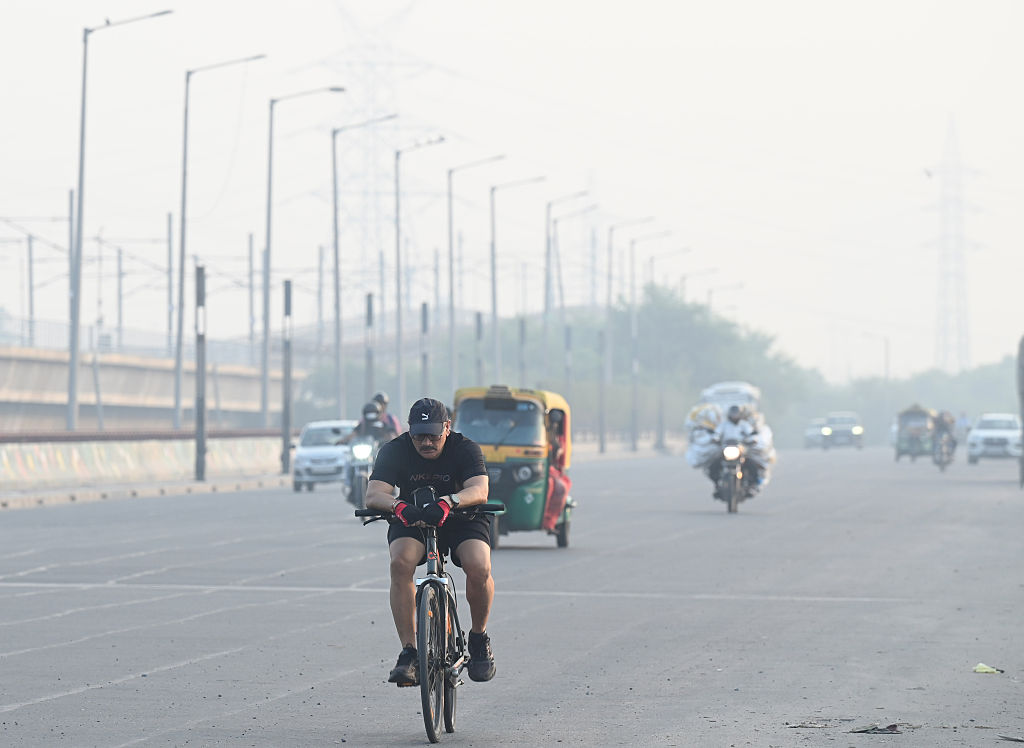
The Commission for Air Quality Management (CAQM) on Wednesday invoked Stage-I of the Graded Response Action Plan (GRAP) across Delhi-NCR with immediate effect after Delhi’s daily average Air Quality Index (AQI) rose to 245 in the ‘Poor’ category at 4 PM, prompting a review of the prevailing air quality situation.
According to the daily AQI bulletin issued by the Central Pollution Control Board (CPCB), Delhi recorded an average AQI of 244 at 2 PM, which rose to 245 at 4 PM.
The measures will be implemented, monitored, and reviewed by the concerned agencies across the region to prevent any further deterioration in air quality. All implementing agencies have been directed to maintain strict vigilance and intensify enforcement of the prescribed measures, according to a press release issued by the Ministry of Environment, Forest and Climate Change.
CAQM Reviews Air Quality, Orders Immediate Implementation of Stage-I Measures
In view of Delhi’s air quality remaining in the ‘Poor’ category, the CAQM Sub-Committee on GRAP convened a meeting on Wednesday to assess the prevailing air quality situation across Delhi-NCR.
After reviewing the regional air quality scenario, Delhi’s AQI, and weather and meteorological forecasts provided by the India Meteorological Department (IMD) and the Indian Institute of Tropical Meteorology (IITM), the Sub-Committee decided to implement all 25 action points under Stage-I of the extant GRAP across the entire National Capital Region (NCR) with immediate effect.
Key Measures Under Stage-I of GRAP
Dust Mitigation and Construction Activities
Ensure proper implementation of directions, rules, and guidelines on dust mitigation at construction and demolition (C&D) sites. Measures include proper storage and covering of construction materials and waste, transportation in covered vehicles, and appropriate use of anti-smog guns and water sprinkling.
Enforce Directions Nos. 11–18 dated June 11, 2021, and prohibit C&D activities at projects with plot sizes of 500 square metres or more that are not registered on the respective state or Government of the National Capital Territory of Delhi (GNCTD) web portal, or do not meet other statutory requirements for remote monitoring of dust mitigation measures.
Ensure regular lifting of municipal solid waste, C&D waste, industrial waste and hazardous waste from designated dumping sites and industrial areas. Illegal dumping of waste on open land must be prevented.
Conduct periodic mechanised road sweeping and water sprinkling, and ensure the scientific disposal of collected dust at designated sites or landfills.
Intensify the use of anti-smog guns, water sprinkling and other dust-suppression measures at road construction, widening, repair and maintenance sites.
Waste Burning and Traffic Management
Strictly enforce the prohibition on open burning of biomass and municipal solid waste. Impose maximum environmental compensation for violations in accordance with the National Green Tribunal’s orders dated December 4, 2014, and April 28, 2015, in Original Application No. 21/2014.
Intensify surveillance to prevent fires at landfill and dumping sites.
Synchronise traffic movements and deploy adequate personnel at identified high-traffic corridors, congestion points and intersections to ensure smooth traffic flow.
Vehicular Emissions and Traffic Restrictions
Enforce pollution-under-control (PUC) norms strictly, maintain close surveillance of vehicles and take action against visibly polluting vehicles through impounding and/or the imposition of maximum penalties.
Strictly enforce the Supreme Court’s order on diverting truck traffic not destined for Delhi through the Eastern and Western Peripheral Expressways.
Enforce orders of the National Green Tribunal and the Supreme Court prohibiting the plying of overage diesel and petrol vehicles, along with other restrictions prescribed under the existing statutes.
Intensify inspections of industries, including those in non-conforming areas, and take strict penal and legal action against non-compliant and illegal industrial units.
Industrial and Power-Sector Pollution Control
Enforce pollution-control regulations at industries, brick kilns and hot-mix plants, ensuring compliance with prescribed emission standards and the use of approved fuels only.
Strictly enforce emission norms at thermal power plants and initiate penal and legal action in cases of non-compliance.
Strictly enforce orders of courts and tribunals concerning firecrackers.
Direct distribution companies (DISCOMs) to minimise power supply interruptions across NCR.
Ensure that diesel generator sets are not used as a regular source of power supply.
Strictly implement regulated operations of diesel generator sets across industrial, commercial, residential and other sectors in NCR in accordance with Direction No. 76 dated September 29, 2023, including any subsequent amendments.
Public Transport and Vehicle Restrictions
Restrict the plying of inter-city and inter-state buses in Delhi-NCR from cities and towns in Haryana, Uttar Pradesh, Rajasthan and adjoining states, including Punjab, Himachal Pradesh, Madhya Pradesh, Uttarakhand and Jammu and Kashmir. Only electric vehicles (EVs), CNG buses and BS-VI-compliant diesel buses will be permitted.
Strictly enforce the existing ban on the use of coal and firewood as fuel in tandoors at hotels, restaurants and open eateries. Ensure that these establishments use only electricity-based, gas-based or other clean-fuel appliances.
Public Awareness and Complaint Redressal
Intensify Information, Education and Communication (IEC) activities through print, electronic and social media, bulk SMS and other channels. Issue alerts to citizens on the dos and don’ts to help minimise polluting activities.
Use mobile applications to inform the public about pollution levels and provide control room contact details, enabling citizens to report polluting activities and sources to the concerned authorities. The apps should also inform users about the action to be taken by the government.
Ensure prompt redressal of complaints received through the 311 App, Green Delhi App, SAMEER App, other similar applications and social media platforms to curb polluting activities.
Reducing Traffic Congestion and Promoting Public Transport
Encourage offices to introduce unified commuting arrangements for employees to reduce the number of vehicles on roads.
Augment public transport services by deploying additional CNG and electric buses and increasing the frequency of Metro and Regional Rapid Transit System (RRTS) services. Introduce differential fares to encourage off-peak travel.
Press Release Link: https://www.pib.gov.in/PressReleaseDetail.aspx?PRID=2326133®=48&lang=1
-PIB inputs


