






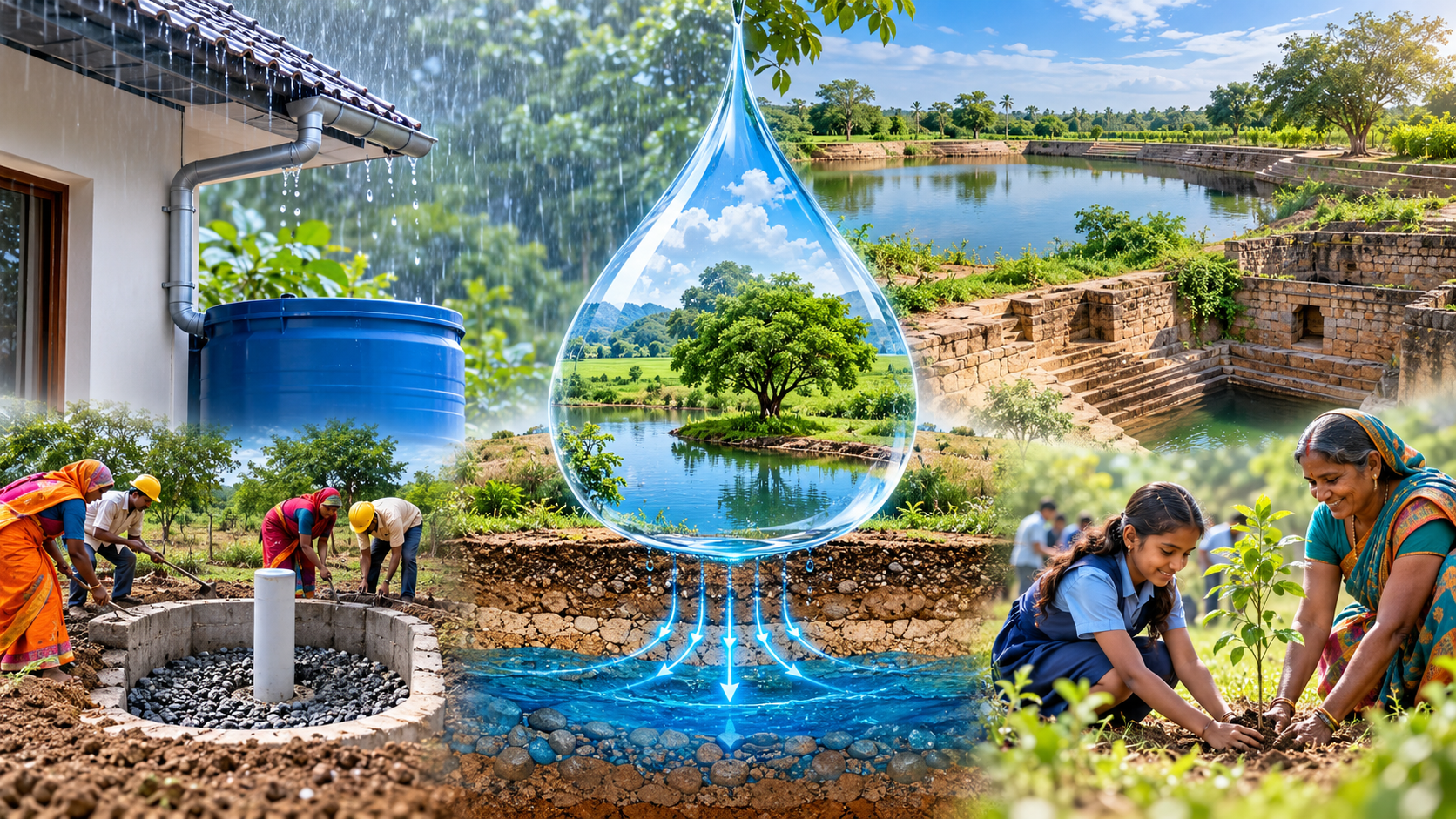
With groundwater recharge, rainwater harvesting and restoration of traditional water bodies emerging as key priorities for water security, the government is strengthening community-led conservation efforts through the Jal Shakti Abhiyan: Catch the Rain and Jal Sanchay Jan Bhagidari initiatives. These initiatives aim to improve water availability through locally appropriate solutions, coordinated government interventions and greater public participation.
The broader objective is to conserve rainwater, replenish groundwater, restore water bodies and strengthen climate resilience.
What is the Catch the Rain campaign?
Launched on March 22, 2021, on World Water Day, the Jal Shakti Abhiyan: Catch the Rain campaign follows the guiding principle, “Catch the Rain, Where It Falls, When It Falls.”
The campaign encourages households, institutions and communities to adopt rainwater harvesting, construct groundwater recharge pits and shafts, restore traditional wells and baolis, and desilt ponds and reservoirs. It also promotes afforestation in suitable water-retention and recharge areas.
The initiative builds on the Jal Shakti Abhiyan launched in 2019, which covered 1,592 water-stressed blocks across 256 districts to promote water conservation.
Over the years, the campaign has expanded its focus. The 2022 campaign emphasised the restoration of traditional water bodies and watershed development, while the 2023 campaign focused on the sustainability of drinking water sources. In 2024, the theme “Nari Shakti se Jal Shakti” highlighted the role of women in water conservation.
What is Jal Sanchay Jan Bhagidari?
Jal Sanchay Jan Bhagidari (JSJB) is a community-oriented initiative that seeks to accelerate water conservation through local participation, low-cost interventions and coordination among government schemes.
The first phase, JSJB 1.0, ran from April 1, 2024, to May 31, 2025. It promoted groundwater recharge and water-storage structures based on the principles of Community, Corporate Social Responsibility (CSR) and Cost, collectively known as the “3Cs”. It also encouraged the revival of defunct borewells and the use of locally suitable conservation methods.
JSJB 2.0, launched on June 1, 2025, placed greater emphasis on groundwater recharge in over-exploited and critical districts. The initiative focused on affordable, location-specific interventions to address local water challenges.
The next phase, Jal Sanchay Jan Bhagidari: Catch the Rain (JSJB: CTR), was launched on June 1, 2026. It integrated the JSJB approach with the broader Catch the Rain campaign, bringing together rainwater harvesting, groundwater recharge, water-asset creation and community participation.
What has been achieved?
According to an official release, more than 1.55 crore artificial recharge and storage structures have been constructed under the JSJB initiative.
An impact evaluation study of JSJB 1.0 assessed 23 lakh structures using rainfall data for the period from June 1 to December 31, 2025. The study estimated that these interventions resulted in 2.43 billion cubic metres of groundwater recharge.
The reported estimate relates to the structures covered by the study and should not be interpreted as a direct measurement of groundwater recovery across the country.
How are government schemes and technology supporting the initiative?
The 2026 JSJB: CTR initiative promotes coordination among multiple government programmes, including VB-G RAM G, Per Drop More Crop under the Pradhan Mantri Krishi Sinchayee Yojana (PMKSY), water-body restoration programmes, CAMPA and Finance Commission grants.
Panchayati Raj Institutions, urban local bodies, women’s groups, youth, educational institutions and civil society organisations are among the stakeholders involved in planning and implementing conservation measures.
The initiative also uses a dedicated portal and mobile application to support monitoring, transparency and public feedback. Jal Shakti Kendras serve as district-level knowledge and facilitation centres, providing technical guidance on rainwater harvesting and water conservation planning.
What can people do to conserve water?
Households and communities can contribute by installing rainwater harvesting systems, maintaining existing structures, restoring local ponds and wells, and supporting tree plantation in suitable areas.
Groundwater recharge structures must be designed according to local soil, geological and groundwater conditions. Proper filtration and maintenance are essential to prevent contaminated water from entering aquifers.
The effectiveness of these interventions also depends on sustained community participation and the long-term maintenance of water assets.
Why does it matter?
The Catch the Rain campaign and Jal Sanchay Jan Bhagidari initiative seek to make water conservation a shared responsibility rather than an activity limited to government agencies.
By combining community participation, scientific planning and coordination across government schemes, the initiatives aim to improve water security, support livelihoods and strengthen resilience to climate-related challenges.
Their long-term impact will depend on the quality of the structures created, their maintenance and reliable assessment of actual groundwater recharge.
-PIB


