






In brief
|
|
|
|
India is exploring Carbon Capture, Utilisation and Storage (CCUS) as a technological pathway to reduce industrial emissions while supporting economic growth. The technology aims to prevent carbon dioxide from entering the atmosphere by capturing it at its source and either putting it to productive use or storing it in suitable geological formations.
As the country advances towards its Net Zero target by 2070, CCUS is gaining importance in sectors where eliminating emissions through renewable energy and electrification alone remains challenging.
The government is supporting research, industry partnerships and technology demonstrations to develop indigenous capabilities and assess the potential for deploying CCUS at scale.

What is Carbon Capture, Utilisation and Storage?
Carbon Capture, Utilisation and Storage, commonly known as CCUS, refers to technologies that capture carbon dioxide generated by industrial processes or other sources, transport it and either utilise it or store it securely underground.
The technology is particularly relevant for industries that generate emissions during manufacturing processes or require carbon-based raw materials.
According to NITI Aayog, CCUS can play an important role in decarbonising hard-to-abate sectors, including steel, cement, oil and gas, petrochemicals, chemicals and fertilisers.
By managing emissions from existing industrial facilities, CCUS could complement the expansion of renewable energy and support India’s transition towards a lower-carbon industrial economy.

How does CCUS work?
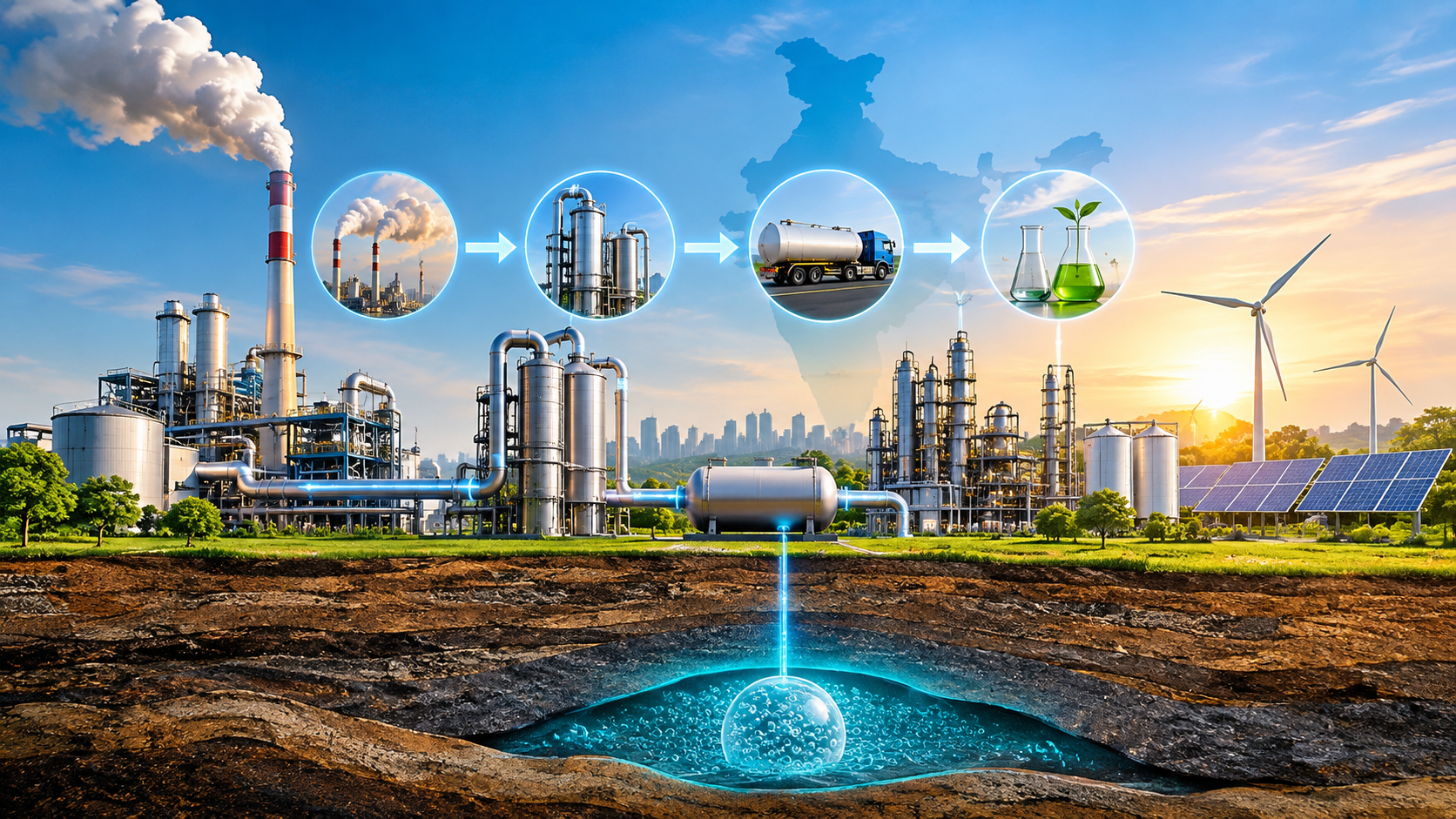
The CCUS process involves three main stages: capturing carbon dioxide, transporting it and then utilising or storing it.
Step 1: Capturing carbon dioxide
Specialised systems separate carbon dioxide from gases released during fuel combustion or industrial processes. The captured gas is then purified, dried and compressed for transportation or further use.
Step 2: Transporting carbon dioxide
The captured carbon dioxide can be transported through pipelines, ships or other suitable modes, depending on the distance, volume, infrastructure and destination.
Step 3: Utilisation or permanent storage
Captured carbon dioxide can be used in applications such as concrete, urea, green methanol, chemicals and certain food and beverage products.
Alternatively, it can be injected deep underground into suitable geological formations, including depleted oil and gas reservoirs, deep saline aquifers and basaltic rock formations. Such storage aims to isolate carbon dioxide from the atmosphere over the long term.
Why is CCUS important for India?
India’s transition towards Net Zero requires reducing emissions across the energy and industrial sectors. However, some industrial processes require very high temperatures or carbon-based inputs, making complete decarbonisation difficult through electrification alone.
Steel, cement, refineries, chemicals and fertilisers are among the sectors where CCUS could help address emissions that are otherwise difficult to eliminate.
An official press release estimates that emissions from hard-to-abate sectors and thermal power generation are expected to reach nearly 2,300 million tonnes per annum by 2030, highlighting the need for technologies that can reduce emissions from existing industrial activity.
CCUS could also help retrofit existing industrial facilities and thermal power plants, enabling essential infrastructure to continue operating while reducing carbon dioxide emissions.

What is the role of CCUS in India’s hydrogen economy?
CCUS could support India’s efforts to develop a low-carbon hydrogen economy, including the production of blue hydrogen.
Blue hydrogen is produced using fossil-fuel-based feedstocks, with carbon capture employed to manage the associated emissions. One potential pathway involves coal gasification combined with carbon capture.
Coal gasification converts coal into synthesis gas, or syngas, through controlled reactions involving oxygen and steam at high temperatures. The resulting gas can be used as a feedstock for producing hydrogen and other industrial products.
Green hydrogen, by contrast, is produced by electrolysis of water using electricity generated from renewable energy sources.
The overall climate benefit of blue hydrogen depends on factors such as the proportion of carbon dioxide captured, residual emissions and the effectiveness of long-term storage.
What are CCUS hubs and clusters?
CCUS hubs and clusters bring together multiple industrial facilities through shared infrastructure for carbon dioxide transportation, utilisation and storage.
Instead of requiring each facility to establish its own complete system, a regional cluster can connect several carbon dioxide emitters to common transport networks and suitable utilisation or storage facilities.
According to the backgrounder, potential regions for developing such clusters include:
-
Gujarat coast: Refineries and chemical industries.
-
Odisha–Jharkhand belt: Steel and cement industries.
-
Northeast India: Opportunities linked to oil and gas resources.
The Department of Science and Technology’s CCUS R&D Roadmap 2025 identifies potential industrial and geological regions for developing such infrastructure. The cluster approach could help reduce infrastructure risks, improve economies of scale and connect carbon dioxide sources with potential users and storage sites.
What initiatives has India taken to promote CCUS?
The government has introduced several policy, research and funding initiatives to advance carbon capture technologies.
Union Budget 2026–27: The release states that ₹20,000 crore has been allocated over five years to promote CCUS in five major industrial sectors: power, steel, cement, refineries and chemicals.
CCUS R&D Roadmap 2025: Launched by the Department of Science and Technology in December 2025, the roadmap outlines priorities for research, technology development, funding and deployment.
National CCUS Centres: Established in 2022 at IIT Bombay and the Jawaharlal Nehru Centre for Advanced Scientific Research in Bengaluru, these centres focus on research, pilot-scale demonstrations and industry collaboration.
Cement-sector testbeds: India launched its first cluster of five Carbon Capture and Utilisation testbeds for the cement industry on May 11, 2025. The initiative brings together industry and research institutions to develop technologies for carbon capture, mineralisation and conversion into concrete products.
What is India’s first integrated CCUS Field Laboratory?
India’s first integrated CCUS Field Laboratory at IIT Bombay was inaugurated in May 2026, according to the release.
The facility brings carbon capture, utilisation and permanent geological storage together on a single pilot-scale platform.
It can capture up to three tonnes of carbon dioxide per day from industrial emissions and ambient air, using non-potable water, and convert it into carbonate and bicarbonate products.
Scientific drilling in the basalt formations of the Deccan Traps will further assess the potential for safe and permanent carbon dioxide storage.
The laboratory is intended to support the development and testing of indigenous technologies before their wider deployment in industrial settings.
How many CCU projects are underway in India?
According to the release, as of April 2026, India’s Carbon Capture and Utilisation project portfolio included operational projects, projects under construction or execution, and proposed initiatives.
-
Operational projects: Three, located in Madhya Pradesh, Tamil Nadu and Maharashtra.
-
Under construction or execution: Six, including three in Andhra Pradesh, two in Telangana and one in Maharashtra.
-
Proposed projects: Sixteen across multiple states. Assam and Odisha account for four each, followed by Gujarat and Rajasthan with two each. Andhra Pradesh, Madhya Pradesh, Haryana and Tamil Nadu have one proposed project each.
The figures reflect a growing project pipeline, but proposed projects should not be interpreted as operational facilities or confirmed emission reductions.
What are the challenges associated with CCUS?
Despite its potential, wider deployment of CCUS will depend on the development of reliable technologies, suitable geological storage sites, transportation infrastructure and economically viable utilisation applications.
The cost of capturing, transporting and storing carbon dioxide remains an important consideration for industrial adoption. Secure geological storage also requires appropriate site assessment, containment measures and long-term monitoring.
The extent to which captured carbon dioxide delivers lasting climate benefits will depend on how it is used or stored. Some utilisation pathways may release carbon dioxide back into the atmosphere, while others can potentially retain it for longer periods.
Research, pilot projects, industry partnerships and effective policy frameworks will therefore be important in determining how quickly CCUS can be scaled up.
What does this mean for India?
CCUS could provide an additional pathway for reducing industrial emissions as India expands renewable energy and works towards its Net Zero target by 2070.
The technology may help sectors such as steel, cement, chemicals and refineries manage emissions that are difficult to eliminate through existing measures alone. It could also create opportunities for indigenous technology development, carbon-based products and new industrial infrastructure.
However, its long-term contribution will depend on safe deployment, commercial viability and the ability to demonstrate measurable and lasting emission reductions.
-PIB


