







A high-stakes political shakeup is brewing in West Asia. While Israel prepares for a crucial election on 27th October, all eyes are turning to what happens just one month later.
On 28th November, Palestinians are scheduled to head to the polls to elect a new Legislative Council. If it goes as planned, it will be the first national legislative vote in 20 years.
The last time Palestinians voted was in 2006 when a surprise Hamas victory shattered Fatah’s dominance. That sparked a brief, violent civil war leading to Hamas seizing total military control of Gaza in 2007. So the stakes could not be higher.
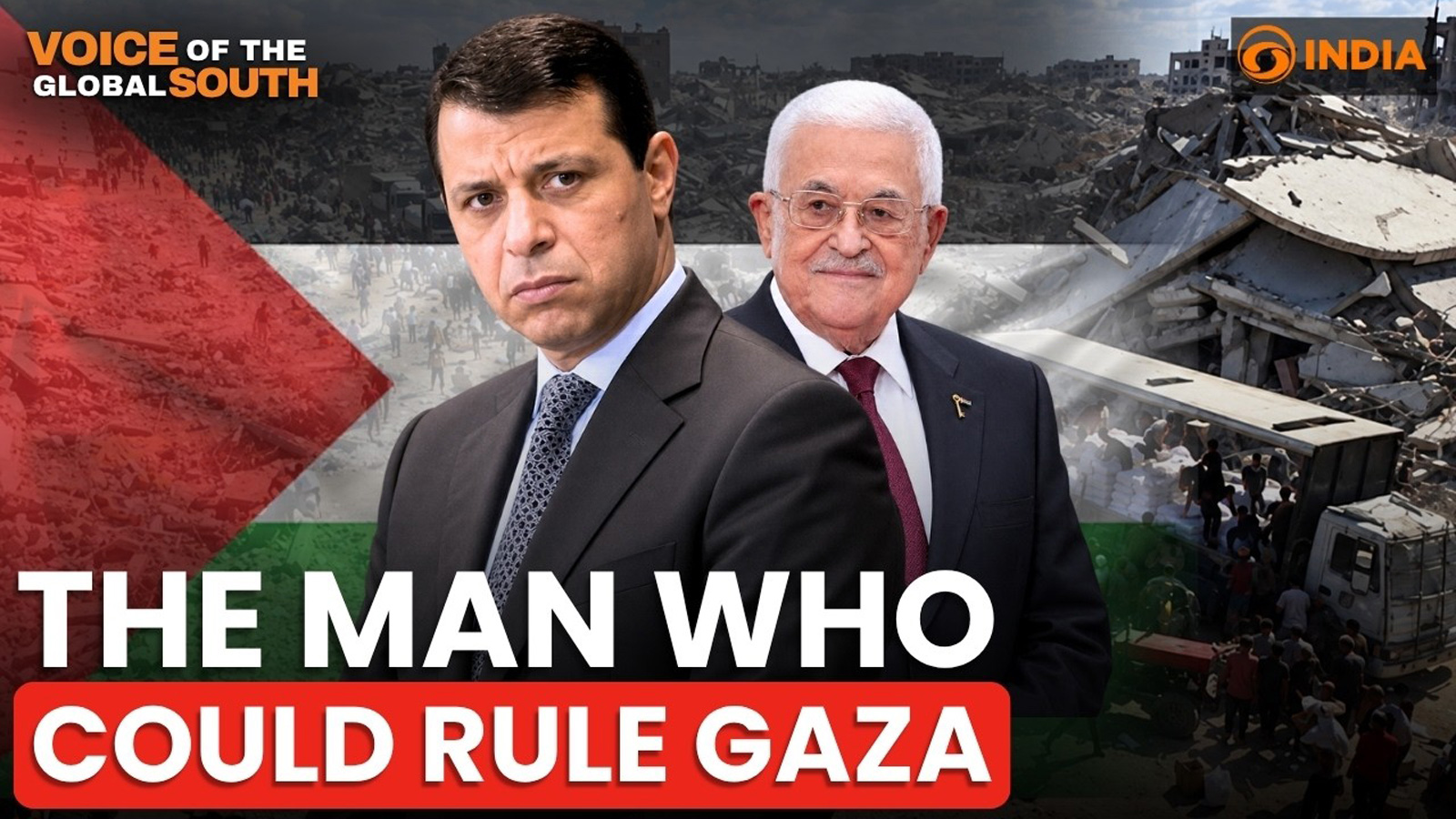
Make no mistake: This election is not just another bureaucratic exercise. The outcome of this vote will determine not only the fate of Gaza but also the future of the Palestinian Authority. And the man shaking up the status quo is Mohammed Dahlan.
Born in the hardscrabble streets of Khan Younis in Gaza, Dahlan cut his teeth in Fatah’s militant youth wing, spending multiple stints in Israeli prisons. By the 1990s, he rose to become the ruthless head of the Palestinian Authority’s Preventive Security Service in Gaza, the primary internal intelligence agency. His control over the Gaza Strip was so absolute that it earned the infamous moniker of “Dahlanistan”.
However, Dahlan’s domestic story ended abruptly in 2011 when a bitter, toxic falling-out with President Mahmoud Abbas led to his formal expulsion from Fatah. Dahlan fled into exile in the United Arab Emirates, where he has lived ever since.
Over time, he dramatically reinvented himself from an ousted security chief into an elite international power broker, fixer and an adviser to the U.A.E. President. Dahlan’s reach is vast, with close backchannel ties extending to Egypt, the U.S. and even Israel.
He has been variously described as a major power broker who has the ear of the most senior people in the U.A.E., the U.S. and Israel; someone who triangulates between the Israeli government, senior figures in the Donald Trump Government and the U.A.E. He is seen as a grand facilitator who interprets the Emiratis for Israel and brokers between Hamas and Fatah, as well as a key player who helped broker a Hamas disarmament plan that was subsequently rejected by Israel. Foreign Policy magazine described him as the U.A.E.’s “Invisible Palestinian Hand” for his behind-the-scenes work engineering the historic Abraham Accords between the Emirates and Israel.
Just consider his recent reported calendar of high-level engagements:
— In May, the head of Israel’s domestic security agency Shin Bet, David Zini, travelled to Abu Dhabi to meet Dahlan;
— in July, Dahlan reportedly acted as a bridge for Trump’s inner team, including son-in-law Jared Kushner and special envoy Steve Witkoff, helping them establish critical channels with Hamas officials in Egypt;
— and in August, Hamas chief Khalil al-Hayya sat down with Dahlan in Cairo to discuss the future of Gaza.
Now, the 65-year-old Dahlan is cashing in on his diplomatic capital to pull off an extraordinary political comeback. His breakaway political faction — the Democratic Reformist Current (also known as the Fatah Reformist Democratic Faction) — has just formed an unexpected, high-stakes electoral alliance. According to the Associated Press news agency, Palestinian Islamic Jihad’s Deputy Secretary-General Mohammed al-Hindi has agreed to join hands with Hamas and Dahlan’s faction.
Dimitri Diliani, a spokesperson for Dahlan’s faction, confirmed to The Times of Israel that they have actively initiated an emergency coalition that includes Hamas, the Palestinian Islamic Jihad and the Popular Front for the Liberation of Palestine. The goal? To gather independent professionals and rival factions around a single, unified national recovery and rebuilding programme.
The 28th November election will be conducted entirely under a proportional representation system. All candidates must run on closed electoral lists representing a party, a coalition or an organised group of voters. The entire territory — including the West Bank, East Jerusalem and the Gaza Strip — functions as a single, unified national voting-district rather than separate geographical constituencies.
However, this alliance that Dahlan is forging is a minefield of ideological contradictions. For starters, Dahlan is a fiercely secular Palestinian nationalist who spent years actively jailing and suppressing Islamist groups in Gaza. Hamas, by contrast, is an Islamist organisation rooted in the ideology of the Muslim Brotherhood.
Furthermore, the legal framework of the election rules poses a massive hurdle — all candidates must formally pledge allegiance to the official policies of the Palestinian Authority, which explicitly requires the recognition of the State of Israel. Neither Hamas nor Palestinian Islamic Jihad recognises Israel. In fact, Islamic Jihad has historically boycotted these elections entirely.
To bypass this legal trap, Dahlan’s faction indicates that the alliance will run a list populated by independent professionals rather than overt group members. This strategy is also driven by geopolitical pressure. U.S. President Trump’s 20-Point Gaza Peace Plan explicitly bars Hamas from holding any role in governance. Therefore, the formation of an alliance under Dahlan’s Fatah Reformist Democratic Faction could give Hamas a quiet avenue to participate under another name.
As Dahlan mounts a direct, organised challenge to the long-running rule of President Abbas, who will turn 91 in November, many are wondering: What role does Dahlan see for himself in Palestinian politics? A kingmaker maybe? A future President perhaps? The Jerusalem Post newspaper says that Dahlan is attempting a political re-entry via Gaza; he is not seeking to govern it personally. He seems to be trying to turn his U.A.E.-backed Fatah dissident network into a bridge between Hamas, other Fatah breakaways, Egypt, the U.A.E. and the U.S.-led Gaza peace process. The Times of Israel newspaper, in turn, says that Dahlan would likely remain behind the scenes from his Emirati perch.
If Dahlan succeeds in his plans, he would inevitably become central to Gaza’s political future. Far from simply rebuilding Gaza, Dahlan could therefore play a central role in providing the Gaza Strip with a truly viable and hopeful future. However, a question critical remains: Will the vote actually happen? President Abbas has a long track record of indefinitely postponing elections to protect his status quo. If the ballots are indeed cast on 28th November, expect Dahlan’s network to position itself as the indispensable, U.A.E.-backed bridge between Gaza, the regional powers and the West.


