







India’s growing use of digital payments, online public services and artificial intelligence is increasing demand for infrastructure that can store data, process information and keep applications running reliably. Cloud computing is becoming a central part of this infrastructure, supporting everything from government portals to business platforms.
Through initiatives such as MeghRaj, expanding data centre capacity and shared AI computing facilities, India is strengthening the digital foundation needed to deliver services at scale. Alongside this expansion, security, control over sensitive information and the availability of skilled professionals are becoming increasingly significant.
What is cloud computing?
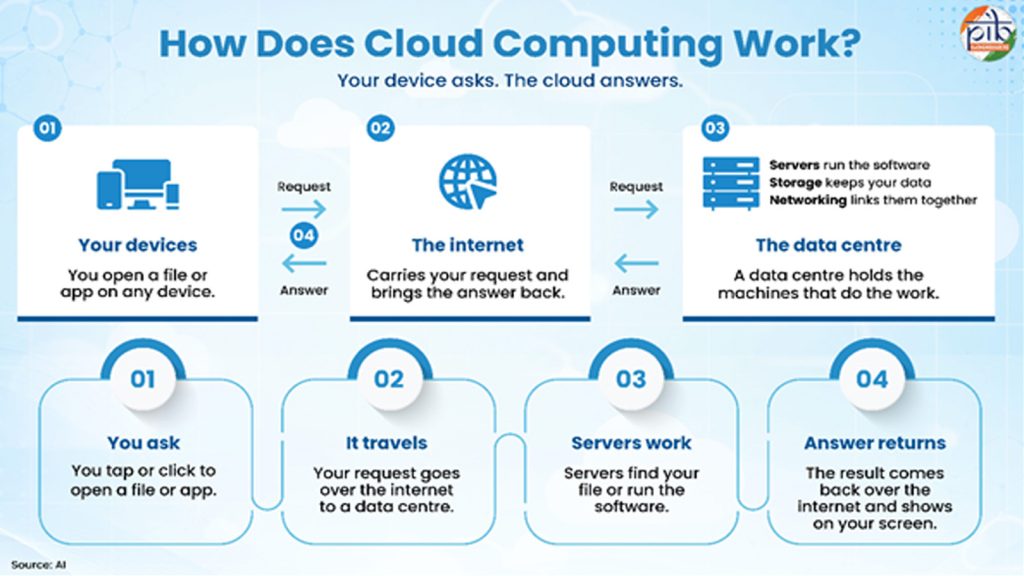
Cloud computing provides access to storage, servers, software and processing power over the internet. Instead of buying and maintaining all its own equipment, an organisation can use computing resources supplied by a cloud provider and adjust them according to its needs.
For example, a government department can host applications and databases on a cloud platform, while a hospital can introduce an online appointment system without establishing its own server infrastructure. At an individual level, services such as Google Drive allow users to store documents online and access them from different devices.
Although users access these services online, cloud computing depends on physical infrastructure. Data centres house the servers, storage systems and networking equipment that make these services possible.
Why does India need more cloud infrastructure?
India’s expanding digital activity is generating large volumes of information that need to be stored, processed and protected.
The country’s internet subscriber base reached 1,092.79 million in March 2026. Average wireless data consumption stood at 25.51 GB per subscriber per month, while total wireless data usage reached 285,376 petabytes during 2025–26.
Digital payments create transaction records, government portals generate administrative information, and AI applications require substantial computing resources to process data and run models.
Cloud infrastructure helps meet these requirements by allowing organisations to expand computing capacity as demand grows. An examination portal, for instance, can increase resources during registration periods and reduce them afterwards.
How does cloud computing support data sovereignty?
Data sovereignty concerns control over data, including where it is stored and processed and the jurisdiction governing its use.
As public services and businesses become more dependent on cloud platforms, the location and management of sensitive information become increasingly important. Domestic cloud infrastructure can strengthen control over critical digital resources when supported by appropriate security safeguards and governance arrangements.
However, infrastructure location and provider ownership are separate considerations. India’s cloud ecosystem includes both Indian companies and international providers operating through Indian entities. Security and control depend on the deployment model, contractual arrangements and applicable governance requirements.
Who provides cloud services in India?
As of September 2026, India had empanelled 30 cloud service providers, with infrastructure in locations including Mumbai, Navi Mumbai, Chennai, Hyderabad, Bengaluru, Delhi-NCR and Jamnagar.
Indian providers include Jio Platforms, Tata Consultancy Services, BSNL, ITI, RailTel, AdaniConneX and Yotta Data Services. International providers include Google Cloud India, Oracle India, Microsoft Corporation India and Amazon Web Services India.
This mix of providers offers government departments and other organisations different options for hosting applications, storing information and accessing computing resources.
What are public, private and hybrid clouds?
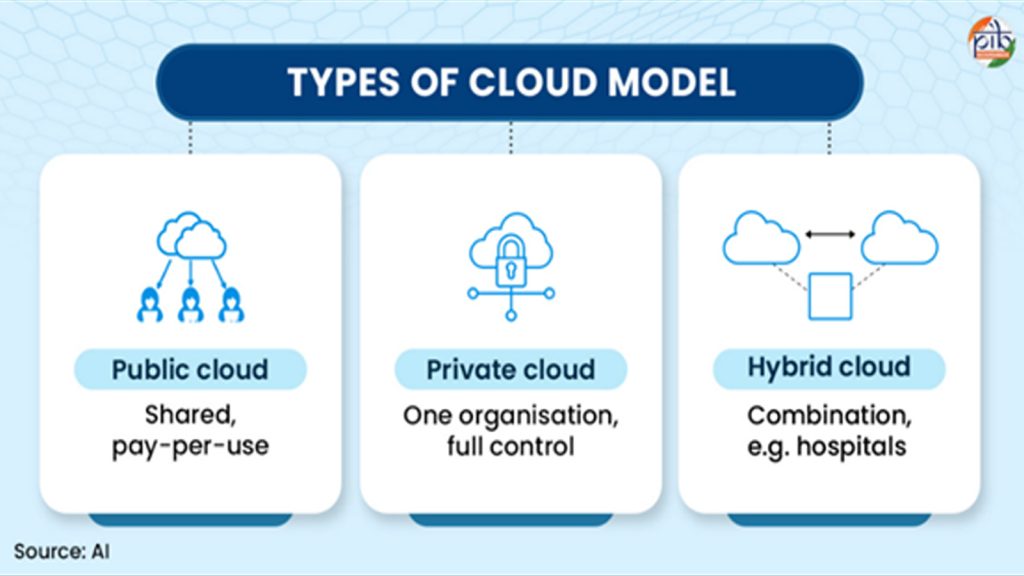
Cloud deployment models determine who uses the infrastructure and how much control an organisation retains.
A public cloud uses infrastructure supplied by a third-party provider and shared among multiple customers. For example, a video-streaming business can use a provider’s computing infrastructure to serve its viewers.
A private cloud provides infrastructure dedicated to a single organisation. For instance, a state treasury can host sensitive payment and accounting records in a dedicated environment with greater control over security.
A hybrid cloud combines public and private cloud environments. For example, a municipal corporation can use a public cloud for its payment portal while keeping citizens’ records on a private cloud.
The choice depends on the sensitivity of the information, security needs, costs and operational requirements.
What services can organisations access through the cloud?
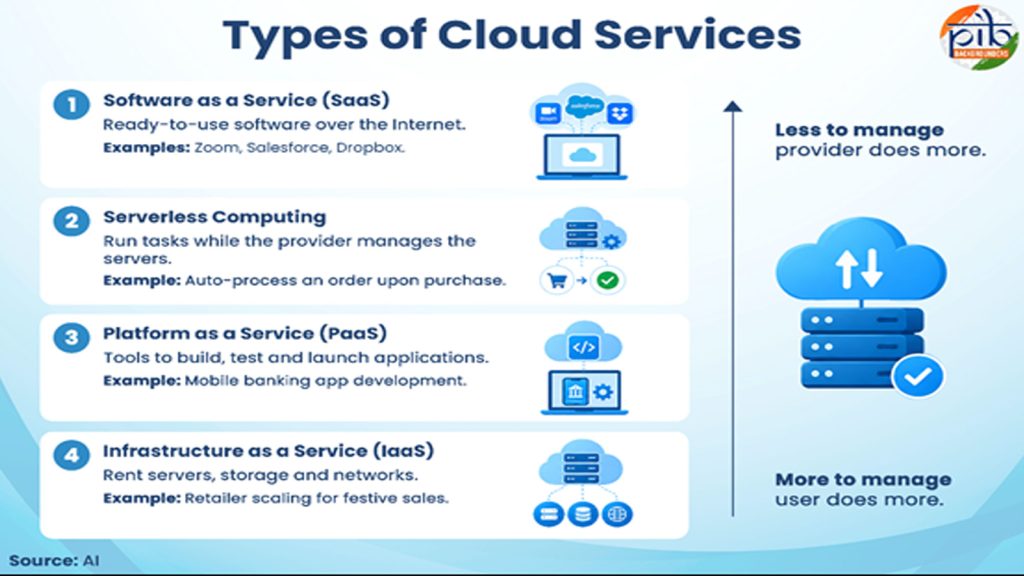
Cloud services offer different levels of support, ranging from basic infrastructure to complete applications.
Infrastructure as a Service (IaaS) provides virtual servers, storage and networks. An online retailer can rent computing capacity to host its website and increase it during festive sales.
Platform as a Service (PaaS) gives developers an environment to build, test and launch applications without managing the underlying infrastructure themselves.
Software as a Service (SaaS) delivers ready-to-use applications over the internet. Examples include Zoom, Salesforce and Dropbox, with providers handling software updates and maintenance.
Serverless computing allows developers to run tasks without directly managing servers. For instance, an application can trigger order processing when a customer completes a purchase. Servers are still involved, but the cloud provider manages them.
What benefits does cloud computing offer?
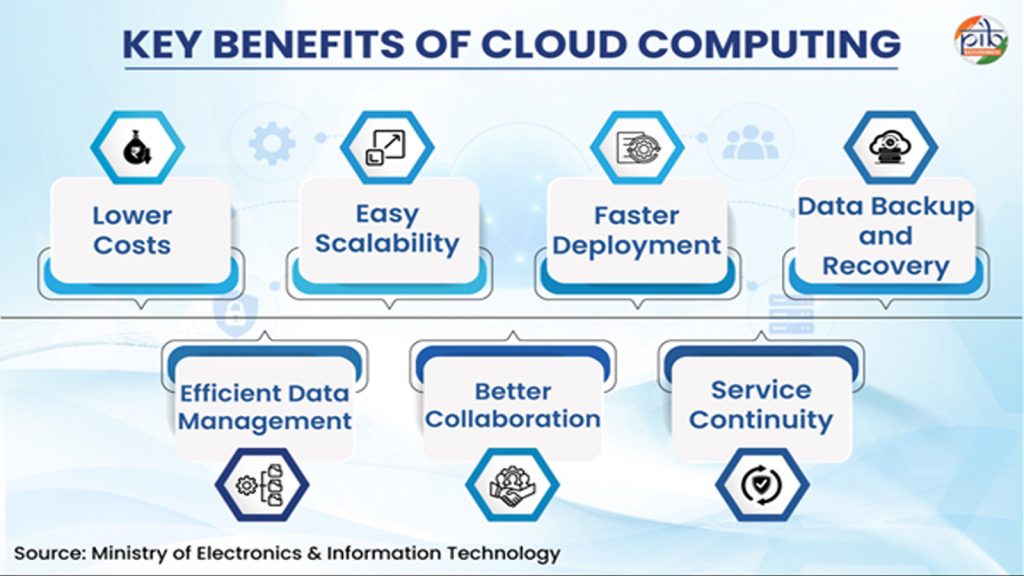
Cloud computing can reduce the need for upfront investment in physical servers and make it faster to introduce digital services. It also allows organisations to increase or decrease resources according to demand.
Shared online access supports collaboration across locations, while centralised systems can simplify the management of records, orders and inventories.
Backup and recovery capabilities help organisations retrieve information after equipment failures or other disruptions. When properly configured, backup infrastructure can also support service continuity by allowing operations to resume or shift to alternative systems.
These benefits depend on how services are designed and managed, including their security, backup and recovery arrangements.
What is MeghRaj, and how has it expanded?
Launched by the Ministry of Electronics and Information Technology in 2014, MeghRaj is the Government of India’s cloud initiative. It aims to accelerate e-governance and improve the use of public expenditure on information and communication technology.
Its second-generation iteration, MeghRaj 2.0, provides infrastructure, platform and software services through a distributed cloud architecture, enabling departments to deploy applications on demand.
By September 2026, adoption had expanded to 2,330 government departments. The ecosystem supports platforms including DigiLocker, MyGov, the National Scholarship Portal and the Department of Posts’ Advanced Postal Technology system.
The National Informatics Centre also operates four National Data Centres and 24 Mini Data Centres. These facilities provide shared hosting, co-location and cloud services, while infrastructure at NIC State Centres supports state-level e-governance.
How quickly is India’s data centre capacity growing?
India’s data centre capacity reached 1.57 GW in August 2026 and is projected to approach 8 GW by 2030.
Existing capacity is concentrated in Mumbai, Navi Mumbai, Chennai, Hyderabad, Bengaluru, Delhi-NCR and Jamnagar. New hubs are also emerging in Andhra Pradesh, Madhya Pradesh, Chhattisgarh and West Bengal.
The sector has around $70 billion in investments underway, alongside a further $90 billion in announced projects. These investments are expected to expand the physical infrastructure supporting cloud services and AI computing.
What does BHASHINI show about domestic cloud adoption?
The Digital India BHASHINI platform offers an example of how Indian cloud infrastructure can support a public digital service.
In February 2026, MeitY reported that BHASHINI had migrated to an Indian cloud operated by Yotta Data Services, keeping its language datasets, AI models and citizen interactions within India’s jurisdiction.
The deployment reportedly delivered performance improvements of up to 40%, cost savings of 20-30% and 99.99% uptime.
BHASHINI’s role in public service delivery was also demonstrated during Maha Kumbh 2025, when it supported real-time translation and voice-based assistance in more than 11 Indian languages.
How is the cloud supporting India’s AI ambitions?
AI development requires computing power that can be costly for individual start-ups and academic institutions to acquire.
The IndiaAI Mission, approved with an outlay of Rs 10,371.92 crore, seeks to broaden access to these resources. More than 45,000 graphics processing units, or GPUs, have been onboarded for a common AI computing facility.
Access to shared computing resources can help researchers and businesses develop AI applications while reducing the need to invest in dedicated equipment.
What policies and institutions guide cloud adoption?
A Cloud Selection Framework issued by MeitY in March 2026 provides ministries and departments with guidance on choosing infrastructure according to data sensitivity and criticality.
The framework introduces a data classification approach aligned with national security considerations, prioritises government-backed infrastructure such as NIC and State Data Centres, and enables hybrid deployments involving empanelled providers.
Personal data protection is another consideration. The Digital Personal Data Protection Act, 2023 forms part of the broader framework governing personal data processing, accountability and cross-border transfers.
The National e-Governance Division provides technical and advisory support for central and state projects. Its work includes examining technology architecture, security, standards and the use of common infrastructure.
Does India have the workforce to support this expansion?
Training initiatives are expanding alongside cloud infrastructure.
The MeitY–NASSCOM FutureSkills PRIME programme, launched in 2021, had 34 lakh registered candidates by August 2026, with more than 23 lakh enrolled or trained across emerging technologies.
The National Institute of Electronics and Information Technology supports training in cloud computing, AI, cybersecurity, blockchain and the Internet of Things through 56 centres, 750 affiliated institutes and more than 9,000 facilitation centres.
A 2026 Cloud Native Computing Foundation report estimated that India had 2.25 million cloud-native developers. It also found that 44% of Indian developers used hybrid cloud environments.
What will shape the next phase?
India’s cloud expansion will depend on how effectively infrastructure investment, security, governance and skills develop together.
More data centres can increase computing capacity, while shared cloud and AI facilities can make that capacity accessible to government departments, researchers and businesses. Clear guidance on handling sensitive information and a workforce capable of operating these systems will be essential to sustaining reliable services.
As digital governance and AI adoption expand, cloud computing is set to play a growing role in how India stores information, delivers public services and develops new technologies.


