






In brief
- What has changed? The government has increased MSPs for all six mandated rabi crops for the 2027-28 marketing season, with safflower receiving the highest hike of ₹675 per quintal.
- How will farmers benefit? The revised MSPs aim to provide price assurance, support farm incomes and encourage crop diversification, with an estimated ₹90,962 crore in payments for 324 lakh metric tonnes of produce.
- How is procurement being strengthened? Digital platforms, biometric authentication, and direct bank transfers are helping improve transparency, streamline procurement, and ensure payments reach eligible farmers.
The Government has increased the Minimum Support Prices (MSP) for all mandated rabi crops for the 2027-28 marketing season, seeking to provide farmers with greater price assurance, encourage crop diversification and strengthen agricultural income prospects.
Approved on September 30, 2026, the revised MSPs are expected to result in payments of around ₹90,962 crore to farmers for 324 lakh metric tonnes of produce, according to the government.
The decision comes amid efforts to expand procurement, improve farmers’ access to assured prices and make the procurement process more transparent through digital platforms.
What is Minimum Support Price and why does it matter?
The Minimum Support Price is a government-announced price at which eligible agricultural produce is procured under designated procurement arrangements. It aims to protect farmers from sharp market price fluctuations, particularly when market prices fall below the announced MSP.
Agriculture involves substantial expenditure on seeds, fertilisers, irrigation, labour and machinery. However, farmers’ earnings ultimately depend on the prices they receive for their produce. A sharp decline in market prices during the harvest season can affect farm income and limit farmers’ ability to invest in the next crop cycle.
MSP-based procurement provides an alternative avenue for eligible farmers to sell their produce at the announced price, subject to applicable procurement arrangements and quality requirements. This can reduce uncertainty over returns and support decisions on cultivation, technology adoption and agricultural investment.
How are MSPs determined?
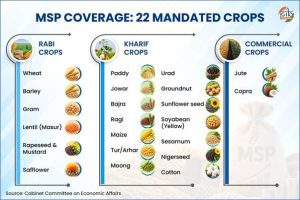
The government announces MSPs annually for 22 mandated agricultural crops on the recommendations of the Commission for Agricultural Costs and Prices (CACP). The commission considers the views of state governments and concerned central ministries and departments before making its recommendations.
Several factors are taken into account while determining MSPs, including:
-
Cost of production.
-
Demand and supply conditions in domestic and international markets.
-
Domestic and global prices.
-
Price parity between different crops.
-
Terms of trade between the agricultural and non-agricultural sectors.
-
The likely impact of price policy on the wider economy.
The government also takes into account a minimum margin of 50 per cent over the cost of production.
The cost calculation includes expenditure on hired labour, leased-in land, seeds, fertilisers, manure, irrigation, diesel, electricity, depreciation on farm equipment and buildings, interest on working capital and other miscellaneous expenses. The estimated value of family labour is also included.
This cost-based approach is intended to account for the resources used in cultivation while determining the announced support price.
What are the revised MSPs for rabi crops in 2027-28?
The latest revision covers six mandated rabi crops: wheat, barley, gram, lentil (masur), rapeseed and mustard, and safflower.
The highest absolute increase has been announced for safflower, followed by rapeseed and mustard and lentil.
Revised MSPs for the Rabi Marketing Season 2027-28:
| Crop | MSP for 2027-28 (₹/quintal) | Increase (₹/quintal) |
|---|---|---|
| Wheat | 2,610 | 25 |
| Barley | 2,286 | 136 |
| Gram | 5,958 | 83 |
| Lentil (Masur) | 7,390 | 390 |
| Rapeseed and Mustard | 6,613 | 413 |
| Safflower | 7,215 | 675 |
Safflower has received the largest increase of ₹675 per quintal, taking its MSP to ₹7,215. The MSP for rapeseed and mustard has been raised by ₹413 to ₹6,613, while lentil has seen an increase of ₹390 to ₹7,390 per quintal.
Wheat, one of the country’s principal rabi crops, has received an increase of ₹25 per quintal, taking its MSP to ₹2,610. The MSP for gram has been raised to ₹5,958, while barley has seen an increase of ₹136 to ₹2,286 per quintal.
According to the government, the estimated margin over the cost of production is highest for wheat at 106 per cent, followed by rapeseed and mustard at 96 per cent, lentil at 92 per cent and gram at 59 per cent. Safflower has an estimated margin of 50 per cent.
The revised prices are intended to provide remunerative returns to farmers and encourage diversification towards crops such as pulses and oilseeds.
How does MSP procurement reach farmers?
The effectiveness of MSP depends not only on the announced price but also on farmers’ access to procurement centres and the agencies responsible for purchasing their produce.
For cereals and coarse cereals, procurement is undertaken by the Food Corporation of India (FCI) and designated state agencies.
For pulses, oilseeds and copra, procurement is carried out under the Price Support Scheme (PSS), a component of the Pradhan Mantri Annadata Aay Sanrakshan Abhiyan (PM-AASHA).
Launched in September 2018, PM-AASHA aims to ensure remunerative prices for farmers while helping maintain price stability for consumers.
Under the Price Support Scheme, procurement can be undertaken when the prevailing market prices of notified crops fall below the MSP during the peak harvest period. Eligible produce must meet Fair Average Quality (FAQ) standards, and procurement is carried out from pre-registered farmers through designated agencies, including the National Agricultural Cooperative Marketing Federation of India Ltd. (NAFED) and the National Cooperative Consumers’ Federation of India Ltd. (NCCF).
For pulses, the government has also introduced procurement arrangements under the Mission for Aatmanirbharta in Pulses till 2030-31. Tur, urad and masur are procured from pre-registered farmers through central nodal agencies to strengthen domestic production and self-reliance.
How are digital platforms improving access to MSP?
The government has increasingly used digital platforms to streamline farmer registration, procurement scheduling and payments.
NAFED’s e-Samriddhi and NCCF’s e-Samyukti platforms facilitate key stages of the procurement process. Farmers can register using details such as Aadhaar, land records, bank account information and crop particulars. Registered farmers can select a nearby procurement centre and schedule their visit through the portal.
MSP payments are transferred directly to farmers’ bank accounts, helping reduce manual intervention and reliance on intermediaries.
Biometric authentication was made mandatory under the Price Support Scheme from the 2025-26 season. Farmer identity is verified through Aadhaar-enabled Point of Sale machines or facial authentication before procurement, with the stated objective of ensuring that benefits reach eligible beneficiaries.
According to government data as of October 19, 2026, the e-Samyukti platform had facilitated procurement involving more than 43 lakh farmers, with over 37.45 lakh metric tonnes procured and more than ₹13,000 crore credited to farmers.
The e-Samriddhi platform had recorded more than 1.37 crore registered farmers, over 2.25 crore units of produce procured and more than 81 lakh payouts.
These platforms are intended to improve transparency and simplify access to procurement facilities, although the practical benefit to individual farmers also depends on procurement availability, eligibility and the arrangements for their particular crop.
What do procurement trends reveal?
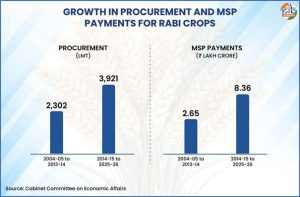
The scale of government procurement and MSP payments has increased over the years, according to the figures cited in the backgrounder.
Between 2004-05 and 2013-14, procurement across six rabi crops stood at 2,302 lakh metric tonnes. This increased to 3,921 lakh metric tonnes between 2014-15 and 2025-26.
MSP payments for these six crops rose from ₹2.65 lakh crore in the earlier period to ₹8.36 lakh crore in the later period.
Wheat procurement also expanded, reaching 3,715 lakh metric tonnes during 2014-15 to 2025-26, compared with 2,254 lakh metric tonnes between 2004-05 and 2013-14.
During the Rabi Marketing Season 2026-27, wheat procurement stood at 357.57 lakh metric tonnes, valued at ₹92,432.51 crore at MSP, benefiting more than 34 lakh farmers.
These figures indicate the growing scale of procurement and the payments made under MSP arrangements. However, aggregate procurement and payment figures alone do not establish how benefits are distributed across regions, crops or categories of farmers.
How can improved farming practices complement MSP?
Price assurance is only one part of improving farm income. Higher productivity, access to scientific guidance and better market linkages can also influence farmers’ returns.
The experience of 72-year-old K. Chikkana, a finger millet farmer from Bombrahalli village in Karnataka, illustrates this combination.
After cultivating traditional finger millet varieties using conventional methods, he adopted the improved HR-13 variety during the 2025 rabi season. The variety was supplied by the Indian Council of Agricultural Research–Indian Institute of Millets Research (ICAR-IIMR) through the Kusumagiri Farmers Producer Organization in Kundrupi.
With scientific guidance, he also adopted transplanting, balanced nutrient management and natural farming practices.
According to the backgrounder, his productivity increased from around 9-11 quintals per acre to 22-23 quintals per acre. Assured procurement through the farmers’ producer organisation at the MSP of ₹4,886 per quintal for the 2025-26 season further supported his returns.
His reported income from six acres rose from approximately ₹2.07 lakh to ₹6.59 lakh.
The example highlights how improved seeds, scientific cultivation, institutional support and access to MSP-based procurement can work together to improve agricultural productivity and earnings. It is an individual case and does not, by itself, establish the outcomes farmers can expect across all regions or crops.
The way ahead
The increase in MSPs for the 2027-28 rabi marketing season forms part of the government’s broader effort to strengthen price assurance, expand procurement and improve access to agricultural markets.
The revised prices provide an announced benchmark for eligible produce, while procurement agencies and digital platforms are intended to make the system more accessible and transparent.
The impact on farmers’ incomes will depend not only on the announced MSPs but also on actual procurement, farmers’ access to designated centres, crop quality and the availability of supporting agricultural services.
-PIB


