







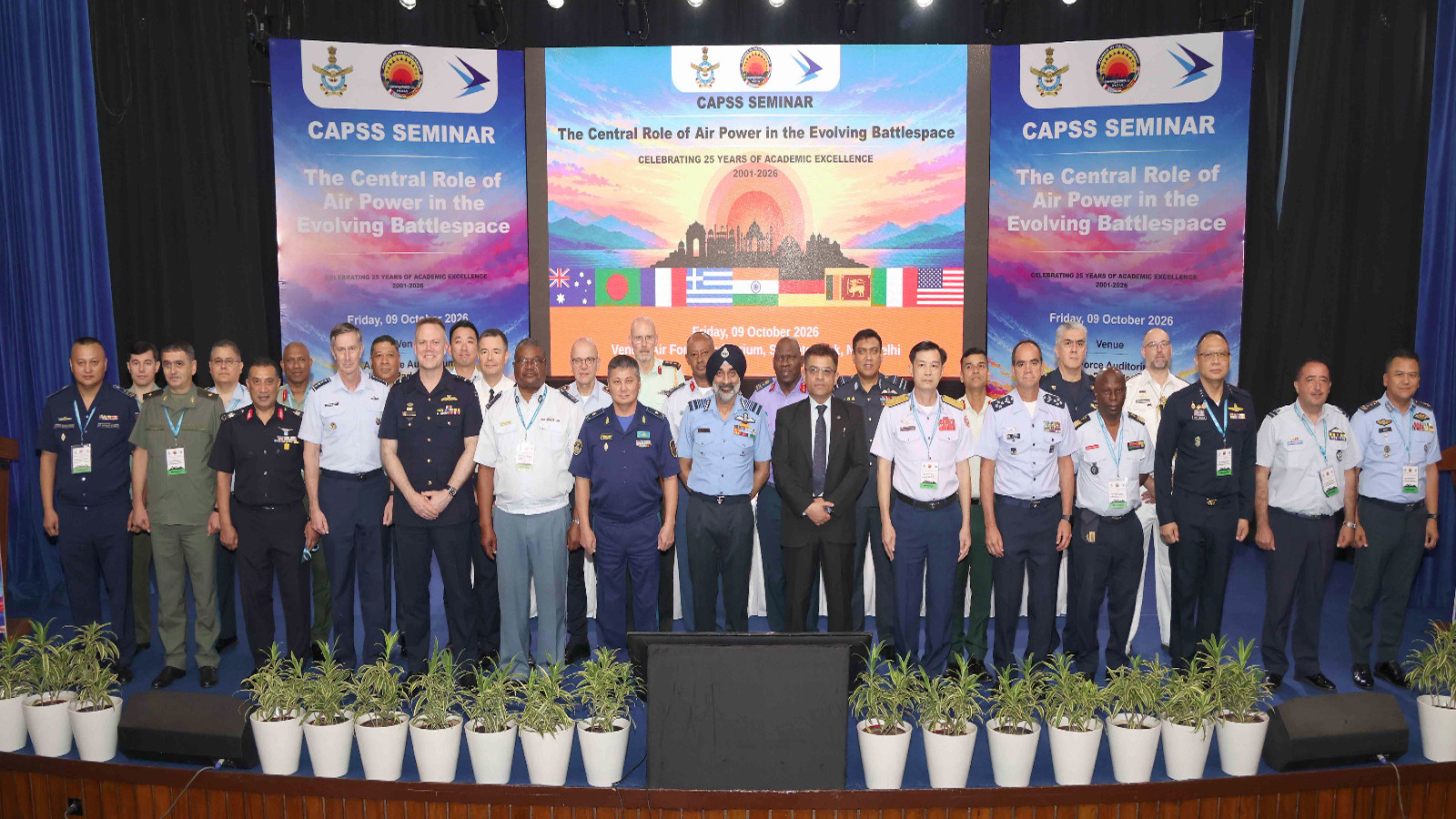
Chief of the Air Staff Air Chief Marshal A. P. Singh called for integrated capabilities, operational resilience and greater interoperability to address emerging challenges in air warfare at a seminar organised alongside Exercise Tarang Shakti 2026.
The Centre for Aerospace Power and Strategic Studies (CAPSS) and the Indian Air Force held the seminar at the Air Force Auditorium, Subroto Park, New Delhi, on October 9. The theme was “The Central Role of Air Power in the Evolving Battlespace”.
Representatives of partner air forces from all continents, senior military leaders, academics, industry representatives and the media participated in discussions on how air power is adapting to the changing character of warfare.
Building on operational experiences from the flying exercise, the seminar sought to identify doctrinal priorities and opportunities for future cooperation among partner air forces.
Delivering the inaugural address, Singh stressed the concurrent development of manned and unmanned operations, supported by clear employment doctrines. Sensors, weapon systems and unmanned platforms should be integrated with communication and data networks from the outset, he said.
He also called for stronger supply chains, innovative training methods and greater capacity to sustain prolonged operations.
Highlighting air power’s contribution to humanitarian assistance, support for partner countries and India’s international standing, Singh urged focused discussions on information warfare and perception management. He also advocated greater sharing of operational experience and closer cooperation among air forces to address common challenges.
CAPSS Director General Air Marshal Nagesh Kapoor (Retd.) delivered the welcome address, outlining air power’s role in contemporary conflicts and the organisation’s contribution to research and dialogue.
Established in 2001 as an autonomous research and analysis body focused on national security, nuclear and aerospace issues, CAPSS marks its silver jubilee in 2026.
The first working session, chaired by former IAF chief Air Chief Marshal V. R. Chaudhari, examined the transformation of air warfare in the 21st century. Discussions covered the shift from air superiority to battlespace control, decision dominance and the use of media as a strategic weapon.
Panellists emphasised that air power involved an entire operational ecosystem extending beyond control of the skies.
The second session, chaired by Royal Australian Air Force chief Air Marshal Stephen Chappell, explored air power as an instrument of national power. It covered deterrence, coercion, escalation control, human capital development and reforms needed to meet emerging and future battlefield requirements.
The discussions offered participants and online viewers a range of perspectives on the future of air power and international cooperation.


