







Three key takeaways
-
India’s social protection coverage has increased from 19% in 2015 to 68.4% in 2026, bringing more than one billion people under the social protection framework.
-
The revision of the mandatory EPFO wage ceiling from ₹15,000 to ₹25,000 per month is expected to bring over 51 lakh additional employees under its coverage.
-
Digital reforms, pension schemes and welfare initiatives such as e-Shram and PM-SYM aim to strengthen social security for formal, informal, gig and platform workers.
India is expanding its social security framework through broader provident fund coverage, pension reforms, digital service delivery, and welfare initiatives to protect workers across organised and unorganised sectors.
According to the Ministry of Labour and Employment, social protection coverage in the country has increased from 19 per cent in 2015 to 68.4 per cent in 2026, bringing more than one billion people within the social protection framework.
The expansion comes amid changing employment patterns, including the growth of informal, gig and platform-based work, where irregular incomes and limited employment continuity make financial protection increasingly important.
From provident fund savings and retirement pensions to insurance benefits and social assistance, several government initiatives are aimed at ensuring financial security for workers and their families.
Here is an explainer on India’s evolving social security framework and the key measures introduced to widen its reach.
What is social security and why does it matter?
Social security refers to a system of financial and welfare protection that supports individuals against income loss and other uncertainties during different stages of life.
It provides assistance during retirement, disability, illness and other vulnerable circumstances, while helping workers and their families maintain financial stability.
With changing employment structures and the expansion of the informal workforce, extending social protection beyond conventional salaried employment has become an important policy priority.
EPFO: Three pillars of worker protection
The Employees’ Provident Fund Organisation (EPFO), functioning under the Ministry of Labour and Employment, is one of the country’s key institutions for providing social security to eligible employees.
Its framework rests on three major components:
1. Employees’ Provident Fund (EPF): The scheme enables employees to accumulate retirement savings through contributions and accrued interest. Members can also make partial withdrawals for specified requirements, including housing, education, marriage and medical treatment, subject to prescribed conditions.
2. Employees’ Pension Scheme (EPS): It provides monthly pension benefits to eligible members after superannuation, retirement or disability. Eligible family members, including spouses and children, can also receive pension benefits in the event of a member’s death.
3. Employees’ Deposit Linked Insurance (EDLI): The scheme provides insurance protection to eligible EPF members in the event of death while in service. It offers insurance benefits of up to Rs 7 lakh without requiring members to pay a separate insurance premium.
How has EPFO expanded its coverage?
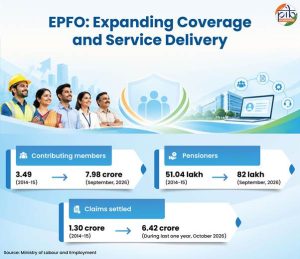
EPFO’s membership and institutional reach have increased over the years, reflecting the expansion of formal employment and social security enrolment.
According to the government, the number of contributing EPFO members increased from 3.49 crore in 2014-15 to approximately 7.98 crore as of September 16, 2026.
The number of establishments contributing to EPFO stood at 7.68 lakh as of September 2026.
Pension coverage has also expanded. While EPFO paid pensions to 51.04 lakh pensioners in 2014-15, around 82 lakh pensioners were receiving benefits as of September 2026.
The volume of claims settled has increased from 1.30 crore in 2014-15 to 6.42 crore in the one-year period up to October 2026.
What does the revised EPFO wage ceiling mean for employees?
One of the significant measures to expand formal social security coverage is the revision of the wage ceiling for mandatory EPFO coverage.
The ceiling, which was last revised in September 2014 from Rs 6,500 to Rs 15,000 per month, was increased to Rs 25,000 per month in September 2026.
The revision is expected to bring more than 51 lakh additional employees under mandatory EPFO coverage, subject to applicable statutory provisions.
The move aims to widen the pool of employees eligible for provident fund and associated social security benefits in line with changing wage levels.
How are PF withdrawals and claim settlements being simplified?
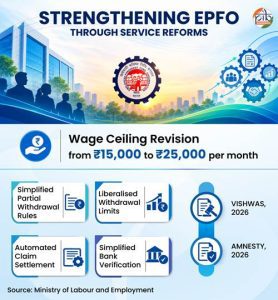
EPFO has introduced changes to make access to provident fund savings easier and reduce procedural delays.
The organisation has consolidated 13 provisions governing partial withdrawals into three categories: Essential Needs, Housing Needs and Special Circumstances.
Essential Needs include expenses related to illness, education and marriage, while the revised framework also provides for withdrawals for housing and other specified circumstances.
The number of permitted partial withdrawals has been increased to 10 for education and five for marriage. Earlier, both purposes shared a combined limit of three withdrawals.
Under the revised framework introduced in October 2025, eligible members can withdraw up to 75 per cent of their PF balance, including employee and employer contributions, subject to prescribed conditions. The minimum service requirement has also been standardised at 12 months.
Additionally, the auto-settlement limit for eligible advance claims has been increased to Rs 5 lakh. EPFO has also removed the requirement to upload cheque-leaf images or attested bank passbooks for eligible online claims, reducing paperwork.
What are VISHWAS and AMNESTY schemes?
Apart from employee-focused reforms, EPFO has introduced initiatives to improve compliance and reduce administrative difficulties for employers.
VISHWAS, 2026: The scheme provides a one-time settlement mechanism for eligible disputes involving damages or penalties under the EPF and Miscellaneous Provisions Act, 1952, and the Code on Social Security, 2020.
It aims to reduce litigation and encourage voluntary compliance through a digital and time-bound process. Eligible pre-June 14, 2024 defaults can attract reduced monthly damage rates depending on the delay period.
AMNESTY, 2026: The one-time scheme aims to help establishments regularise their provident fund trusts that are recognised under the Income Tax Act but lack formal exemption under the relevant EPF legislation.
The scheme allows eligible establishments to obtain retrospective exemption, subject to prescribed conditions, and remains open until December 28, 2026.
How is digitalisation improving access to EPFO services?
Digital reforms are playing an important role in simplifying registration, withdrawals, pension disbursement and claim processing.
Since November 2019, workers have been able to generate their Universal Account Number (UAN) independently. In April 2025, EPFO introduced UAN generation and activation through Aadhaar-based Face Authentication Technology on the UMANG application.
As of October 2026, approximately 1.74 crore UANs had been self-generated.
The UAN is a unique and permanent number assigned to an EPFO member. It links provident fund accounts across different establishments, facilitating portability when employees change jobs, subject to verification.
Other important digital initiatives include:
Centralised Pension Payment System (CPPS): Enables pensioners to receive their pension through any bank branch across the country without transferring their Pension Payment Order when changing locations or bank branches.
Doorstep Digital Life Certificate: EPFO, in partnership with India Post Payments Bank, provides doorstep Digital Life Certificate services to pensioners. The cost of Rs 50 per certificate is borne by EPFO.
Redesigned EPFO website: Launched on November 1, 2025, the mobile-responsive portal provides access to passbooks, claim forms, pension services and profile updates.
EPFO 3.0: The initiative aims to modernise EPFO operations through core banking-based technology, automated claims, multilingual self-service and faster processing. Risk-validated claims are designed to reduce settlement time from up to 20 days to under three days.
Beyond EPFO: How are unorganised workers being covered?
India’s social security framework extends beyond formal employment through schemes and digital platforms designed to reach vulnerable groups and workers outside conventional employer-employee arrangements.
e-Shram: Launched in August 2021, the portal created India’s first Aadhaar-seeded National Database of Unorganised Workers. It had recorded 31.89 crore registrations as of August 2026.
The e-Shram One-Stop Solution, launched in October 2024, integrates 15 social security and welfare schemes. It also connects workers with platforms such as the National Career Service, Skill India Digital Hub and myScheme.
Pradhan Mantri Shram Yogi Maandhan (PM-SYM): The voluntary contributory pension scheme targets eligible unorganised workers aged 18 to 40 years with monthly incomes of up to Rs 15,000.
It provides an assured minimum monthly pension of Rs 3,000 after the beneficiary attains 60 years of age, subject to prescribed conditions. Monthly contributions range from Rs 55 to Rs 200, depending on the age of enrolment, with an equal contribution from the Central Government.
What is the Pradhan Mantri Samajik Sahayata Yojana?
The Pradhan Mantri Samajik Sahayata Yojana, revised from the existing National Social Assistance Programme (NSAP) in October 2026, provides financial assistance to eligible elderly persons, widows, persons with disabilities and bereaved families.
The scheme is set to continue from 2026-27 to 2030-31.
Its key benefits include:
Old-age pension: Rs 200 per month for beneficiaries aged 60-79 years and Rs 500 for those aged 80 years and above.
Widow pension: Rs 300 per month for widows aged 40-79 years and Rs 500 for those aged 80 years and above.
Disability pension: Rs 375 per month for beneficiaries below 80 years and Rs 625 for those aged 80 years and above. The benchmark disability threshold has been reduced from 80 per cent to 40 per cent, and the minimum age criterion has been removed.
Family benefit: One-time financial assistance of Rs 20,000 to eligible households following the death of the primary breadwinner aged 18-59 years.
What role does the Code on Social Security, 2020 play?
The Code on Social Security, 2020 consolidates nine existing central labour laws relating to social security into a unified legislative framework.
It provides for benefits such as provident fund, pension, insurance, maternity benefits and gratuity, with provisions extending to organised and unorganised workers, including gig and platform workers.
The Code also provides for social security schemes for gig and platform workers, supported by a social security fund.
Other provisions include gratuity for eligible fixed-term employees on a proportionate basis after one year of service, subject to applicable conditions.
Women-centric provisions include maternity benefits of up to 26 weeks for eligible women, the option of work from home where the nature of work permits and crèche facilities in establishments meeting prescribed conditions.
-PIB


