






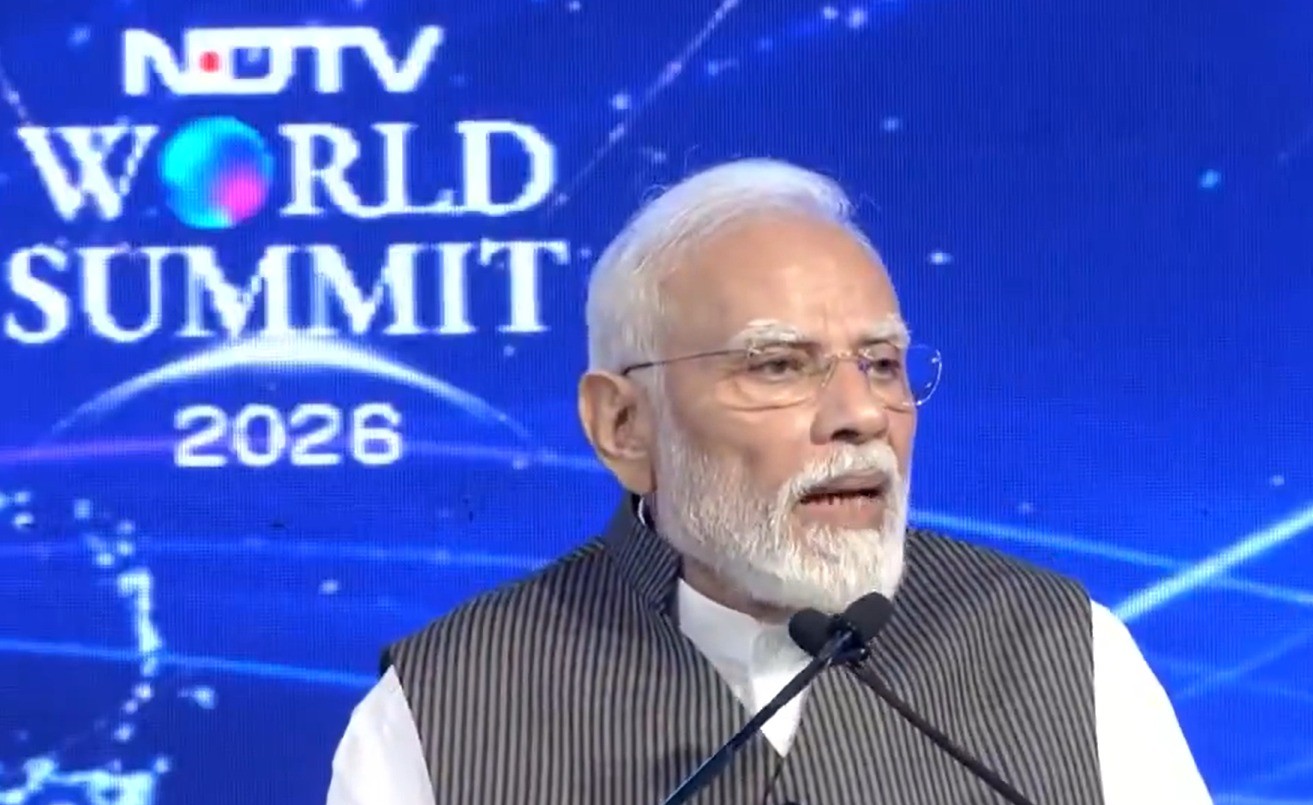
Prime Minister Narendra Modi on Thursday highlighted India’s growing global capabilities in technology, green energy, semiconductor design and pharmaceuticals, saying the country hosts more than half of the world’s Global Capability Centres (GCCs) and ranks among the top three AI ecosystems. Addressing the NDTV World Summit in New Delhi, he said India’s progress towards self-reliance would strengthen global supply chains and contribute to worldwide prosperity.
India’s growth to benefit the world
PM Modi said a developed India would not only benefit its own people but also contribute to a better world. He said a stronger Indian economy and a skilled workforce would boost global prosperity, innovation and productivity.
Despite difficult global circumstances, India continued to be the fastest-growing major economy and was working to become one of the world’s top three economies, he said. India also ranked among the leading countries in green energy and among the top three in AI and startup ecosystems, while being one of the largest digital economies and the world leader in real-time digital payments.
Exports, jobs and women’s empowerment
Highlighting India’s economic progress, PM Modi said exports of goods rose nearly 25 per cent in September compared with the same month last year, while seafood exports had more than doubled over the past 12 years.
More than 3.5 crore women had become Lakhpati Didis, with the government aiming to increase the number to six crore, he said. Around 70 lakh new jobs had also been created in a short period under the Pradhan Mantri Viksit Bharat Rozgar Yojana.
He added that income tax had been brought down to zero for incomes up to ₹12 lakh, while improvements in ease of living and expanding employment opportunities were supporting the vision of Viksit Bharat.
India shifts from ‘Back Office’ to ‘Brain Office’
PM Modi said more than half of the world’s Global Capability Centres were located in India, with their work expanding beyond traditional support services to artificial intelligence, cloud computing, engineering, analytics and product development.
Describing the shift, he said India had moved from “Talent at Scale” to “Thinking at Scale”. The world, which once relied on India’s manpower, was increasingly trusting its intellectual capabilities, he said, adding that India was now working with global partners not merely as a “Back Office” but as a “Brain Office”.
Semiconductor design and research gain momentum
Nearly 20 per cent of the world’s chip-design workforce was in India, PM Modi said, adding that Indian engineers were working on advanced 2-nanometre and 3-nanometre chip designs. Students at Indian academic institutions had designed more than 325 chips, while the country was expanding facilities to develop its semiconductor talent pool.
He also highlighted India’s growing research capabilities, saying the country ranked third globally in research publications and saw nearly 1.5 lakh patent filings in 2025. India was no longer merely a service provider but was increasingly innovating, designing and developing technologies for the world, he said.
PLI scheme boosts domestic pharmaceutical production
PM Modi said government policies and investment decisions were aimed at building domestic capabilities, reducing dependence on other countries and preparing for future challenges.
Citing the pharmaceutical sector, he said domestic production of Penicillin G, an essential ingredient used in antibiotic manufacturing, had resumed at Kakinada in Andhra Pradesh after decades. Production had practically ceased in India over the past two to three decades before the product was brought under the Production Linked Incentive (PLI) Scheme.
He said the government was also building a domestic supply chain for Active Pharmaceutical Ingredients (APIs), the raw materials used in medicine manufacturing. The PLI scheme had attracted investments exceeding ₹5,000 crore, with around 40 projects underway, he added.
‘We will turn every challenge into an opportunity’
PM Modi said the vision of Viksit Bharat reflected the aspirations of 140 crore citizens and called for confidence, innovation and collective effort to achieve it.
India would continue to dream big, turn challenges into opportunities and translate its commitments into reality, he said, adding that the country’s progress should be linked with global success.
-PIB inputs


