






Inside This Week’s Economic Brief
This week’s Economic Brief covers the India-New Zealand free trade agreement entering force, US Secretary of State Marco Rubio’s Jamnagar visit amid heavy crude diplomacy, and France’s economic fallout from nationwide student riots.
This week’s edition of The Economic Brief on DD India examined three major stories: the India-New Zealand free trade agreement coming into effect, US Secretary of State Marco Rubio’s visit to Reliance’s Jamnagar refinery amid heavy crude diplomacy, and France’s economic and political fallout from nationwide unrest. The episode featured extensive analysis from Professor Rakesh Mohan Joshi, international trade expert and former Vice Chancellor of the Indian Institute of Foreign Trade, alongside remarks from Michał Matlak of ITEC Poland on the upcoming India-EU trade deal.
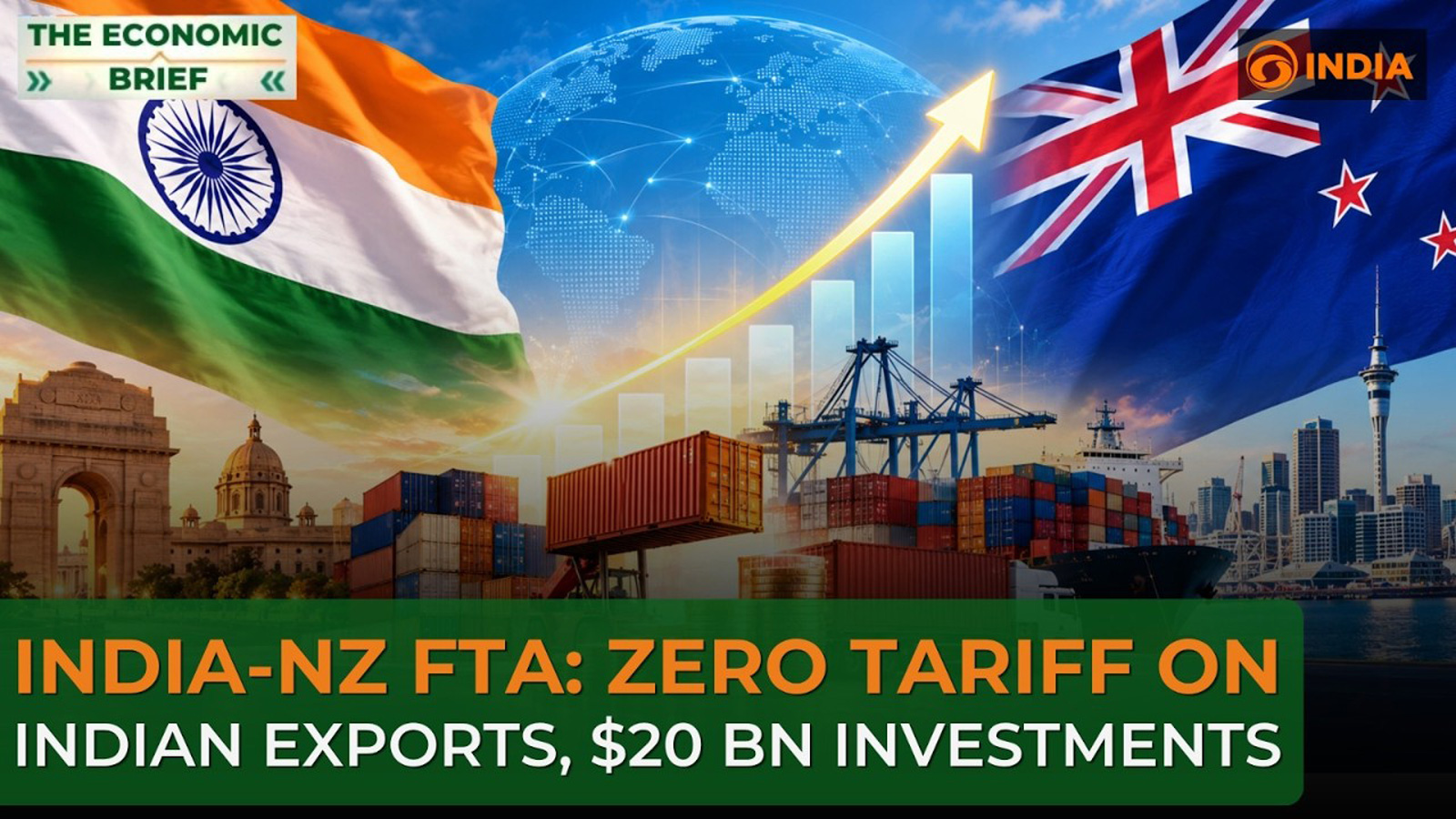
India-New Zealand FTA Delivers Immediate Duty-Free Access
The India-New Zealand free trade agreement took effect on October 20, offering India full and immediate tariff elimination rather than the five-to-fifteen-year phase-ins typical of most FTAs. Key elements include:
* 100% immediate duty-free access for Indian goods, described by industry bodies as a rare full-schedule liberalization, with the biggest gains expected in textiles, apparel, leather, footwear, engineering goods, machinery, chemicals, pharmaceuticals, and medical devices.
* A $20 billion investment pledge from New Zealand over 15 years, targeting agriculture, food processing, renewable energy, infrastructure, education, agritech, and fintech.
* New mobility pathways, including 5,000 skilled temporary employment visas, 1,000 working holiday visas for ages 18-30, and up to three years of open post-study work rights for STEM graduates, with no job offer or sponsorship required.
* Protection for sensitive sectors, with dairy, sugar, edible oils, and roughly 30% of tariff lines – including onion, chana, peas, corn, and almonds – excluded to safeguard India’s farmers and food security.
* Bilateral trade targeted to more than double from $2.4 billion to $7 billion by 2030, with New Zealand already reporting a “halo effect” of rising apple, kiwifruit, and Manuka honey exports and increased Indian tourism even before the deal’s entry into force.
Separately, Poland’s Prime Minister Donald Tusk visited India as momentum builds toward the EU-India FTA, finalized in January and expected to be signed in December. Michał Matlak of ITEC Poland highlighted India’s entry into the EU’s Horizon Research Programme, opening European funding for joint academic research with institutions like IIT and CSIR.
Professor Rakesh Mohan Joshi called the New Zealand deal more than a trade agreement, citing new market access across 118 services subsectors, first-time dedicated access for Ayush and traditional medicine, and the mobility and investment provisions as evidence of its depth. He noted that while 57% of New Zealand’s exports now enter India duty-free, that share will rise to 82% over time, with sensitive items like wine phased in gradually and tariff-rate quotas protecting Indian farmers. He called India’s scale as the world’s fastest-growing large economy the central draw for New Zealand and future FTA partners alike.
https://www.youtube.com/watch?v=Zqdog57TQN0&t=231s
Rubio’s Jamnagar Visit Signals Heavy Crude Diplomacy
With Brent crude trading around $110 a barrel and US diesel prices elevated ahead of the midterms, Secretary of State Marco Rubio visited Reliance’s Jamnagar refinery – the world’s largest single-site facility – to deepen cooperation on refining heavy Venezuelan crude. Rubio called India a “refining superpower,” noting few refineries worldwide can process the dense, high-sulfur grades that yield more diesel. He also pushed forward a proposed $300 billion Reliance refinery project in Brownsville, Texas, though Professor Joshi noted the actual refinery investment is closer to $5 billion.
Joshi said India faces a 25% reciprocal US tariff tied to its Russian oil purchases, even as Washington struggles to contain its own fuel prices – US retail diesel rose from $3.99 a gallon in December 2022 to $6.28 by October 2026. He argued a Texas refinery makes genuine business sense for Reliance given proximity to crude supply and the target market, noting India’s refining capacity at Jamnagar alone exceeds that of America’s two largest refineries combined.
https://www.youtube.com/watch?v=w0dKaf51qYw&t=4s
France Faces Nationwide Riots and Mounting Economic Losses
Student protests over teacher shortages and aging schools have spiraled into nationwide riots in France, prompting deployment of counter-terrorism forces. Over 3,000 businesses have been affected, with Morningstar DBRS estimating potential insurance losses up to $1.34 billion. President Trump blamed immigration for the unrest, prompting President Macron to call the remarks “unacceptable and stupid” and warn of AI-generated disinformation falsely depicting mass migrant invasions. France hosts 9.2 million immigrants (13.8% of its population), with 60% of citizens surveyed believing the country is undergoing profound demographic change.
The unrest traces back to education funding shortfalls rooted in France’s strained finances: public debt stands at $4.08 trillion (119% of GDP), 2025 government spending equaled about 57% of economic output, and the IMF projects just 0.4% growth – the lowest among developed economies. The riots have already pushed France’s borrowing costs to a 24-year high.
https://www.youtube.com/watch?v=8uurIiGY6rY&t=3s
Key Takeaways
The India-New Zealand FTA sets a new benchmark for full, immediate market access while protecting India’s sensitive agricultural sectors. Rubio’s Jamnagar visit underscores how central India’s refining capacity has become to US energy strategy amid high diesel prices and domestic political pressure. And France’s nationwide unrest reflects deeper fiscal stra


