







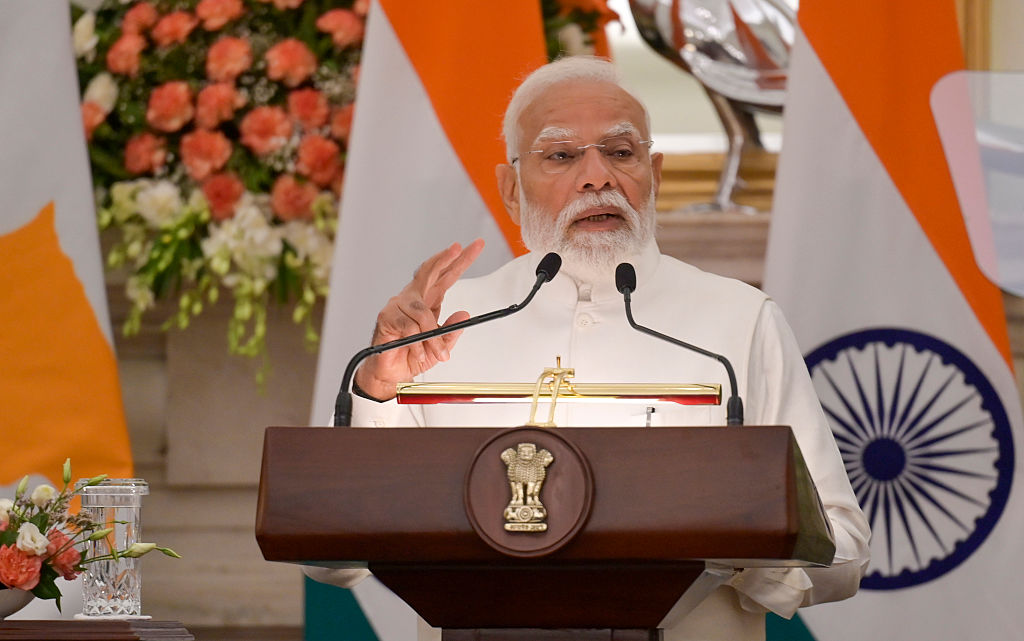
Prime Minister Narendra Modi on Wednesday said that India’s civilisational journey has, for centuries, been a story of cultural exchange, with centres of learning such as Nalanda facilitating the exchange of knowledge across Asia and Buddhist monks, scholars, traders and travellers carrying Indian ideas to different parts of the world through land and maritime routes.
In his message to the three-day international conference on ‘Bharat’s Cultural Connections across the Globe’, being held at Vigyan Bhawan, New Delhi, from October 14 to 16, the Prime Minister observed that this cultural dialogue continues to flourish, with Indian philosophy, music, dance, literature, cinema and culinary traditions connecting societies across the world with India. He added that the celebration of Indian festivals and traditions in different countries, along with the global spread of yoga, demonstrates how India’s ancient knowledge traditions continue to connect people across cultures, according to a press release by the Ministry of Culture.
Conference Marks Centenary of Greater India Society
The Prime Minister extended his best wishes to the Ministry of Culture and the Indira Gandhi National Centre for the Arts (IGNCA), which organised the conference, and welcomed the scholars, researchers, diplomats and other distinguished participants from India and abroad.
Noting the growing global recognition of India’s cultural heritage, PM Modi highlighted the significance of the conference in marking the centenary of the Greater India Society, which has played an important role in promoting the study and understanding of India’s cultural and intellectual relations with Asia and other parts of the world. He expressed hope that the deliberations would deepen understanding of India’s historical and cultural ties with the world and strengthen international cultural cooperation.
The Prime Minister’s message was read out by Vivek Aggarwal, Secretary, Ministry of Culture, who also delivered the introductory address.
Culture Should Connect the World, Not Divide It: Shekhawat
Inaugurating the conference, Union Minister of Culture and Tourism Gajendra Singh Shekhawat said the Brihattar Bharat Conference offered an opportunity to explore how the wisdom of the past could guide the future and how cultural exchanges enabled civilisations to share ideas, knowledge and artistic traditions.
Marking the centenary of the Greater India Society, established in Calcutta on October 14, 1926, the conference reaffirmed the importance of studying India’s historical and cultural connections with the world, he said.
Shekhawat emphasised that Brihattar Bharat should be understood not as a political or territorial claim, but as a broad sphere of historical and cultural connections. Reiterating the Indian civilisational principle of Vasudhaiva Kutumbakam — the world is one family — he said it offered a lasting message of mutual respect and shared responsibility.
“Culture should connect the world, not divide it,” he said, stressing that cultural exchanges and evidence-based research could foster understanding and sustain dialogue even when political relations became difficult or language barriers arose.
He called for the study of India’s global cultural connections to develop into a dynamic, evidence-based field grounded in international collaboration. Brihattar Bharat, he said, should become a platform where shared heritage inspires joint research, strengthens mutual understanding and builds enduring international partnerships.
The conference, he added, should not merely commemorate a significant scholarly endeavour but also mark the beginning of a renewed international movement to study, preserve and exchange the cultural connections that unite humanity.
Brihattar Bharat Project to Promote International Research
Vivek Aggarwal highlighted that the Brihattar Bharat Project seeks to bring India’s ancient cultural connections with the world to international recognition through collaborative, evidence-based research involving scholars from around 51 countries.
Marking the centenary of the Greater India Society, the project aims to explore India’s contributions to global knowledge systems, languages, sciences, art and cultural traditions through joint research, seminars and workshops. It also envisages a structured five-year agenda for international academic exchange and seeks to explore multinational nominations of shared intangible cultural heritage to UNESCO’s Representative List.
Describing Brihattar Bharat as a joint scholarly endeavour, Aggarwal said the initiative seeks to deepen understanding of shared heritage and strengthen international relations. By fostering academic collaboration and cultural dialogue, the project aims to advance peace, unity and shared prosperity, rooted in the principle of Vasudhaiva Kutumbakam.
IGNCA Highlights Shared Cultural Heritage
In his welcome address, Dr. Sachchidanand Joshi, Member Secretary of IGNCA, said the identity of civilisations was shaped not only by geographical boundaries but also by the movement of ideas and people and the memories they left behind.
Throughout history, merchants had crossed mountains and seas, Buddhist monks and pilgrims had travelled between sacred sites, scholars had exchanged ideas and translated texts, and artisans had carried their skills and artistic traditions across regions. These encounters had enabled cultures to engage in dialogue, learn from one another and evolve, creating connections that continued to shape the world, he said. The concept of Brihattar Bharat was rooted in this history of cultural exchange.
Joshi explained that Brihattar Bharat was an initiative of the ICR Division of the Ministry of Culture, implemented by IGNCA, to identify, document, preserve and make accessible the shared cultural heritage of Indian civilisation and selected countries. The initiative seeks to look beyond geographical and political boundaries to explore historical connections and cultural exchanges among people across nations.
Exhibition Showcases Asia’s Shared Cultural Heritage
An exhibition titled ‘Asia’s Shared Cultural Heritage’ was organised as part of the conference. Shekhawat, Aggarwal and other distinguished guests visited the exhibition, which showcases the shared heritage and historical cultural connections between India and other Asian countries.
Dr. Arvind Kumar, Joint Secretary, Ministry of Culture, proposed the vote of thanks. Prof. Dharm Chand Choubey, Head of the Brihattar Bharat Division at IGNCA, was also present on the occasion.
-PIB inputs


