






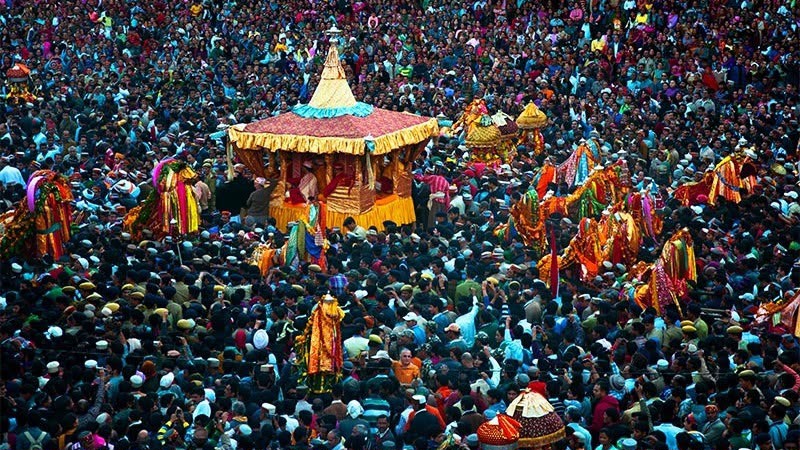
When Dussehra celebrations draw to a close across much of India, festivities begin in Himachal Pradesh’s Kullu Valley. At the historic Dhalpur Maidan, village deities arrive in decorated palanquins, accompanied by priests, musicians and devotees, for a week-long celebration centred on Lord Raghunath.
The International Kullu Dussehra 2026 is scheduled for October 21-27. The festival brings together hundreds of local deities and their followers, offering a distinctive expression of the valley’s religious traditions, folk culture and community life.
Its significance lies in a living relationship between village communities and their deities – a tradition that continues to shape Kullu’s social and cultural identity.
A tradition rooted in the 17th century
The origins of Kullu Dussehra are traced to the 17th century, when Raja Jagat Singh installed an idol of Lord Raghunath brought from Ayodhya in the palace temple at Kullu. The ruler invited the region’s deities to assemble at Dhalpur, establishing the tradition of collective worship.
Lord Raghunath remains the principal deity of the valley and the central figure of the festival. Visiting deities first pay their respects at his abode in Sultanpur before joining the celebrations.
Unlike celebrations centred on Ramlila performances and the burning of effigies of Ravana, Kumbhkarna and Meghnad, Kullu Dussehra follows its own ceremonial traditions. Its central observance is the gathering of deities and their homage to Lord Raghunath.
The chariot procession at the heart of the festival
The arrival of Goddess Hadimba from Manali is an important part of the festivities. The principal ceremony features Lord Raghunath’s procession to Dhalpur and the pulling of his decorated wooden chariot by devotees.
Preparations involve customary offerings, the invitation to the erstwhile royal family and the adornment of the idols of Lord Raghunath and Sita with flowers and ceremonial clothing.
The procession includes the decorated horse associated with Narsingh, palanquins of village deities, musicians, priests and traditional attendants. Bijli Mahadev and Hadimba participate with their ceremonial retinues.
At Dhalpur, the idols are placed in the wooden chariot, decorated with colourful cloth, ornaments and bells. Following prayers and ritual circumambulation, devotees pull it amid chants of “Jai Siya Ram” and “Jai Hanuman”.
The chariot is then stationed in the grounds during the festival, with visiting deities occupying their traditionally allotted places.
Why Kullu is called the land of deities
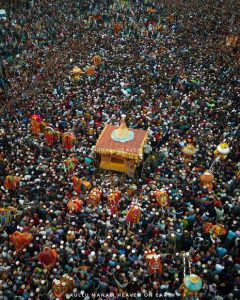
Kullu’s village deities are integral to community life. According to local belief, they protect their territories and guide their followers through oracles and established ritual practices.
Their journeys to festivals involve organised retinues comprising a kardar, or manager, an oracle, priests, musicians and devotees. Families and community members gather to accompany them, renewing connections that often extend beyond the valley.
At Dhalpur, palanquins adorned with colourful textiles, jewellery and gold and silver moharas, or deity masks, arrive from areas including Ujhi, Lagg, Maharaja, Rupi, Banjar, Sainj and Outer Saraj.
The sounds of dhol, nagara, shehnai, dhouns, bhana and ransingha give the gathering its distinctive musical character.
A platform for folk traditions
Kullu Dussehra is also an important setting for the preservation and presentation of folk arts. Traditional Nati dances, music, processions, exhibitions, handicraft markets and cultural programmes bring the valley’s heritage into public view.
Lalhri Nati holds a particular place in festival memories. Traditionally, devotees danced through the night outside the tents of their deities, with large gatherings at the Kullu ruler’s ceremonial camp, or Chanani.
These practices have changed as improved road access allows more participants to return home in the evening. The continuing traditions nevertheless highlight the importance of preserving community participation alongside formal performances.
Accorded international festival status in 1972, Kullu Dussehra also provides a platform for cultural troupes from elsewhere in India and abroad. Performances at the Lal Chandra Prarthi Kala Kendra connect local traditions with wider folk cultures.
Heritage and livelihoods
The festival draws domestic and international visitors, supporting local markets, accommodation providers, artisans and other businesses.
Kullu’s wool-weaving traditions, particularly its shawls and caps, form an important part of the valley’s identity. Festival bazaars and exhibitions provide opportunities to display handicrafts and other regional products.
Situated at an altitude of around 1,200 metres, Kullu combines this cultural heritage with the landscape of the Beas Valley, surrounding mountains and neighbouring valleys.
Yet the festival’s enduring importance rests with its communities. The gathering at Dhalpur brings villages together, sustains ritual responsibilities and passes music, dance and collective memory to younger generations.
As the valley prepares for the 2026 celebrations, Kullu Dussehra remains a meeting point of devotion, cultural expression and community belonging – where the journey of each village deity becomes part of a shared regional tradition.


