






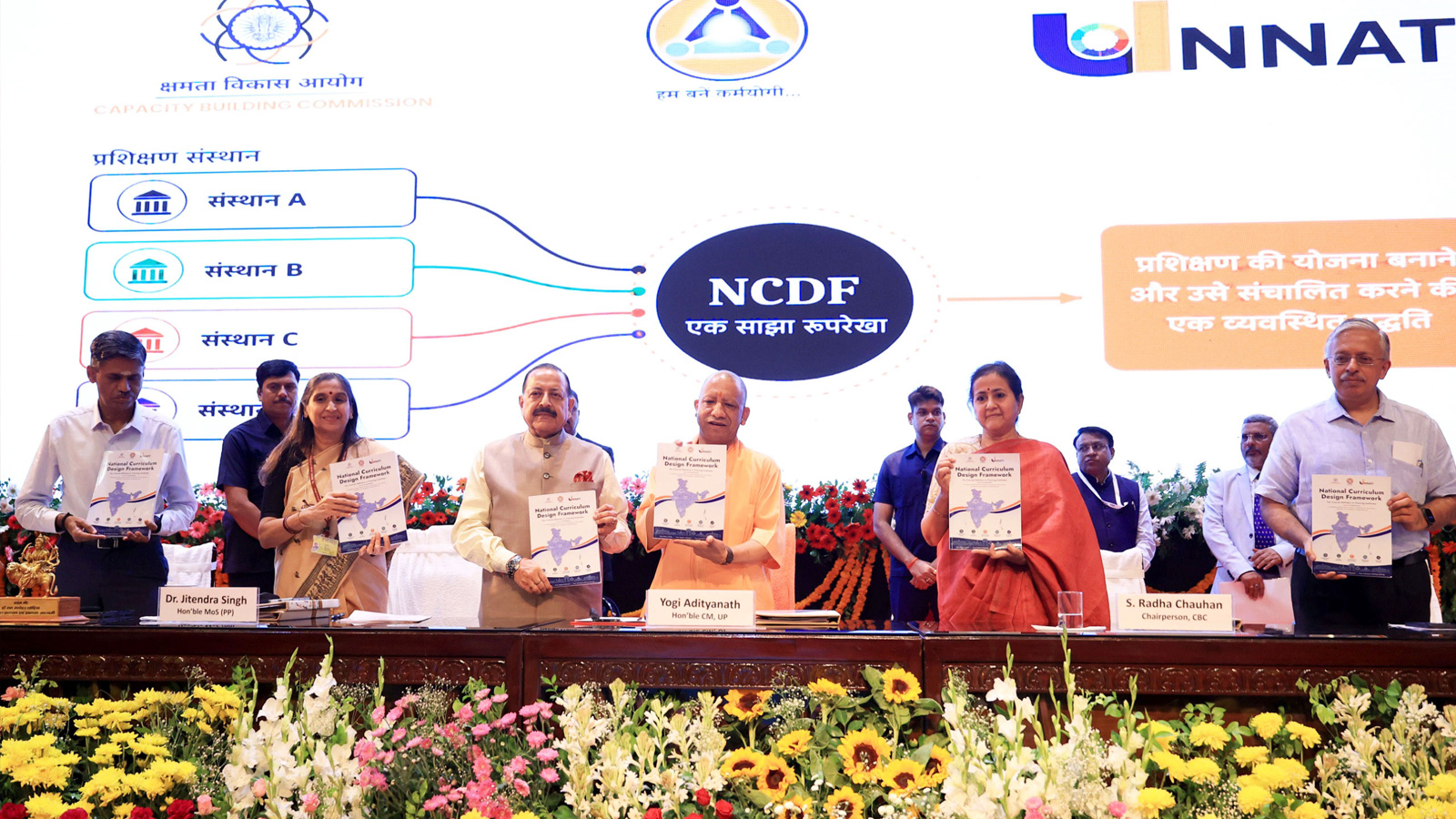
Union Minister Jitendra Singh on Friday said Mission Karmayogi marked a shift from rule-based to role-based governance, equipping government officials with the competencies needed to perform their responsibilities effectively and improve public service delivery.
Addressing the third regional workshop of Sadhana Shrinkhla 2026 in Lucknow, Singh called on government training institutions to evolve into modern capacity-building institutions and centres of excellence.
The two-day workshop, organised by the Capacity Building Commission in collaboration with the Uttar Pradesh government on October 23–24, brings together representatives from eight states and four Union Territories in the northern region. Uttar Pradesh Chief Minister Yogi Adityanath also attended the event.
Singh said the Capacity Building Commission, conceptualised by Prime Minister Narendra Modi, was an important institutional step in the government’s administrative reform programme. Capacity building should help officials move beyond routine file processing, adapt to changing requirements and deliver tangible improvements in governance, he said.
Reviewing reforms introduced since 2014, the minister cited the removal of the requirement for gazetted officers to attest documents and the discontinuation of interviews for certain government recruitment processes as measures aimed at simplifying procedures and strengthening public trust.
He also referred to Rozgar Melas, the Centralised Public Grievance Redress and Monitoring System (CPGRAMS) and Digital Life Certificates as initiatives that had improved access to public services.
Annual grievance registrations on CPGRAMS had risen from around two lakh in 2014 to approximately 25 lakh, Singh said, attributing the increase to greater public confidence in the mechanism. Around 95–97 per cent of grievances were being disposed of in a time-bound manner, he added.
Digital Life Certificates, including those using biometric and facial-recognition technologies, had eased compliance for pensioners and reduced the need for cumbersome physical procedures, he said.
Singh stressed that training institutions must respond systematically to the competency needs of government. He called for stronger institutional governance, improved faculty capabilities, updated curricula, technology adoption and assessment of training outcomes.
Referring to the principles of “Tradition, Technology and Tangible Outcomes”, he said institutional knowledge, technology-driven learning through iGOT Karmayogi and Human Resource Management Systems could together help align officials’ skills with their responsibilities.
The minister praised Uttar Pradesh’s participation in iGOT Karmayogi, saying more than 19 lakh state officials and employees had registered on the platform, contributing to national participation of approximately 1.7 crore.
He highlighted the popularity of courses on yoga and artificial intelligence among learners from the state, describing it as an example of traditional knowledge and modern technology advancing together.
Singh also appreciated Uttar Pradesh’s contribution to UNNATI, the Unified New Age National Training Initiative, which connects training institutions to promote collaboration, resource sharing and alignment with government capacity-building needs.
He said the success of these initiatives should be judged by improvements in governance rather than simply by the number of training programmes conducted or officials trained. The results should be visible in stronger competencies, institutional leadership and better government performance.
Training institutions should increasingly become centres of learning, mentorship and leadership development, working with academia, industry and practitioners while keeping citizen-centric governance at the core of their work, he added.


