







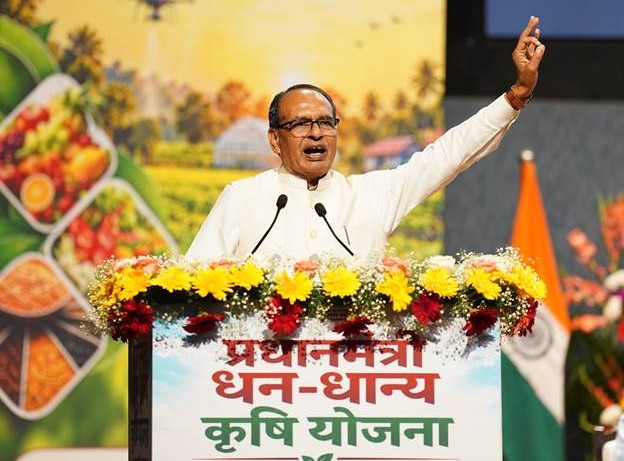
Gaya district in Bihar secured first position, followed by Nagaur in Rajasthan and Umaria in Madhya Pradesh, among the best-performing districts under the Prime Minister Dhan-Dhaanya Krishi Yojana (PMDDKY). Union Minister for Agriculture and Farmers Welfare and Rural Development Shivraj Singh Chouhan attended an event in New Delhi on Monday to mark the completion of one year of the scheme, where 18 districts were also recognised for their work across six key objectives.
Khet Bachao Abhiyan to Focus on Soil Health
Chouhan highlighted the Khet Bachao Abhiyan, scheduled to be organised across all states from October 22 to November 30 to promote soil health through the balanced and judicious use of fertilisers. He urged State Governments and concerned authorities to ensure the campaign’s successful implementation and encourage sustainable agricultural practices, according to a press release by the Ministry of Agriculture and Farmers Welfare.
Chouhan Calls for Improved Agricultural Productivity
Addressing the gathering, Chouhan said the first year had focused on establishing strong foundations, while the coming year must prioritise improving agricultural productivity, increasing cropping intensity, strengthening irrigation and water management, promoting high-value agriculture, upgrading post-harvest infrastructure and expanding access to agricultural credit.
He said the scheme’s success would ultimately be measured by its impact on farmers’ lives. He called for stronger coordination among stakeholders and reaffirmed the Centre’s commitment to working with State Governments, district administrations, scientific institutions and farmers to make all 100 identified districts models of agricultural prosperity.
District-Centric Planning and Monitoring
In his welcome address, the Secretary, Department of Agriculture and Farmers Welfare, highlighted the scheme’s district-centric approach, with action plans tailored to local soil conditions, rainfall, cropping patterns, water availability, infrastructure and farmers’ needs.
The scheme monitors district performance against 121 indicators through a dedicated dashboard, with monthly rankings promoting transparency and healthy competition. The Secretary also acknowledged the contributions of State Governments, district officials, Krishi Vigyan Kendra scientists and District Dhan-Dhaanya Samitis in planning and implementation.
Districts Showcase Agricultural Initiatives
Representatives of three PMDDKY districts presented their initiatives during the programme. Gadchiroli showcased its work on water conservation and drought resilience, Alluri Sitharama Raju highlighted high-value horticulture initiatives, and Banka presented the Lilawaran Natural Farming Land Revival Model.
The presentations demonstrated how locally tailored interventions and farmers’ participation can help address agricultural challenges and develop replicable solutions.
18 Districts Recognised Across Six Objectives
Besides the top three districts in the overall rankings, 18 districts were recognised across six objectives: agricultural productivity; crop diversification and sustainable farming; post-harvest storage; irrigation infrastructure; access to agricultural credit; and governance and service delivery.
For agricultural productivity, the recognised districts were Chhatrapati Sambhajinagar in Maharashtra, Chitrakoot in Uttar Pradesh and Geyzing in Sikkim. Mahoba in Uttar Pradesh, Dindori in Madhya Pradesh and Chamoli in Uttarakhand were recognised for crop diversification and sustainable agricultural practices.
Tikamgarh and Sidhi in Madhya Pradesh, along with Dantewada in Chhattisgarh, were recognised for post-harvest storage capacity. Kishtwar in Jammu and Kashmir, Dahod and Chhota Udaipur in Gujarat received recognition for irrigation infrastructure.
For access to agricultural credit, the recognised districts were Narayanpet in Telangana, Jalaun in Uttar Pradesh and Sri Sathya Sai in Andhra Pradesh. Nagarkurnool in Telangana, Kachchh in Gujarat and Haveri in Karnataka were recognised for governance and service delivery.
The programme concluded with a commitment to strengthen district-level planning, promote innovation and improve coordination between Central and State Government schemes to support sustainable agricultural development and enhance farmers’ incomes.
-PIB Inputs


