






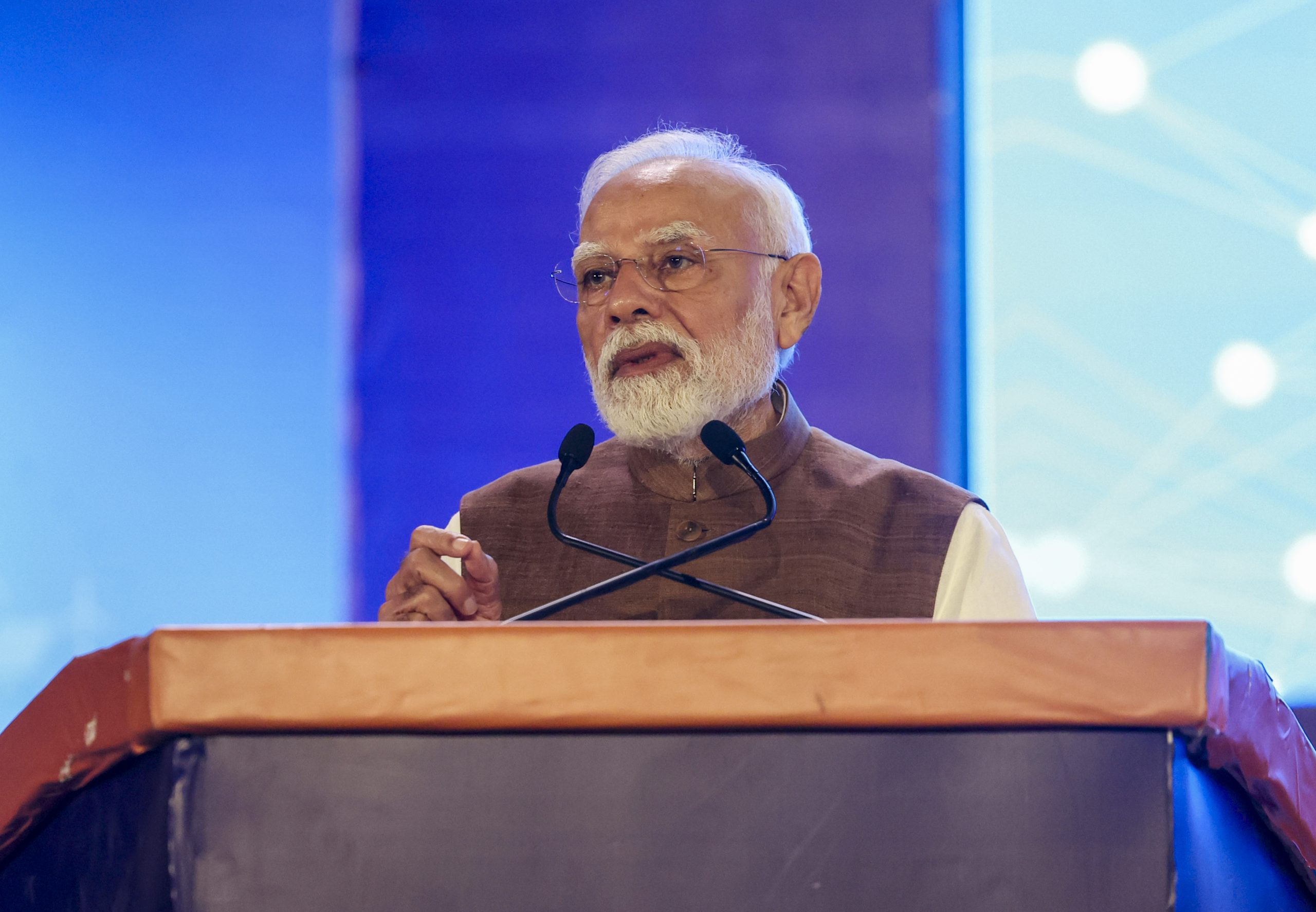
Prime Minister Narendra Modi on Tuesday called for India to lead the world in emerging science and technology, highlighting the country’s growing capabilities in nuclear energy, space, artificial intelligence (AI) and semiconductors, and its potential to develop solutions to global challenges at scale.
Inaugurating the Emerging Science, Technology and Innovation Conclave 2026 at Bharat Mandapam in New Delhi, PM Modi emphasised India’s ability to develop secure, population-scale solutions, drawing on the success of the Digital Stack and indigenous 5G technology. He said that while sectors ranging from nuclear energy and space to AI and semiconductors have distinct requirements, they collectively reflect India’s growing strength and confidence in emerging technologies.
“The scale at which the youth of India are thinking and the self-confidence with which they are moving forward is encouraging,” PM Modi said, referring to his interaction with startup founders earlier in the day. He highlighted India’s capacity to deliver “Solution at Scale” so that domestic breakthroughs can address global challenges.
From adopting technologies to creating them
Recalling his participation in the previous edition of the Conclave, PM Modi contrasted the earlier approach, when India adopted or modified foreign innovations years after their development, with the present ambition to create original technologies, set global directions and solve worldwide challenges.
Citing India’s development of indigenous COVID-19 vaccines for domestic use and supply to other nations, its successful Mars mission on the maiden attempt and its landing on the uncharted lunar South Pole, he outlined the country’s technological ambitions.
“India must embrace the technologies of the future, innovate boldly, and lead the world in creating them,” PM Modi said.
Advances in nuclear energy and space
Highlighting India’s scientific heritage, from the invention of zero and the number system to astronomy, PM Modi said the country was advancing this legacy through modern technology and renewed confidence. Referring to the birth anniversary of Dr. Homi Jehangir Bhabha on October 30, he began his review of recent achievements with the nuclear sector.
He said building a Viksit Bharat required massive nuclear energy capacity, while dependence on imported nuclear fuel remained a challenge to energy security. India was rapidly advancing its Fast Breeder Reactor technology, he noted.
The indigenous 500-Megawatt Prototype Fast Breeder Reactor achieved First Criticality a few months ago, marking a major step towards strengthening India’s long-term capabilities in nuclear energy, PM Modi said.
Turning to the space sector, he highlighted achievements this year, including an Indian space startup placing a satellite into orbit on its maiden attempt using a Made-in-India rocket and India mastering satellite docking capability. He also noted that domestic startups were developing new space science solutions, with growing participation from young scientists and entrepreneurs.
“Our goal is also to expand our power in Critical Technologies,” PM Modi said.
AI, semiconductors and battery storage
PM Modi described India’s achievements across multiple sectors as unprecedented. He noted that the country hosted the AI Impact Summit this year, launched its own AI Model and began shipping India-made semiconductor chips to the world.
He also highlighted efforts to build battery storage capacity using raw materials available entirely within the country.
“The diverse sectors in which India is achieving successes is unprecedented,” PM Modi said.
Science must improve people’s lives
PM Modi said science and technology should serve humanity rather than be viewed merely as instruments of power. He stressed that scientific progress must translate into solutions that improve everyday life and strengthen healthcare, agriculture, education, employment and disaster resilience.
He expressed satisfaction that Indian startups were prioritising these areas, citing work on wearable EEG technology to understand brain activity, indigenous wireless and satellite communications, specialised nutritional products, new semiconductor technologies and solutions to utilise industrial waste such as steel slag.
“The real success of Science occurs when it steps out of the lab and makes the life of the common citizen better,” PM Modi said.
Recalling his recent visit to IIT Madras in Chennai, PM Modi referred to the inauguration of a modern Brain Centre that has created a globally exemplary brain imaging technology platform. The platform aims to develop high-resolution digital 3D images of the human brain and help unravel complex neurological diseases.
He said “Science for Society” and “Technology for Transformation” must remain the ultimate benchmarks for scientific progress.
Research funding and rising patent filings
Emphasising the importance of research in building technological capabilities and self-reliance in critical technologies, PM Modi referred to his slogan “Jai Vigyan, Jai Anusandhan” and highlighted the rapid momentum of the Anusandhan National Research Foundation.
He recalled last year’s pledge at the same forum to provide one lakh crore rupees for Research, Development, and Innovation. Over the past year, the government committed 12,000 crore rupees for market-ready lab technologies, matched by an equal amount of 12,000 crore rupees from private investors.
“Meaning, in just one year, a total new Commitment of 24 thousand crore rupees has been made for Research and Development,” PM Modi said.
PM Modi also pointed to a sharp rise in intellectual property creation over the past decade. Annual patent filings have increased from fewer than 50,000 ten years ago to nearly 1.5 lakh last year, reflecting a broader shift towards a stronger research and innovation culture.
“They are a sign of that change in which Research and Innovation are becoming a strong Culture in India,” PM Modi said.
AI must strengthen scientific thinking
Raising questions about how scientific judgement would evolve in the age of AI, PM Modi said leading laboratory scientists and Nobel Laureates developed their expertise over years of solving problems, experimenting, learning from failures, questioning established patterns and identifying overlooked details.
He said AI could rapidly perform routine tasks and improve productivity, but should enrich rather than restrict independent thinking. Researchers should use the time saved to address harder problems, conduct new experiments and validate ideas.
“AI can give us answers quickly, but the responsibility of testing the veracity of the answer must lie with the scientist alone,” PM Modi said.
National Missions and security in emerging technologies
PM Modi called for scientists and institutions to prepare continuously for future-shaping fields through dedicated National Missions covering semiconductors, quantum technologies, biotechnology, advanced materials, robotics, space, clean energy and next-generation communications.
He stressed that safety and security must be prioritised across AI, synthetic biology and autonomous systems. Warning of emerging AI-era cybersecurity threats to financial networks and national security, he called for AI-based and quantum security solutions to protect national systems and serve humanity.
“Our goal is to develop such technologies which empower India and also contribute to solving the problems of humanity,” PM Modi said.
Three-year targets for measurable outcomes
Calling on researchers, industry leaders, startup founders and students attending the Conclave to set concrete three-year targets, PM Modi urged them to identify the technology, prototype, pilot project or product they would help develop.
He said their efforts should contribute to building a Viksit Bharat and establishing India as a global hub for solutions. He emphasised that the Conclave must move beyond discussions and deliver tangible results.
“This Conclave should not remain limited merely to the exchange of ideas; may it become a platform for Measurable Outcomes,” PM Modi said.
Concluding his address, PM Modi highlighted India’s status as the world’s youngest nation and its talent and determination. He stressed the need to nurture a generation that leads emerging science and technology rather than merely participates in it, and extended his best wishes for the success of the Conclave.
“We have to prepare such a generation which is not merely a participant in Emerging Science and Technology, but leads it,” PM Modi said.
-PIB Inputs


