






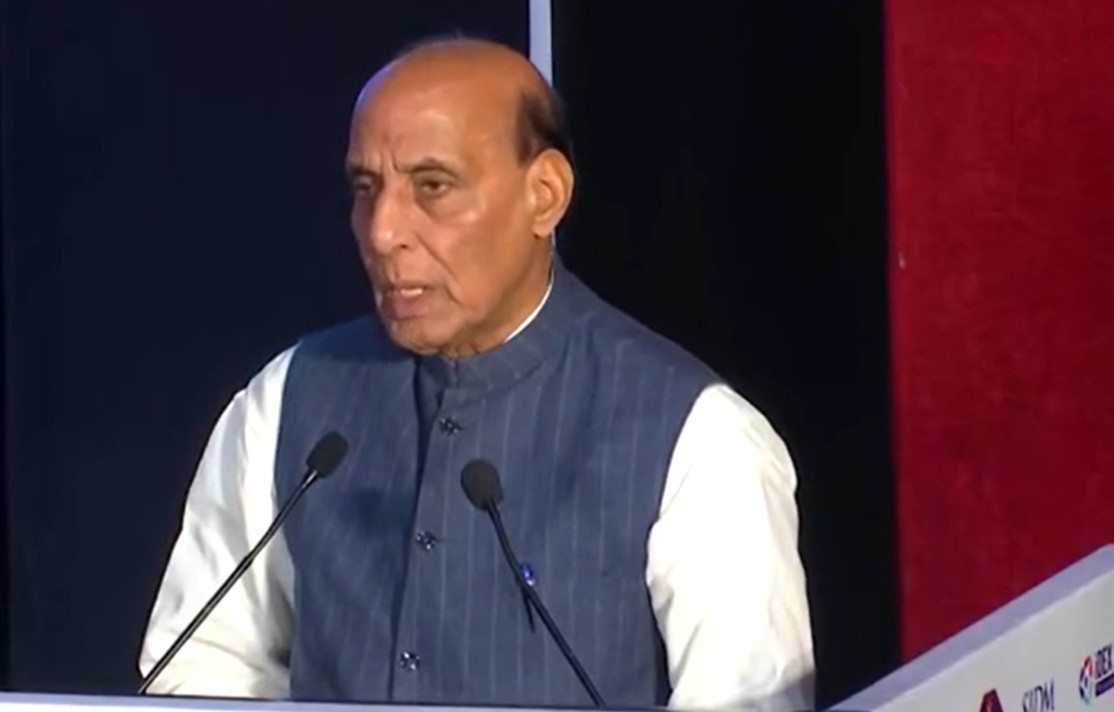
Defence Minister Rajnath Singh has called for ‘Aatmanirbharta 2.0’ in the defence sector, emphasising the development of top-end, state-of-the-art technologies, strengthening Research & Development (R&D), and building resilient supply chains to reduce import dependence and achieve technological superiority, thereby contributing to the vision of Viksit Bharat@2047.
He was addressing the fifth edition of SWAVLAMBAN, the Indian Navy’s Naval Innovation and Indigenisation Seminar, in New Delhi on October 26. He emphasised the need to build on the gains of the first phase of self-reliance achieved under the leadership of Prime Minister Narendra Modi, stating that defence innovators with futuristic vision and scientific discipline could play the role of ‘impact players’ in pursuing more challenging technological goals, according to a press release by the Ministry of Defence.
Focus on advanced technologies and resilient supply chains
Highlighting the strides made by the nation towards Aatmanirbharta in defence over the last decade, Rajnath Singh said the progress achieved so far had created a strong foundation for the next phase, which must focus on advanced technologies and objectives considered difficult to achieve. He underlined the need to indigenously manufacture products that are cost-effective, operationally superior and globally competitive.
The Defence Minister described supply chain management as not just a technical issue but a strategic imperative directly linked to national security. He called for a dynamic roadmap that sets clear timelines for achieving self-reliance in each item, identifies the technologies to be developed and the industries that will drive their innovation, and outlines the resources required to achieve these objectives.
“Supply chain dependencies arise from a limited domestic availability of certain raw materials, such as rare earth elements, and the absence of specific technologies within the country. While some external dependencies may persist until viable alternatives are developed or domestic resources become available, there is a need to prioritise critical areas for indigenisation,” he said.
Rajnath Singh underscored the need to remain prepared against potential disruptions in supply routes, stressing that the assessment of buffer stocks and domestic production capabilities must be carried out in advance rather than waiting for a crisis. He identified R&D as central to addressing these challenges and expressed confidence in the ability of the nation’s talent pool to develop cutting-edge technologies indigenously with sustained focus and investment.
Strengthening R&D and private sector participation
The Defence Minister spoke of the inherent risks associated with research and called for a change in attitude towards failure. He highlighted that even countries with advanced R&D ecosystems experience high failure rates, which are a natural part of the innovation process.
“While this risk aversion is, in one sense, natural, it also presents an opportunity. Can we develop funding mechanisms capable of supporting high-risk, high-reward projects? Can we attract more private sector participation in R&D, given its greater propensity for risk-taking? We must seriously consider how to advance in two key areas: engaging the private sector and fostering low-cost technologies. The private sector possesses a greater capacity for taking risks, while low-cost technologies allow us to achieve significant results through smaller-scale experiments,” he said.
Rajnath Singh highlighted the R&D culture in countries such as Israel, South Korea and the United States where innovation, he said, is embraced as a way of life, with failure being viewed as an opportunity to learn. He stressed the need to foster a deep-rooted culture of research and innovation in India through stronger industry-academia collaboration, greater encouragement in educational institutions and increased opportunities for the youth to pursue careers in R&D.
iDEX and indigenous defence technologies
Highlighting the contribution of iDEX in enabling start-ups and MSMEs to develop technologies that India previously imported, Rajnath Singh stated that over 4,000 proposals had been submitted against 229 challenges issued by the Indian Navy, reflecting the depth of Indian talent and the enthusiasm of entrepreneurs.
Commending the progress made through iDEX, he said Indian start-ups and MSMEs have developed solutions in naval systems, sensors, communications and other critical areas by translating operational challenges into opportunities for innovation.
Rajnath Singh highlighted that the demand for naval ships is steadily increasing in view of the evolving situation in the Indian Ocean Region. Since their construction is capital-intensive, he said there is a need to explore ways to reduce costs while expanding domestic production.
He stated that the next phase of Aatmanirbharta must focus not only on the quantity of indigenous products but also on their quality, efficiency and affordability. He emphasised that self-reliance must strengthen national security as well as economic resilience.
“Our Government has ensured that a lack of funding does not become an obstacle to the aspirations of our talented youth. Naval contracts worth over Rs 1,900 crore demonstrate that our efforts are delivering tangible results. The steady progress of our Navy is a testament to this resolve… There is a need to address the remaining areas of import dependence, particularly Buyer Nominated Equipment, to further advance the Indian Navy’s journey towards self-reliance,” said the Defence Minister.
Call for a Dual Technology Roadmap
For a broader approach to indigenisation, Rajnath Singh called for the development of a ‘Dual Technology Roadmap’ to identify and prioritise technologies that can serve both civilian and military requirements.
He stressed the need to expand efforts beyond existing Positive Indigenisation Lists and develop priority lists of technologies and products required for civil and military shipping. He also suggested identifying technologies that could be used across all three Services and the Indian Coast Guard, terming it as a technological application of inter-service jointness, which can serve as a significant milestone in the second phase of self-reliance.
The Defence Minister appreciated the collaboration among the Defence Forces, industry and academic research institutions in addressing emerging challenges, including quantum technologies, artificial intelligence in warfighting and uncrewed systems. He underscored that developing such advanced capabilities requires perseverance, sustained collaboration and a clear focus on future operational requirements.
Indian Navy highlights progress under SWAVLAMBAN
Speaking on the occasion, Chief of the Naval Staff (CNS) Admiral Krishna Swaminathan highlighted SWAVLAMBAN’s growth since 2022, with Navy-specific iDEX challenges increasing from 20 to 229, accounting for approximately 35% of all iDEX challenges across the defence sector.
He noted that 41 Acceptance of Necessity (AoN) cases worth over Rs 3,500 crore have been accorded, while 25 contracts valued at over Rs 1,900 crore have been signed.
Emphasising the opportunities presented by advances in Artificial Intelligence, autonomous systems, robotics and quantum sensing, the CNS underscored the need to translate promising innovations into operational capabilities. He highlighted five key areas for accelerating capability development: ideation, prototyping, testing, contracting and induction, and life-cycle support.
He called for stronger collaboration between the Indian Navy, industry, start-ups and MSMEs to accelerate the development and induction of indigenous technologies and build a self-reliant, future-ready defence ecosystem.
Defence Production Secretary calls for collaboration
Secretary (Defence Production) Sanjeev Kumar stated that SWAVLAMBAN 5.0 marks another milestone in the nation’s journey towards defence innovation and indigenisation, bringing together stakeholders from across the defence ecosystem to deliberate on emerging technologies, address evolving operational requirements and explore opportunities for indigenous capacity development.
This year’s theme, ‘Strength and Power through Innovation & Indigenisation’, he added, reflects the growing importance of collaboration and technological advancements to build a strong and self-reliant defence ecosystem. He exhorted all the stakeholders to shift from competition to collaboration mode to contribute in further strengthening national security and nation-building.
The Secretary (Defence Production) appreciated the Indian Navy’s contribution to the success of the iDEX initiative. iDEX is translating indigenous innovations into tangible procurement outcomes and bolstering the Navy’s operational capabilities, he said.
Chief of Defence Staff General NS Raja Subramani, Chief of the Army Staff General Dhiraj Seth, Vice Chief of the Air Staff Air Marshal Ashutosh Dixit, CISC Air Marshal Tejinder Singh, Vice Chief of the Naval Staff Vice Admiral Ajay Kochhar, Vice President, Society of Indian Defence Manufacturers (SIDM) Shri Neeraj Gupta, serving and retired officials, industry & academia representatives and iDEX winners were present on the occasion.
Technology exhibition showcases indigenous solutions
Rajnath Singh visited the technology exhibition featuring over 100 stalls by start-ups/MSMEs and interacted with innovators working on naval challenges and problem statements. Start-ups/MSMEs engaged with naval users showcased niche technologies being progressed for operational capability development. The success stories section of the exhibition showcased developed products which are under induction by the Indian Navy.
Solutions in autonomous maritime platforms, quantum and AI in war-fighting, persistent surveillance, resilient navigation, advanced communications and counter-drone technologies illustrated the breadth of indigenous development.
On the progress made since the launch of SWAVLAMBAN in 2022, Rajnath Singh stated that the platform has consistently contributed to meeting the operational requirements of the Indian Navy. He expressed confidence in the capability of Indian industry to develop reliable, high-end indigenous technologies, stating that the innovations showcased at the event reflected the country’s growing technological strength.
Publications released and innovators felicitated
Rajnath Singh released ‘Compendium of Technology Imperatives, Problem Statements and Future Concepts’ and ‘Swavlamban 5.0’ document, providing industry visibility of naval priorities and development opportunities. He also felicitated eminent speakers of the seminar and iDEX innovators, recognising their contribution to India’s defence capabilities.
About SWAVLAMBAN 2026
The event, organised by the Indian Navy in collaboration with the Defence Innovation Organisation and SIDM, is being held at Manekshaw Centre from October 26 to 27 on the theme ‘Strength and Power through Innovation and Indigenisation’.
The seminar features deliberations on future and emerging technologies, including quantum technologies, Artificial Intelligence, autonomous systems and hypersonic technologies, with a focus on their potential applications in future warfare and naval operations.
Dedicated sessions are aimed at strengthening self-reliance and the iDEX ecosystem, building resilient domestic supply chains, promoting academic entrepreneurship and enabling start-ups to scale promising indigenous technologies. Engagements with investors and venture capitalists will provide opportunities to explore funding, scaling and commercialisation pathways for promising defence enterprises.
-PIB Inputs


