






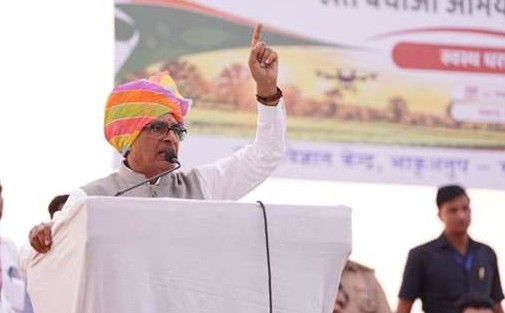
Union Agriculture and Farmers’ Welfare Minister Shivraj Singh Chouhan on Thursday launched the nationwide ‘Khet Bachao Abhiyan’ from Taraori in Haryana’s Karnal district, calling for a countrywide public awareness campaign from October 22 to November 30 to promote soil conservation, balanced fertiliser use and sustainable farming practices.
Chouhan urged agricultural scientists, universities and officials to reach out directly to farmers and raise awareness about protecting soil fertility and preventing agricultural land from becoming barren.
Centre approves 28,422 houses for Haryana under PMAY
During the programme, Chouhan, who also holds the Rural Development portfolio, announced approval for the construction of 28,422 permanent houses for eligible poor families in Haryana under the Pradhan Mantri Awas Yojana (PMAY)-Gramin.
An amount of ₹1,343.06 crore was sanctioned for the purpose. Chouhan handed over the formal approval letter to Haryana Agriculture and Animal Husbandry Minister Shyam Singh Rana, who was present at the event.
The approval is expected to help eligible economically disadvantaged families in the state realise their dream of owning permanent homes.
Government bears fertiliser subsidy burden
Chouhan said the Centre, under Prime Minister Narendra Modi’s leadership, was absorbing the impact of rising international fertiliser prices to protect farmers from additional financial burdens. The government was providing fertiliser subsidies exceeding ₹1.5 lakh crore, enabling farmers to buy a bag of urea for ₹266 and a bag of di-ammonium phosphate (DAP) for ₹1,350, he said.
However, he cautioned farmers against excessive fertiliser use, stressing that affordability should not lead to indiscriminate application. Fertilisers should be used in balanced quantities according to soil requirements, he said.
He also highlighted the potential of green ammonia to help India move towards self-reliance in fertiliser production.
Three measures to protect soil fertility
Chouhan outlined three practical measures that farmers could adopt to conserve soil health and sustain agricultural productivity.
Balanced fertiliser use: Farmers should consult their Soil Health Cards, including through mobile phones, to identify nutrient deficiencies and apply only the required fertilisers in appropriate quantities.
Crop rotation: He urged farmers to diversify beyond the repeated paddy-wheat cycle by incorporating pulses such as chickpea, lentil and pigeon pea. Pulse crops help replenish soil nitrogen through biological nitrogen fixation, thereby improving soil fertility.
Natural farming: Farmers were encouraged to begin natural farming on at least half an acre rather than converting their entire landholding at once. Chouhan cited preparations such as Beejamrit and Ghanjeevamrit, made using cow dung, cow urine and soil collected from beneath trees, as options for reducing cultivation costs and chemical inputs while improving soil health.
He said farmers could gradually expand natural farming based on their experience and improvements in soil conditions.
Crop-residue burning harms soil health
Highlighting the crop-residue management efforts of farmers in Taraori, Chouhan described stubble burning as a self-destructive practice that causes air pollution and destroys beneficial microorganisms, insects and earthworms in the soil.
These organisms play a vital role in maintaining soil fertility and supporting the natural decomposition of organic matter, he said. Protecting them is essential to preserving the health and productivity of agricultural land.
Scientists and officials urged to reach villages
Chouhan called on vice-chancellors of agricultural universities, the Director General of the Indian Council of Agricultural Research (ICAR), scientists and officials to visit villages and hold meetings with farmers during the nationwide campaign from October 22 to November 30.
He urged them to explain the importance of soil health, balanced fertiliser application, crop rotation and sustainable farming practices through direct engagement with farming communities.
Chouhan said he would also actively participate in the campaign on the ground to ensure its message reached farmers across the country and helped protect India’s agricultural land from degradation.
-PIB inputs


