






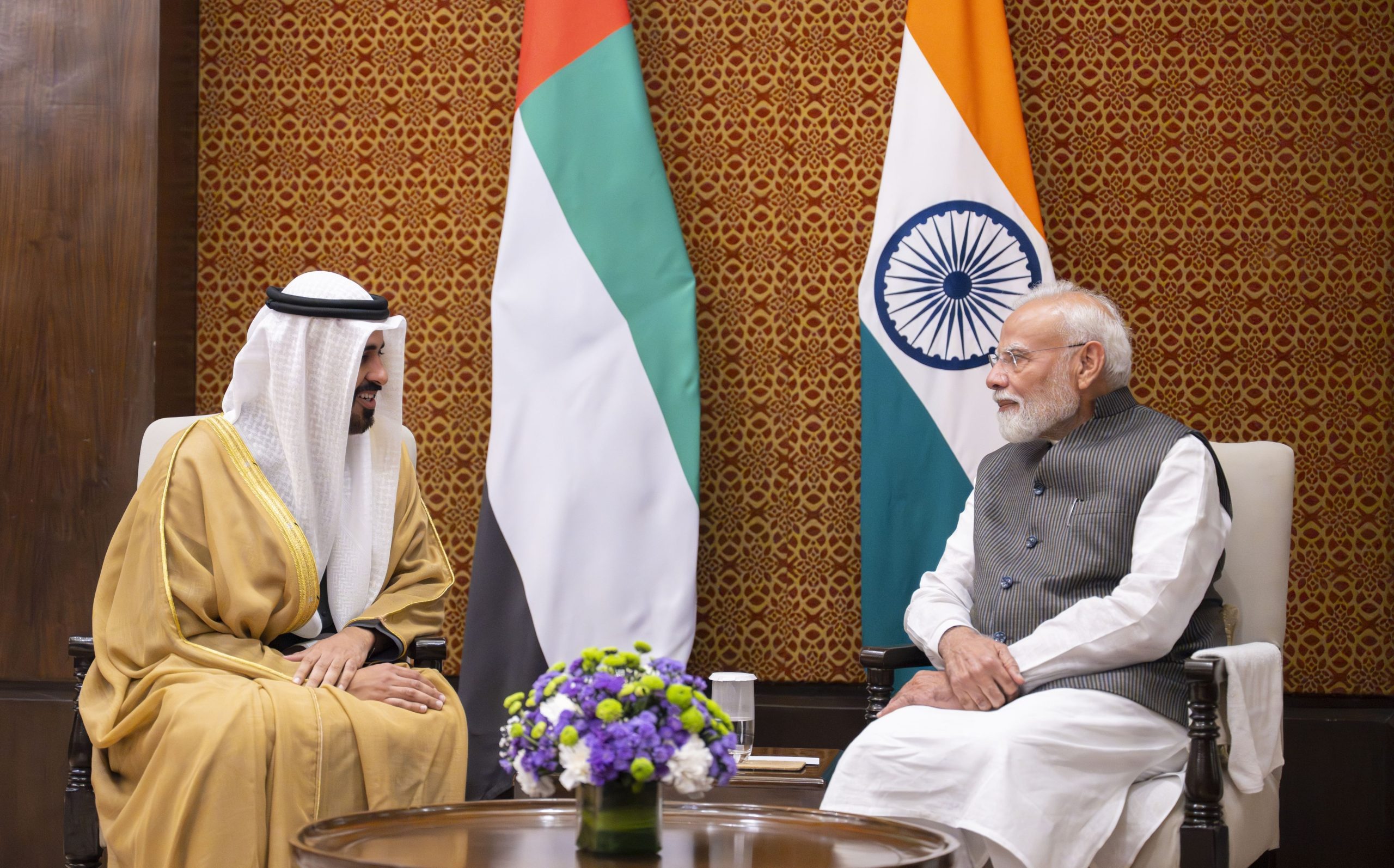
Sheikh Theyab bin Mohamed bin Zayed Al Nahyan, Deputy Chairman of the Presidential Court for Development and Fallen Heroes’ Affairs, met with Prime Minister Narendra Modi on the sidelines of the NDTV World Summit 2026 in New Delhi. The two sides discussed bilateral friendship and cooperation, and ways to strengthen ties. They also exchanged views on key issues like shifts in the global economy, the role of technology and artificial intelligence in advancing development, and the importance of international partnerships in turning global challenges into opportunities for growth and prosperity.
The UAE delegation to New Delhi also included Abdulla bin Touq Al Marri, Minister of Economy and Tourism; Saeed bin Mubarak Al Hajeri, Minister of State; Abdulla Saif Al Nuaimi, UAE Ambassador to India and a number of senior UAE officials. Al Marri delivered the UAE’s address in the Summit and participated in a session titled “India and the UAE: Building Partnerships in a Changing Gulf”.
Al Marri highlighted the Comprehensive Economic Partnership Agreement (CEPA), signed in February 2022, as a milestone in bilateral economic relations. He said the agreement had helped drive trade growth, while the partnership had expanded into investment, logistics, energy, industry, payments, food security and advanced technology. “The agreement is an engine that drives us forward, not a station where we stop,” he said.
The minister noted that non-oil trade between the UAE and India had risen by almost 50 percent in the last three years, from around USD 51 billion in the agreement’s first year to more than USD 76 billion in 2025. Total bilateral trade exceeded 101 billion in India’s last financial year, while the two countries have set a target of USD 200 billion in bilateral trade by 2030. He said the relationship had evolved beyond a conventional trading partnership into one that increasingly connects investment, financial services, infrastructure and emerging technologies.
On innovation, Al Marri highlighted the complementary strengths of India and the UAE. India brings scale, skills and an exceptional digital ecosystem, while the UAE offers capital, infrastructure, energy and a strategic location connecting Asia with the Middle East, Africa and Europe. Citing recent investment developments, Al Marri pointed to plans of India-UAE cooperation for an integrated aluminium complex in Odisha valued at US$11.5 billion.
Addressing the summit, Al Marri said the global economy was undergoing a period of transition, making partnerships built on trust, investment and practical cooperation increasingly important. He said the UAE-India relationship had become more important as the world grew increasingly turbulent, drawing on historical maritime links that predate formal economic agreements. “Between us and India lies a sea that our ancestors did not view as a challenge, but as a path,” he said, recalling how dhows carried spices, textiles and pearls between ports long before the concept of economic corridors emerged.
Turning to the UAE’s economic outlook, Al Marri acknowledged the difficult conditions facing the Gulf region, while emphasising that the UAE’s openness remained a source of strength. He said economic resilience depended on building a diversified economic structure capable of absorbing disruption, rather than assuming that economies could remain immune to external shocks. He outlined priorities centred on productivity, innovation and structural transformation, stressing that economic performance should be assessed not simply by how much is produced, but by how much value is generated by every worker, company and dirham of capital. The UAE’s response, he said, involved accelerating the adoption of artificial intelligence, developing skills, strengthening competition and making it easier for growing companies to access finance.
Addressing the changing global order, he argued that diplomatic goodwill alone could not guarantee resilience. Countries also needed infrastructure, investment and effective execution to translate partnerships into tangible economic outcomes. He cautioned against responding to global fragmentation with further fragmentation, describing diversification as a shield against economic fluctuations while emphasising that it could not replace partnerships founded on mutual trust.
He said economic corridors needed to deliver practical commercial value rather than remain lines on a map. Such corridors require connected ports, coordinated customs authorities, available financing and companies that find it worthwhile to use them. Without these elements, he said, a corridor would remain merely a project.
The minister also highlighted the contribution of the Indian community in the UAE, describing people as the most important bridge between the two countries. Millions of Indians have made the UAE their home and contributed to its economic development and it will never be forgotten, he said.
(Manish Shiva is a Senior Correspondent with Prasar Bharati)


