






For residents of Bihar’s Seemanchal and Kosi regions, catching a flight once meant travelling more than 200 km to Bagdogra Airport. In Arunachal Pradesh’s Lohit district, reaching an airport could involve a lengthy journey across difficult terrain. For pilgrims travelling to Deoghar in Jharkhand, the final stretch to Baba Baidyanath Dham often required hours on the road.
The arrival of airports in these regions has shortened journeys and widened access to opportunities. A flight can mean quicker access to medical care, an easier pilgrimage, a new market for agricultural produce or a stronger connection between a local business and its customers.
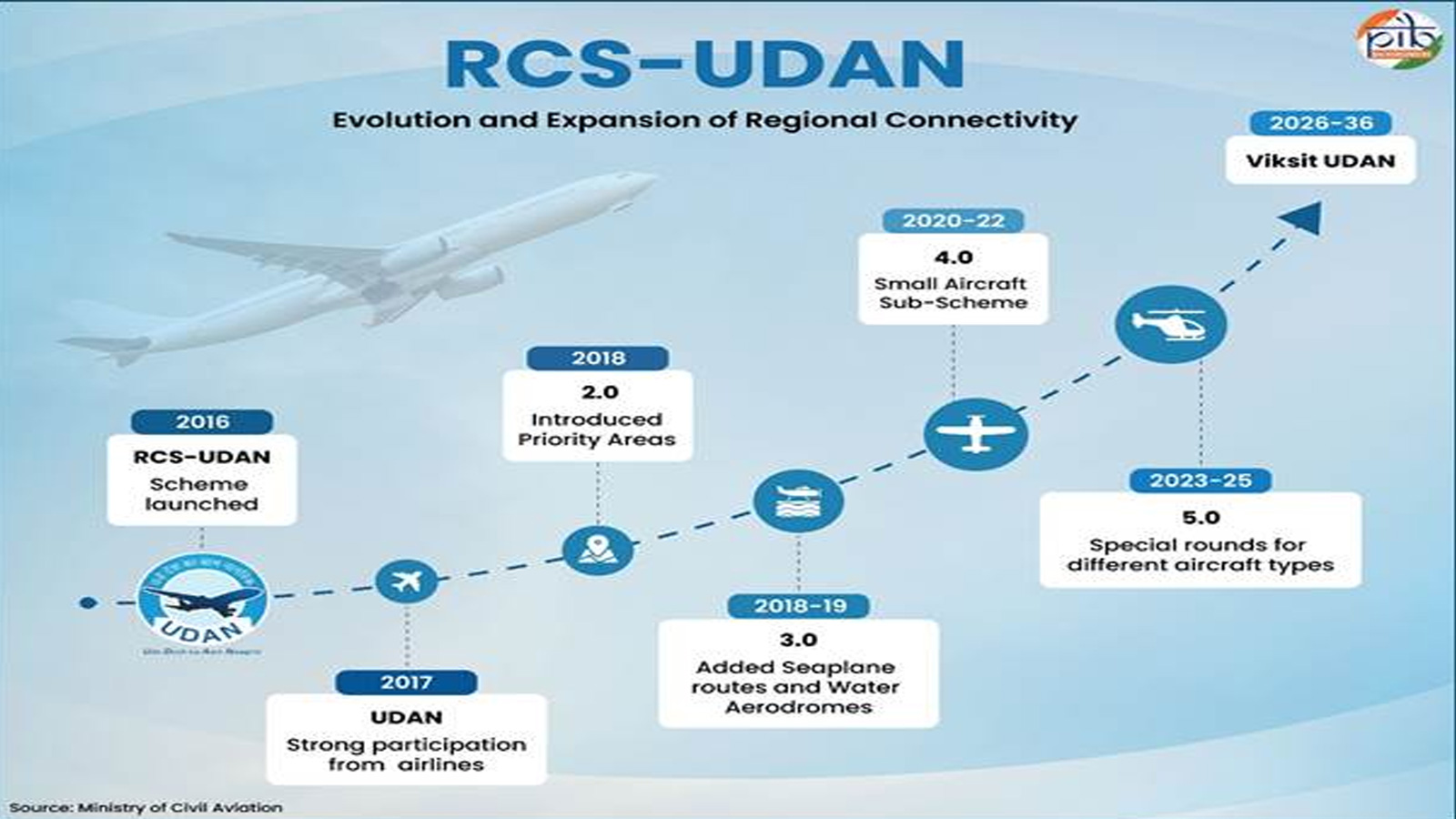
As the Regional Connectivity Scheme, popularly known as UDAN, completes ten years on October 21, 2026, these changes illustrate its impact beyond the airport terminal. Launched in 2016, UDAN—Ude Desh ka Aam Nagrik—sought to make regional air travel affordable while encouraging commercially viable operations on routes serving unserved and underserved areas.
Its first flight, between Shimla and Delhi, took off in April 2017. Since then, the scheme has operationalised 687 regional routes and 95 aerodromes, including 17 heliports and two water aerodromes. More than 3.68 lakh flights have carried 1.72 crore passengers under the programme.
The expansion has accompanied a broader growth in Indian aviation. The country’s operational airport network has increased from 74 in 2014 to 166, while India has become the world’s third-largest domestic aviation market.
For regional India, however, the significance of this expansion is often best understood through the journeys it has changed.
Purnea Airport, operationalised in 2025, has brought air access closer to residents across more than ten districts of Bihar. The region, known for agricultural products such as makhana, litchi and vegetables, previously lacked direct air connectivity and air cargo facilities.
According to the Civil Aviation Ministry, journeys to Kolkata and Patna that could take about ten and eight hours by road have been reduced to nearly two hours and one hour by air, respectively. With an approximately 2.8-km runway capable of handling A320 and B737 aircraft, the airport has strengthened the region’s links with major economic centres and supported local economic activity.
In Arunachal Pradesh, Tezu Airport offers another example of what regional connectivity can mean in difficult terrain. Operationalised in 2021, it serves more than two lakh people in a remote area near India’s eastern frontier. The airport has reduced the journey to Guwahati to about an hour and enabled air cargo movement of agricultural produce such as ginger, cardamom and rice.
Such connections are particularly important in the North-East, where hilly terrain makes surface travel challenging. Under UDAN, 90 priority regional routes have been operationalised across the north-eastern states. Of the 52 aerodromes identified in the region, including heliports and water aerodromes, 12 have become operational.
Elsewhere, regional airports have strengthened established centres of pilgrimage and commerce.
Deoghar Airport, which opened in July 2022, has brought Baba Baidyanath Dham within a two-hour flight of Delhi. Improved access has supported pilgrimage, patient travel to AIIMS Deoghar and the local hospitality industry. The Ministry said that the airport’s opening lead to establishment of more than 30 new hotels.
In Rajasthan, Kishangarh Airport has improved access to Kishangarh, Ajmer and Pushkar, where travellers previously depended on Jaipur, more than 100 km away, for flights. Its influence extends across the marble trade, religious tourism and aviation training.
The airport also hosts Avyanna Aviation Academy, a Category ‘A’ Flying Training Organisation established there in 2022. According to the Ministry, the airport has generated more than 200 direct jobs.
These examples reflect the wider economic role of aviation. Across the sector, employment has grown from around three million in 2014 to nearly 7.7 million in 2026, with the potential to reach 25 million by 2040.
Sustaining regional flights, however, requires more than opening airports. Airlines must be able to operate routes reliably, while aerodromes need resources for upkeep and daily operations. UDAN addresses these requirements through market-based route selection, airfare caps, concessions and Viability Gap Funding, or VGF. As of October 15, 2026, ₹5,091.23 crore had been disbursed under VGF.
The next phase seeks to strengthen this foundation.
Launched on July 4, 2026, the Modified UDAN Scheme has a total outlay of ₹28,840 crore and will run from 2026–27 to 2035–36. It combines the expansion of aviation infrastructure with operational support and measures to build indigenous aviation capacity.
Under the scheme, 100 airports are to be developed from existing unserved airstrips, with an outlay of ₹12,159 crore over eight years. Another ₹3,661 crore has been earmarked for the development of 200 modern helipads during the same period.
To support the functioning of these facilities, the scheme provides an estimated ₹2,577 crore for three years of operation and maintenance assistance covering approximately 441 aerodromes. Annual support is capped at ₹3.06 crore per airport and ₹90 lakh per heliport or water aerodrome.
Airlines operating regional routes will receive support through a ₹10,043-crore VGF allocation over ten years. Funding will be available for up to five years, tapering from the third year, while route exclusivity will be limited to three years.
The scheme also proposes ₹400 crore for two HAL Dhruv helicopters for Pawan Hans and two HAL Dornier aircraft for Alliance Air. The initiative aims to strengthen services in remote areas and challenging terrain while supporting indigenous aviation.
States and Union Territories will have a central role in identifying where this expansion takes place. Twenty-one memoranda of understanding have been signed between the government, participating states and Union Territories, and the Airports Authority of India to coordinate the identification, development and operationalisation of aviation assets.
A dedicated Challenge Mode Portal will allow states and Union Territories to nominate airstrips and helipads for development, helping align new infrastructure with local connectivity needs.
After a decade of adding routes and bringing airports into service, UDAN’s next test will be the durability of those connections. Its new phase places greater emphasis on maintaining aerodromes, supporting sustained airline operations and developing infrastructure suited to diverse geographies.
For the communities these airports serve, that continuity matters: it determines whether a shorter journey becomes a dependable part of everyday life.


