





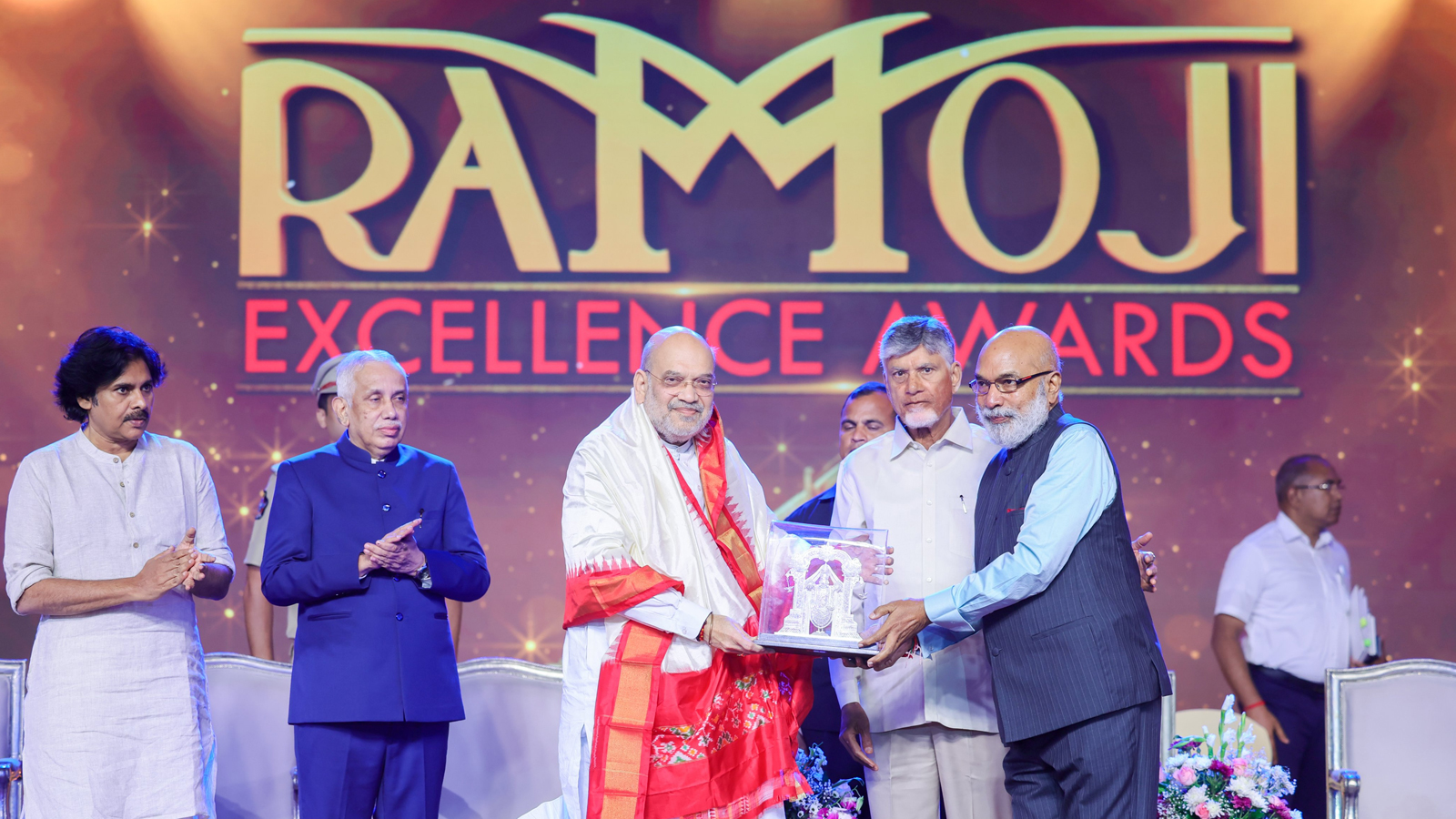
Union Home Minister Amit Shah on Monday paid tribute to media pioneer Ramoji Rao on his 90th birth anniversary, describing him as an institution-builder whose contributions to journalism, education, agriculture and filmmaking would continue to inspire the nation for generations.
Addressing the Ramoji Excellence Awards Ceremony 2026 in Vijayawada, Andhra Pradesh, HM Shah said only a few individuals transform themselves into institutions during their lifetime. He recalled meeting Ramoji Rao on four occasions and said the media entrepreneur had an exceptional understanding of developments across the country, a clear grasp of national challenges and the courage to express his views fearlessly.
Andhra Pradesh Governor S. Abdul Nazeer, Chief Minister N. Chandrababu Naidu, Union Ministers G. Kishan Reddy and K. Ram Mohan Naidu, Deputy Chief Minister K. Pawan Kalyan and other dignitaries attended the event.
HM Shah said Ramoji Rao remained deeply connected to ground realities and served as a role model for young people in several fields, including agriculture, education, filmmaking and media. He also recalled Rao’s understanding of the geographical conditions, population, challenges and causes of insurgency in the northeastern region.
From a farming family to building a media institution
Recalling Ramoji Rao’s journey, HM Shah said he was born into a poor farming family in Krishna district and had neither inherited resources nor formal training in journalism. However, his vision and determination enabled him to establish the newspaper Eenadu without external backing.
Through the newspaper, Rao sought to ensure that the first voice reaching Telugu households every morning was the voice of truth, HM Shah said. He compared Rao’s contribution to Indian journalism with that of media entrepreneur Ram Nath Goenka.
The Home Minister said Ramoji Rao consistently adapted to technological changes and expanded his media presence with the launch of ETV. At a time when private television broadcasting was emerging, Rao envisioned round-the-clock news channels in regional languages and took the ETV network beyond Telugu to several other Indian languages.
HM Shah also recalled Rao’s ambition to bring television content to mobile phones. He said the media entrepreneur had once told him that he wanted to launch television channels on mobile platforms, reflecting his determination to keep pace with changing technology and reach wider audiences.
Journalism as the fourth pillar of democracy
HM Shah said Ramoji Rao viewed journalism as the fourth pillar of democracy and upheld this belief despite financial losses, pressure and personal challenges. He maintained the impartiality of his news platforms and did not treat newspapers and television channels merely as profit-making businesses.
Distinguishing between those who struggle to build careers and those who struggle to uphold values, HM Shah said the latter achieve a greater stature. He observed that Rao not only fought to protect journalistic values but also established institutions that continued to uphold them.
Referring to the Padma Vibhushan conferred on Ramoji Rao in 2016, HM Shah said the honour was not merely a recognition of an individual but also an acknowledgement of journalism, literature, education and Telugu pride. He said Rao had created institutions rather than businesses, ensuring that their founding values continued even in his absence.
Ramoji Film City’s contribution to Indian cinema
The Home Minister also highlighted Ramoji Rao’s contribution to the film industry, saying it was difficult to imagine a regional-language film industry without Ramoji Film City.
He recalled Rao’s commitment to providing filmmakers with the infrastructure and facilities required to realise their creative ambitions. Filmmakers, HM Shah said, could bring their resources and creative vision to the studio, with the remaining requirements available within the complex.
HM Shah also congratulated the nine recipients of the Ramoji Excellence Awards, who were selected for their contributions to science and technology, young leadership, service to humanity, art and culture, education, medicine and healthcare, rural development, journalism and women’s achievements. He said an award associated with Ramoji Rao’s name carried special significance because of the values and legacy he represented.
HM Shah highlights India’s economic and infrastructure progress
Turning to the country’s development, HM Shah said India had witnessed stability, continuity and decisive leadership under Prime Minister Narendra Modi after a prolonged period of policy paralysis. He described the shift towards performance-driven politics and development-oriented governance as a significant change.
He cited the abrogation of Article 370, progress in addressing Naxalism, economic growth and improvements in national security as major developments during the period.
Highlighting India’s economic outlook, HM Shah said Moody’s had recently raised its growth forecast for the country for 2026-27 from 6.5 per cent to 7 per cent. He added that India recorded exports worth a record USD 863 billion in 2025-26, with the next target set at USD 1 trillion.
He also said India had become the world’s second-largest producer in the manufacturing sector and was producing more steel than the United States and Japan combined.
On digital connectivity, HM Shah said the number of Gram Panchayats connected through 4G services had reached approximately 2.15 lakh, accounting for around 98 per cent of the total. He contrasted this with the earlier figure of just 58 Gram Panchayats having internet connectivity.
He further highlighted the development of a hydrogen-powered train using indigenous technology, stating that it had begun operating on railway tracks. The number of airports in the country, he said, had increased from 76 in 2014 to 150.
Citing a World Bank report, HM Shah said around 50 crore Indians had come out of poverty over the past 12 years. He also expressed satisfaction over the progress in tackling Naxalism, saying the country had moved away from a period when more than 2,000 Naxal attacks were reported annually.
Andhra Pradesh poised for rapid development
HM Shah praised Chief Minister Chandrababu Naidu’s leadership and said Andhra Pradesh was progressing rapidly. Based on his assessment of the State’s development data, he expressed confidence that Andhra Pradesh would emerge as the country’s most developed State over the next decade.
He highlighted Google’s proposed USD 15 billion artificial intelligence hub in Visakhapatnam, describing it as a major achievement for both Andhra Pradesh and India. The project, which includes a one-gigawatt data centre, is expected to be Google’s largest AI hub outside the United States. He also referred to plans for establishing a new undersea cable gateway in the State.
The Home Minister pointed to the foundation stone laying for Andhra Pradesh’s first semiconductor unit, the establishment of major steel plants and the recent inauguration of Alluri Sitarama Raju International Airport by the Prime Minister. He also mentioned the foundation stones laid for projects worth ₹18,000 crore on the same occasion.
HM Shah said Naidu had succeeded in translating investments worth ₹30 lakh crore into projects on the ground in just two-and-a-half years, calling it a significant achievement.
He also underscored the importance of completing the Polavaram Dam project, saying that once water reaches different parts of the State, it would create major opportunities for farmers. He described the project’s progress through a determined and time-bound approach as an important step towards strengthening Andhra Pradesh’s agricultural potential.
(PIB)


