






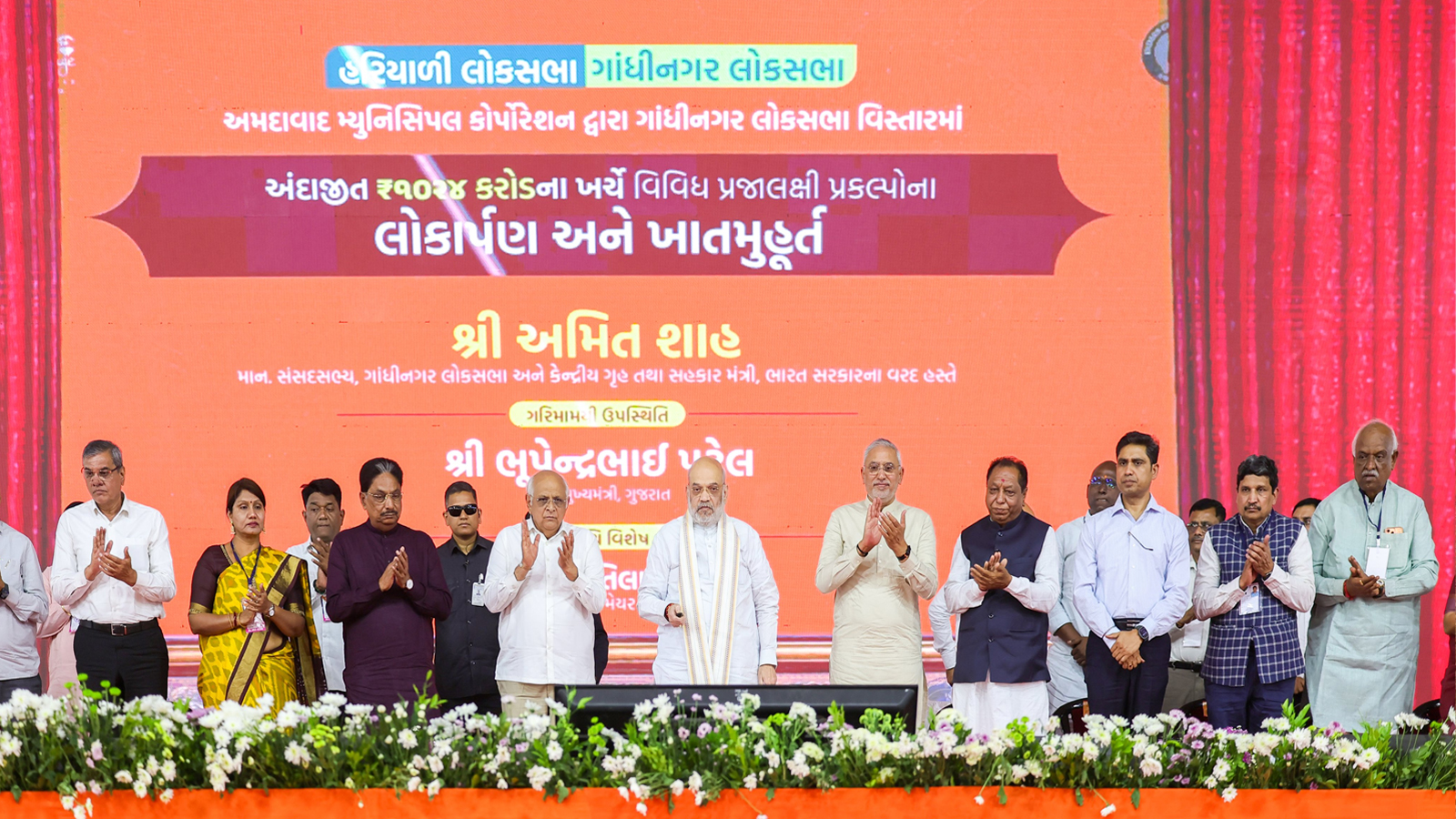
Union Home Minister Amit Shah on Monday inaugurated and laid the foundation stones for development projects worth approximately ₹1,400 crore in Ahmedabad, while calling for a collective effort to make Gujarat drug-free by December 31, 2028.
Gujarat Chief Minister Bhupendra Patel and other dignitaries were present at the event. Of the projects, works worth around ₹1,024 crore have been undertaken by the Ahmedabad Municipal Corporation (AMC), while projects worth approximately ₹400 crore have been completed or initiated with support from the Gujarat Government’s Roads and Buildings Department and the Government of India.
Addressing the gathering, HM Shah highlighted the pace of development in Gujarat under the leadership of Prime Minister Narendra Modi and Chief Minister Bhupendra Patel. He said the projects covered housing, education, water management and urban infrastructure.
Slum rehabilitation to benefit over 55,000 people
Highlighting the slum rehabilitation initiative in Ahmedabad, HM Shah said the housing scheme for people living in slums was launched by PM Modi in 2007 and was now being taken forward by the Gujarat Government.
He said residents of Ramapir No Tekro were being provided with permanent flats. Once the entire project is implemented, more than 55,000 people will have access to social security, recreational, educational and healthcare facilities within a single complex.
The Home Minister also referred to the initiative to rehabilitate nearly one lakh slum dwellers in Ahmedabad by providing permanent housing. He said the state government was successfully implementing the scheme.
Referring to the area’s transformation, HM Shah said that for decades, residents of Ramapir No Tekro had not received adequate attention despite voting for the Opposition party. He said the process of change began in 1995 with the election of the first councillor, and he was subsequently elected as the area’s MLA in 2012.
HM Shah urged residents to give priority to their children’s education. Referring to the inauguration of two primary schools, he said the AMC had transformed all primary schools in the area into smart schools. He added that schools across the Gandhinagar Lok Sabha constituency had also been upgraded through the respective Primary Education Committees.
Major push to urban infrastructure
The Home Minister said the foundation stone for a pump house had been laid to improve rainwater drainage in the Bopal-Ghuma area. He said he had been associated with the locality for nearly 30 years and had promised to establish a system before 2029 to prevent waterlogging.
Work on the four-kilometre-long ISKCON overbridge also commenced as part of the development initiatives. HM Shah said the project, expected to be completed within three years, would significantly reduce travel time between Sarkhej and Gandhinagar by providing a signal-free route. He recalled that the journey earlier took around two-and-a-half hours.
The Jalasapur Water Treatment Plant was also inaugurated during the programme.
HM Shah said development projects worth ₹25,000 crore had been completed in the Gandhinagar Lok Sabha constituency over the past seven years, including the initiatives being undertaken now. He reiterated his commitment to the vision of a “Green Gandhinagar, Developed Gandhinagar” constituency.
1033 helpline to report drug-related activities
HM Shah also outlined the government’s strategy to combat drug abuse and trafficking, urging citizens, teachers and parents to play an active role in making Gujarat drug-free.
Referring to a joint meeting held the previous Saturday between the Union Ministry of Home Affairs (MHA) and Gujarat’s Home Department, he said discussions had covered the implementation of the new criminal laws, modernisation of the Home Department and measures to tackle drug abuse.
The Home Minister urged citizens to report information about the sale or consumption of drugs through the 1033 helpline. He assured that the identity of informants would remain confidential and that strict action would be taken on complaints.
Describing drug abuse as a serious threat to the physical and mental health, concentration and future of young people, HM Shah said the government had set a target of making India drug-free by December 31, 2029, after working towards a Naxal-free country. He appealed to people to work towards achieving the target of a drug-free Gujarat a year earlier, by December 31, 2028.
He called upon teachers to arrange for testing and consult parents whenever they noticed unusual changes in a child’s behaviour. Parents and citizens were also urged to report drug-related activities in their neighbourhoods.
HM Shah said de-addiction centres were being established to help young people struggling with substance abuse. He stressed that there should be no shame or hesitation in seeking treatment and assured that the identities of those undergoing treatment would not be made public.
Three-hour response mechanism from December 1
Emphasising that the fight against drug abuse could not be carried out by the government alone, HM Shah said cooperation from citizens, teachers and parents was essential to achieve the goal of a drug-free Gujarat and India.
He announced that a dedicated control room would become operational from December 1, with a mechanism to ensure action within three hours of receiving information related to drugs. He said a scientific system had been developed for this purpose and arrangements were being made to ensure that key operators and kingpins involved in the drug trade were brought to justice.
HM Shah assured people that the government would not retreat from its campaign against drug trafficking and administered a pledge to local residents to actively contribute towards making Gujarat drug-free.
The Home Minister also extended his greetings to the people of Gujarat on Diwali and the Gujarati New Year, Bestu Varas, which begins on November 10.
(PIB)


