






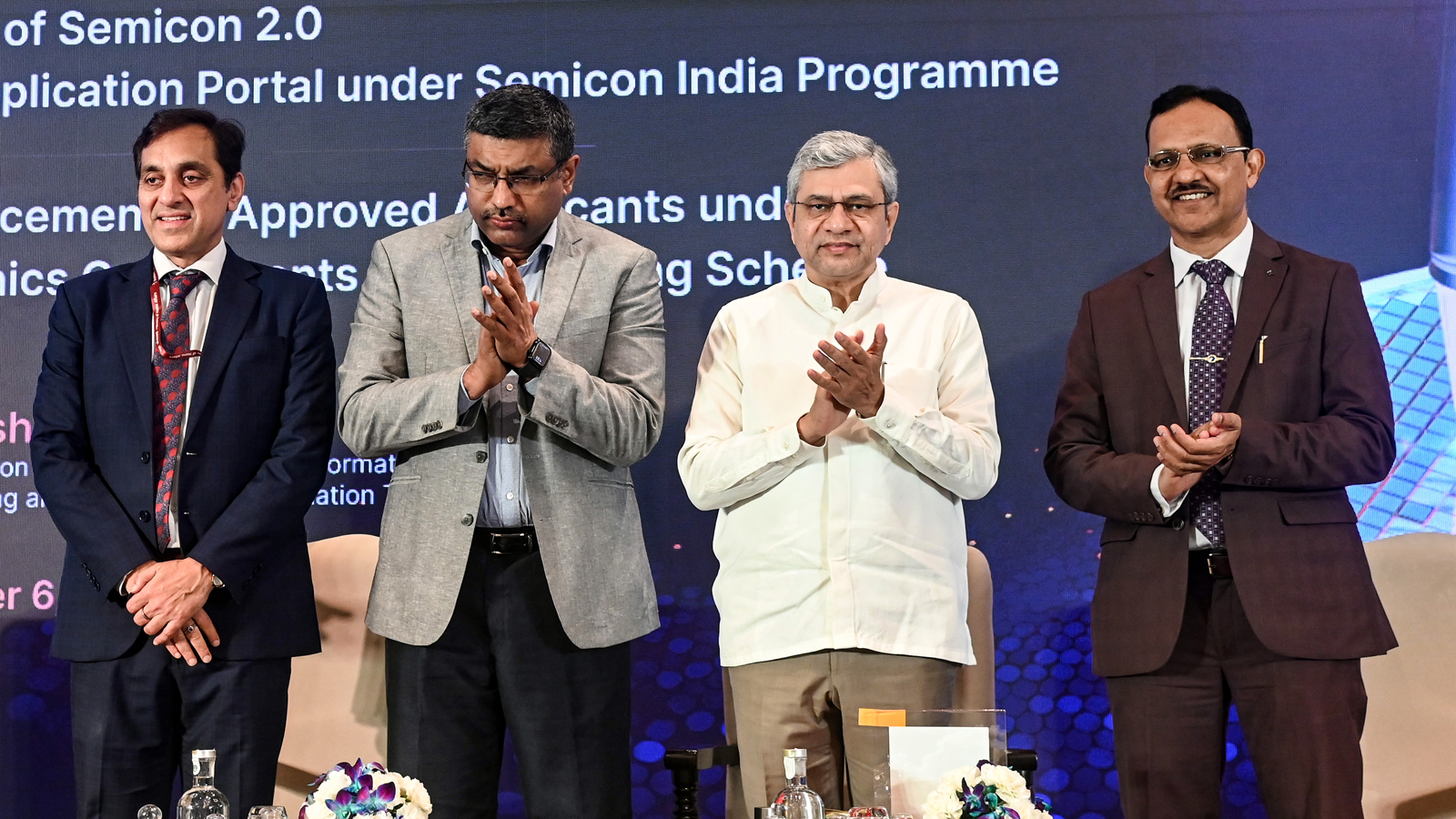
Union Minister for Electronics and Information Technology, Railways, and Information and Broadcasting Ashwini Vaishnaw on Friday launched the Semicon 2.0 web application portal for the second phase of the Semicon India Programme and announced 12 additional approvals under the Electronics Components Manufacturing Scheme (ECMS), involving a projected investment of ₹7,503 crore.
The newly approved projects are expected to generate production worth ₹39,045 crore and create 7,127 direct employment opportunities. The approvals cover 10 target-segment products across components, supply chain materials and capital goods, with projects spread across Gujarat, Karnataka, Madhya Pradesh, Maharashtra, Punjab, Tamil Nadu and Uttar Pradesh.
With the launch of the Semicon 2.0 portal, applications have opened for three of the programme’s six strategic pillars: machines and materials (Pillar 2), setting up additional semiconductor fabrication facilities (Pillar 3), and strengthening the assembly, testing, marking and packaging (ATMP) and outsourced semiconductor assembly and test (OSAT) industry (Pillar 4).
Semicon 2.0 to receive ₹1.27 lakh crore outlay
The Union Cabinet has approved Semicon 2.0 with a financial outlay of ₹1,27,500 crore under the India Semiconductor Mission (ISM). The programme marks the next phase of India’s efforts to build a robust and self-reliant semiconductor ecosystem.
Its six strategic pillars cover chip design, machines and materials, additional fabrication facilities, expansion of the ATMP/OSAT industry, research and development, and talent development.
Addressing the gathering, Vaishnaw said India’s electronics manufacturing sector had moved beyond assembly towards developing a comprehensive domestic value chain covering modules, components, materials and advanced technologies.
He highlighted the growing domestic capabilities in battery cells, copper foils, copper-clad laminates and high-end printed circuit boards. Government initiatives, he said, were strengthening domestic supply chains and creating opportunities for micro, small and medium enterprises (MSMEs), which account for nearly 50 per cent of the units approved under the scheme.
The minister said Semicon 2.0 would give particular attention to equipment, materials, chemicals and gases, with a target of attracting at least three major equipment manufacturers and five companies in chemicals and gases to India.
Emphasising the need for rigorous project selection, he said quality, technological depth, research and development, and global competitiveness must guide India’s semiconductor ambitions. He also called on industry stakeholders to collaborate, share expertise and pursue continuous improvement to establish India as a globally competitive electronics and semiconductor manufacturing hub.
12 new ECMS approvals cover 10 product segments
The latest approvals follow the earlier announcement of 106 applications involving investments of ₹69,548 crore. With the addition of 12 projects, the total number of approved applications under ECMS has reached 118, covering 34 products across 16 states.
The newly approved projects include four component categories: multi-layer printed circuit boards (PCBs), relays, heat sinks and specialty ceramics. Manufacturing approvals in these segments have been granted to NeST ICELR Private Limited, TDConnex (Chennai) Private Limited, Modern Automotives Limited and Voltix Semicon Private Limited, respectively.
Five supply-chain products have also received approval. Indo Asia Copper Limited will manufacture copper foil, an important input for copper-clad laminates used in PCBs and lithium-ion cells. TACC Limited has been approved for anode material for lithium-ion cells, while Vidyuta Materials Private Limited will manufacture cathode active material.
Enerfolie LLP has received approval for polypropylene film used in capacitor-grade dielectric applications, and Surface Modification Technologies Pvt. Ltd. will manufacture camera rims.
The approvals also cover capital goods and their parts, aimed at strengthening domestic manufacturing capabilities in equipment and factory automation. TDConnex (Chennai) Private Limited has been approved for precision moulds and tooling, Rockwell Automation India Private Limited for power and control systems for capital equipment, and Wipro Pari Robotics Private Limited for capital equipment used in factory automation and system integration.
The latest round includes the first approvals under ECMS for copper foil, cathode active material and specialty ceramics, expanding the range of upstream materials and components that will be manufactured domestically.
ECMS projects envisage ₹5.73 lakh crore production
With all 118 approved applications, ECMS now envisages a total investment of ₹77,051 crore, projected production worth ₹5,73,146 crore and direct employment for 81,755 people.
The government expects the projects to strengthen domestic supply chains, increase value addition, reduce import dependence and build advanced manufacturing capabilities, supporting India’s emergence as a global electronics manufacturing hub.
Semicon India Programme builds domestic capabilities
Vaishnaw said the India Semiconductor Mission had catalysed the growth of the country’s semiconductor ecosystem within a few years of its establishment.
Under the first phase of the Semicon India Programme, 12 projects were approved across six states, involving cumulative investments of more than ₹1.64 lakh crore. Of these, five projects had commenced commercial production as of October 2026.
The government has also supported the development of semiconductor design capabilities. As many as 105 startups have been provided access to electronic design automation (EDA) tools, 24 startups have received funding support and 15 have secured venture capital funding.
Under the Chips to Startup (C2S) Programme, 332 institutions have been provided EDA tools, while approximately 70,000 students have been trained.
Addressing the media, Vaishnaw said India had undergone a fundamental transformation over the past decade, but the development of its semiconductor and electronics industry was only beginning. He credited policy initiatives and coordinated efforts by the public and private sectors with laying the foundation for the sector’s growth and the vision of Atmanirbhar Bharat.
He also highlighted the country’s growing focus on manufacturing computers and their components domestically to reduce import dependence and build a stronger, self-reliant electronics value chain.
The launch of the Semicon 2.0 portal and the latest ECMS approvals mark a further push to expand India’s semiconductor manufacturing capacity, deepen domestic component production and strengthen its position in the global electronics supply chain.
(PIB)


