






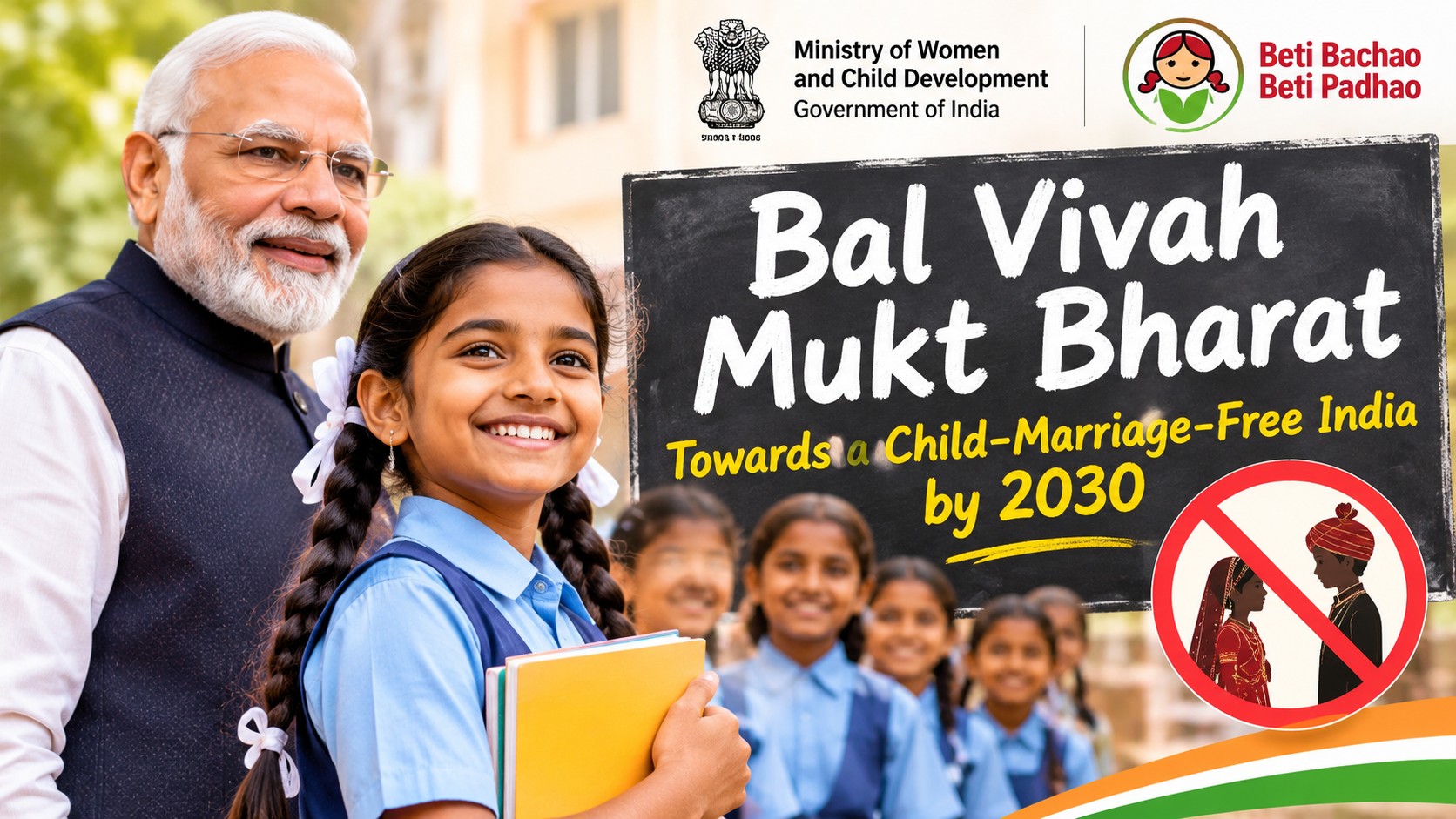
India’s journey towards becoming a developed nation is not limited to economic growth, infrastructure expansion or technological advancement. It also requires addressing deep-rooted social challenges that have restricted the progress of generations. Child marriage is one such challenge. Recognising that the empowerment of girls is fundamental to national development, the Central Government under Prime Minister Narendra Modi has placed considerable emphasis on social transformation through targeted policies, institutional reforms and public participation. The Bal Vivah Mukt Bharat campaign is an important reflection of this commitment.
Launched on November 27, 2024, by the Ministry of Women and Child Development, the campaign seeks to make India free from child marriage by 2030. It represents an approach to governance in which legislation, awareness and community participation work together to address a social problem. Rather than treating child marriage merely as a legal violation, the initiative recognises its wider consequences for girls’ health, education, dignity and economic independence.
The government’s approach builds upon the foundation of initiatives such as Beti Bachao Beti Padhao, launched in 2015. Over the years, this programme has sought to improve the survival, protection and education of the girl child while challenging discriminatory social attitudes. By connecting these objectives with the Bal Vivah Mukt Bharat campaign, the government has strengthened the link between women’s empowerment and the larger national development agenda.
One of the most significant aspects of the Modi government’s approach is its emphasis on taking policy implementation beyond government offices and bringing it directly to communities. The Bal Vivah Mukt Bharat campaign has mobilised educational institutions, local administrations, religious leaders, civil society organisations, Panchayati Raj institutions and ordinary citizens. This whole-of-government and whole-of-society approach acknowledges that social reform cannot be achieved through legislation alone, it requires a change in attitudes and collective responsibility.
The campaign’s reported achievements indicate the scale of this mobilisation. According to the Ministry of Women and Child Development, 6.85 lakh awareness programmes have been conducted, reaching 12.47 crore participants, while 42.01 lakh pledges have been registered. The campaign has also strengthened the institutional framework, with 71,882 Child Marriage Prohibition Officers reflected on its portal, including 59,686 designated at the Gram Panchayat level.
Another important feature is the use of technology to improve transparency, accessibility and accountability. The Bal Vivah Mukt Bharat portal enables citizens to access information about Child Marriage Prohibition Officers, report incidents and participate in the national pledge initiative. Such digital interventions demonstrate how technology can be used not only for administrative efficiency but also for addressing social concerns and encouraging citizen participation.
The progress reflected in national data is encouraging. According to NFHS-6 (2023-24), the proportion of women aged 20-24 who were married before the age of 18 has declined to 20.1 percent from 23.3 percent recorded in NFHS-5 (2019-21). Although this reduction is significant, the remaining prevalence underlines the need for sustained intervention. The government has also identified 257 high-burden districts for focused attention, recognising that social challenges require region-specific strategies.
What makes these initiatives particularly relevant is their connection with the broader vision of inclusive development articulated by Prime Minister Narendra Modi. A nation cannot realise its full potential when a section of its young population is denied opportunities for education, personal growth and independent decision-making. Ensuring that girls remain in schools, acquire skills and participate in the economy is not simply a matter of social welfare, it is an investment in India’s human capital.
At the same time, the responsibility cannot rest with the government alone. Families, communities, educational institutions and local leaders must become active partners in changing social attitudes. Effective implementation of the law, timely intervention by authorities and continued awareness are essential to ensure that progress reaches every village and household.
The Bal Vivah Mukt Bharat campaign illustrates an important dimension of the government’s development philosophy, which is- national progress must be accompanied by social reform. The journey towards a child marriage-free India will require consistency, accountability and collective commitment. By combining policy intervention with grassroots mobilisation, the central government has established an important framework for addressing this challenge.
A developed India must also be an India where every girl has the freedom to learn, grow, make informed choices and shape her future. Ensuring that childhood is protected and opportunities remain open is not merely a government objective, it is a national responsibility. The success of this mission will ultimately be measured not only in statistics but in the lives and opportunities secured for millions of young girls.


