







The Bureau of Indian Standards (BIS) has strengthened consumer protection in the precious metals market through its hallmarking system, which enables buyers to verify the purity and authenticity of gold and silver jewellery.
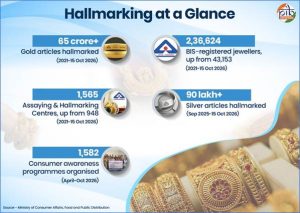
Since the introduction of mandatory gold hallmarking in June 2021, more than 65 crore gold articles have received Hallmark Unique Identification (HUID) numbers as of October 15, 2026. The number of BIS-registered operative jewellers has also increased from 43,153 to 2,36,624 during this period.
Hallmarking certifies the purity of precious metal articles against prescribed standards, helping consumers make informed purchasing decisions and reducing the risk of misrepresentation.
Gold is widely regarded in Indian households as both a valuable possession and a store of wealth. However, since pure gold is relatively soft, it is mixed with other metals to make jewellery durable. This process can also create scope for adulteration and incorrect claims about purity, making independent verification important.
Expansion of the Hallmarking Framework
The voluntary hallmarking scheme was launched in 2000, with BIS designated as the sole agency responsible for implementing it in India. The hallmarking scheme for silver articles was introduced in 2005.
Mandatory hallmarking of gold jewellery came into effect on June 23, 2021, initially covering 256 districts. Its coverage has since expanded to 392 districts, supported by an increase in the number of recognised Assaying and Hallmarking Centres (AHCs), from 948 to 1,565.
Gold hallmarking covers seven grades of purity — 9K, 14K, 18K, 20K, 22K, 23K and 24KS — under the prescribed Indian Standard IS 1417.
Silver hallmarking, meanwhile, remains voluntary. However, all silver articles hallmarked under the BIS scheme must carry an HUID code from September 1, 2025. More than 90 lakh silver articles have received HUID-based marking. The revised IS 2112:2025 standard provides for eight grades of silver purity, ranging from 800 to 999 fineness.
Three Marks Consumers Should Check
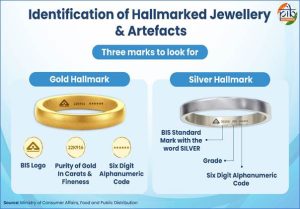
Consumers purchasing hallmarked jewellery should look for three key markings: the BIS Standard Mark, the purity or fineness mark, and the six-digit alphanumeric HUID code.
For gold jewellery, the purity mark indicates its caratage and fineness, such as 22K916. For silver, the mark indicates its fineness, such as 925. The HUID provides a unique identification number for each hallmarked article, enabling digital traceability.
How the Hallmarking Process Works
The process begins with jewellers registering with BIS. They can apply online through the National Single Window System or the BIS Manak Online portal. Registration is free of charge and remains valid for a lifetime.
Registered jewellers submit their jewellery to BIS-recognised Assaying and Hallmarking Centres, where the weight and purity of each article are assessed using prescribed equipment and procedures.
Following testing, the BIS server generates a unique HUID for each article. The HUID, along with the BIS Standard Mark and applicable purity mark, is then laser-marked on the jewellery.
The process has also been strengthened through digital integration. Since September 2024, X-ray fluorescence machines have been integrated with the BIS system through an application programming interface to reduce the possibility of manual data entry. Weighing systems also capture readings directly.
Since June 8, 2026, AHCs have been required to upload photographs of jewellery articles, their hallmarks and their weights directly to the Manak Online portal, further strengthening traceability.
Digital Verification Through BIS CARE App
Consumers can independently verify hallmarked gold and silver jewellery through the BIS CARE App by entering the HUID number.
The app provides details such as the article’s purity, product type, jeweller and the Assaying and Hallmarking Centre where it was tested. Following digital upgrades introduced on June 8, 2026, consumers can also access photographs of the article and its hallmark, along with its automatically recorded weight.
This enables buyers to compare the physical jewellery with the details available in the BIS database before completing a purchase. The app is available free of charge on Android and iOS and supports 12 languages.
Surveillance and Consumer Awareness
Alongside digital monitoring, BIS conducts physical surveillance and regulatory checks to ensure compliance with prescribed standards. These include random sampling of hallmarked articles from jewellery outlets, surveillance audits of AHCs and enforcement action against violations.
During 2025-26, more than 30 enforcement activities were conducted against jewellers for violations related to hallmarking.
BIS has also organised consumer awareness programmes to familiarise buyers with hallmarking standards and verification procedures. Between April 1 and October 31, 2026, its Regional and Branch Offices conducted 1,582 consumer awareness programmes across the country.
Through wider coverage, digital traceability and regulatory oversight, the hallmarking framework seeks to improve transparency and accountability in the precious metals market, while helping consumers make informed choices when purchasing jewellery.


