






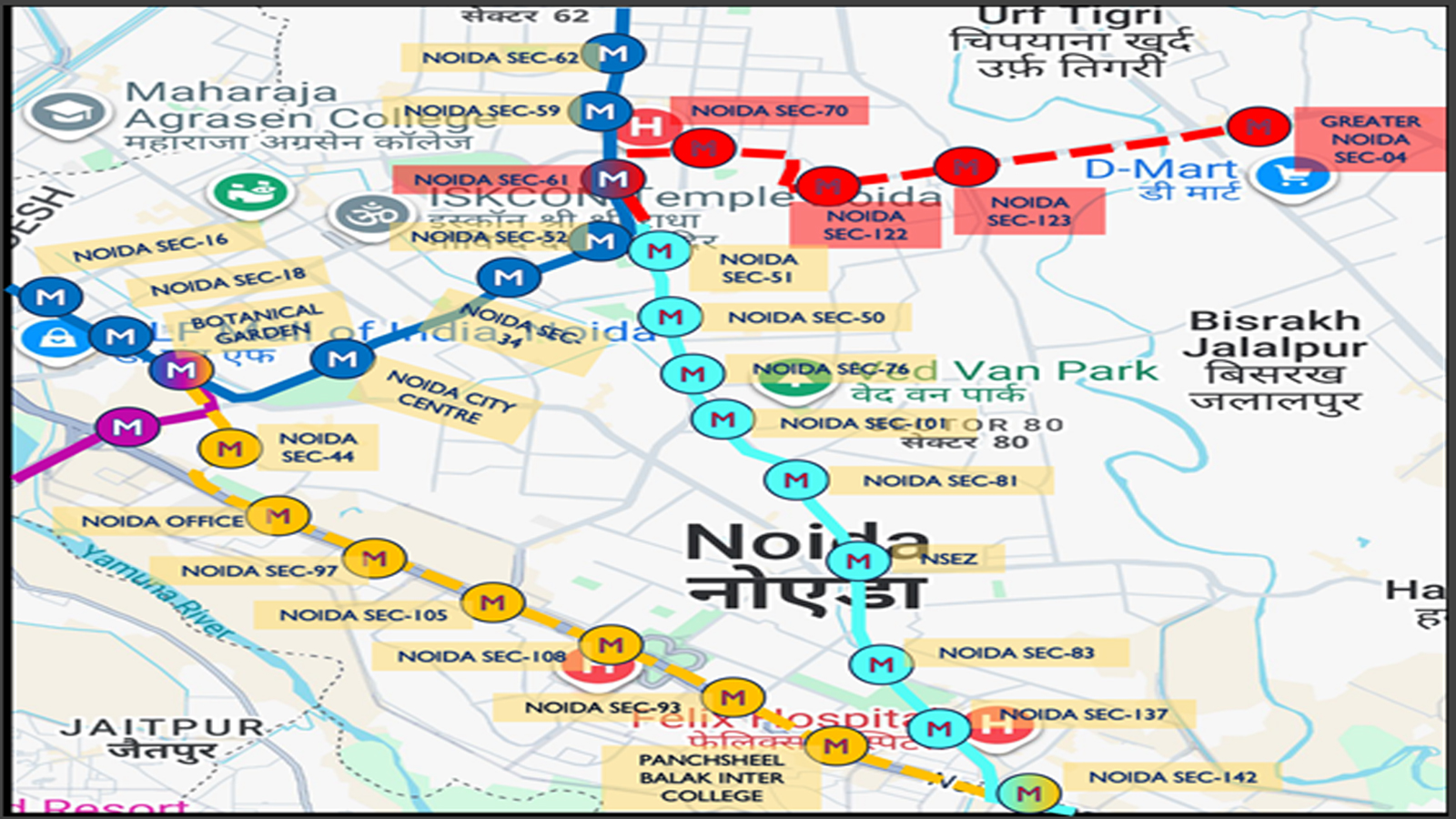
The Union Cabinet, chaired by Prime Minister Narendra Modi, has approved the extension of the Aqua Line Metro corridor from Noida Sector 51 to Greater Noida Sector 4. The 8.449-km extension will comprise five elevated stations and form part of the Noida Metro Rail Project.
Once operational, the new corridor will take the total active Metro rail network in Noida and Greater Noida to 71.878 km. The project is expected to strengthen public transport connectivity between the two cities and improve access to major residential, commercial, institutional and employment centres.
A key feature of the extension will be improved interchange connectivity with the Delhi Metro Blue Line at Noida Sector 61. This will provide commuters with better access to wider transport networks and important destinations across the National Capital Region.
The corridor is expected to connect several commercial and retail destinations, including Gaur City Mall, H&S Mall and office spaces, Blue Sapphire Mall, commercial establishments in Greater Noida Sector 4, IKEA near Noida Sector 51 and Anthurium Mall in Sector 73.
It will also improve access to major corporate and technology hubs, including the Tech Mahindra and TCL Tech offices in Noida Sector 60, the Oil Industry Development Board in Sector 73 and Golden I office and commercial space in Greater Noida Sector 4.
Educational institutions such as Delhi Public School in Noida Sector 122, along with healthcare facilities including Kailash Hospital, Rama Hospital in Sectors 70 and 62, and Cloud9 Hospital in Sector 51, are among the key destinations expected to benefit from improved Metro connectivity.
Residents of major housing clusters, including Cleo County in Noida Sector 122 and Gaur City 1 and 2 in Greater Noida Sector 4, are also expected to gain from the extension.
Improving urban mobility and reducing congestion
The new corridor is expected to provide commuters with an alternative to road-based transport, helping reduce pressure on existing roads and ease traffic congestion. A shift towards Metro travel could also contribute to shorter travel times, smoother road movement and improved road safety.
The expansion is expected to deliver environmental benefits by encouraging the use of public transport and reducing dependence on fossil-fuel-based private vehicles, thereby helping lower transport-related carbon emissions.
Improved connectivity to workplaces, commercial centres and transport hubs is also expected to support economic activity and productivity. Easier access to different parts of Noida and Greater Noida, as well as onward connections to Delhi’s airport, railway stations and bus depots, will benefit daily commuters and business travellers.
The project is also expected to encourage investment and development around the new stations, particularly in areas where public transport connectivity has so far been limited. Better access to employment, education and essential services will further benefit residents across different socio-economic groups.
The Aqua Line extension is a significant addition to the urban transport infrastructure of Noida and Greater Noida. By connecting key residential and economic centres and strengthening integration with the wider Metro network, the project is expected to support more efficient, accessible and sustainable urban mobility in the region.
(PIB)


