






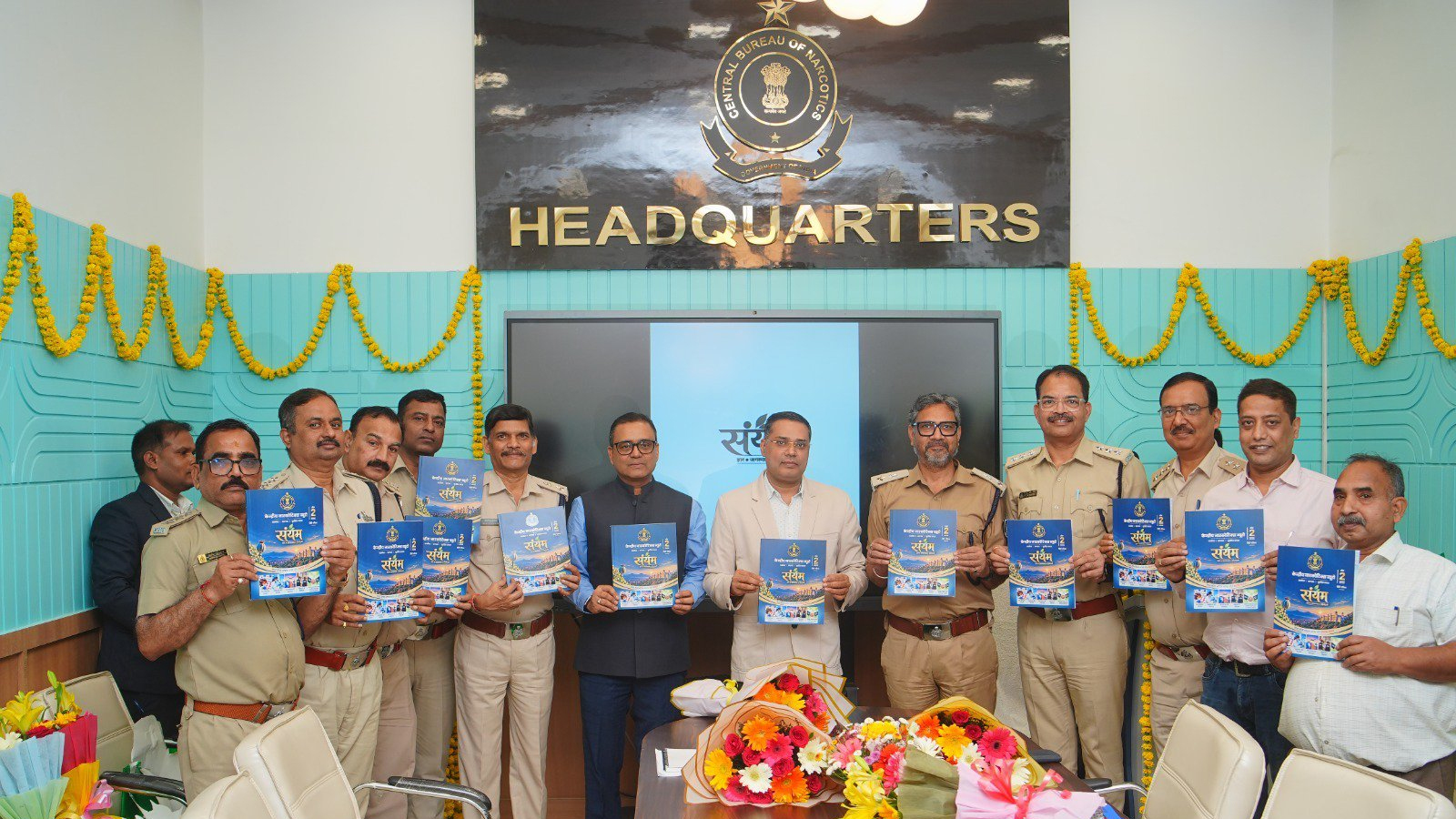
The Central Bureau of Narcotics (CBN) on Friday celebrated its 77th Foundation Day at its headquarters in Gwalior, Madhya Pradesh, reaffirming its commitment to combating drug trafficking and advancing the vision of a “Drug-Free Youth for a Developed India” through stronger enforcement, digital governance and community outreach.
Officers and staff participated in the celebrations, during which the Bureau also unveiled the second edition of its Hindi magazine, Sanyam 2.0.
Established on November 6, 1950, the CBN is one of India’s oldest drug law enforcement agencies under the Department of Revenue, Ministry of Finance. Its responsibilities include regulating the licit cultivation of opium poppy, overseeing the import and export of narcotic drugs, psychotropic substances and precursor chemicals, and conducting intelligence-led operations against trafficking under the Narcotic Drugs and Psychotropic Substances (NDPS) Act, 1985.
Originally set up to bring regional opium administrations under a unified structure, the Bureau has evolved into a national regulatory and enforcement agency. It also serves as India’s Competent National Authority under relevant United Nations conventions.
More than 1,000 cases registered in anti-trafficking operations
The CBN said its specialised Preventive and Intelligence (P&I) Cells registered more than 1,000 cases and arrested 1,325 people between 2022 and October 2026 as part of an intensified campaign against drug trafficking and transnational synthetic drug networks.
One of its major operations during this period was the seizure of 12 crore Tramadol Hydrochloride tablets, weighing approximately 100 metric tonnes, in Delhi in July 2026. The Bureau described the operation as a major breakthrough against an international pharmaceutical smuggling network.
The agency also reported the destruction or incineration of 342 metric tonnes of seized narcotic drugs, psychotropic substances and controlled substances. In addition, 2,535 kg of high-purity raw opium seized from illegal channels was transferred to the Government Opium and Alkaloid Works facility in Neemuch for recovery of medicinal alkaloids.
Over 1.11 lakh acres of illicit cultivation destroyed
The CBN has intensified action against illegal drug cultivation, targeting illicit opium poppy and cannabis crops at their source. Between 2022 and October 2026, it mapped and destroyed more than 1,11,300 acres of illegal cultivation across high-risk states, including Himachal Pradesh, Arunachal Pradesh, Manipur and Uttarakhand.
Under Operation Parivartan in Himachal Pradesh, CBN teams conducted operations in the high-altitude terrain of Kullu district, reaching elevations of up to 3,500 metres. The operation resulted in the manual uprooting of 2,070 hectares, or approximately 5,165 acres, of illicit cannabis cultivation, using ground teams, drone technology and mapping tools.
In Arunachal Pradesh, the Bureau worked with forest and paramilitary forces to identify and destroy 3,600 hectares, equivalent to around 8,896 acres, of illegal opium poppy cultivation during the crop’s flowering season.
Alongside enforcement, the CBN has promoted alternative livelihood opportunities for farmers involved in illicit cultivation. Through public dialogues under its Jan Samvad initiative in villages such as Malana, the agency has encouraged a transition towards legal and sustainable activities, including apiculture, dairy farming, animal husbandry and eco-tourism.
Mission Yuva Raksha reaches over 20,000 participants
The Bureau has also expanded its preventive and community-based initiatives through its flagship Mission Yuva Raksha, aimed at protecting young people from substance abuse and drug trafficking networks.
During 2026, CBN outreach programmes and Mission Yuva Raksha activities reached more than 20,000 participants across Madhya Pradesh, Rajasthan, Uttar Pradesh and Delhi.
As part of its efforts to strengthen values-based preventive education and counselling, the CBN signed a memorandum of understanding with Prajapita Brahma Kumaris Ishwariya Vishwa Vidyalaya at Mount Abu, Rajasthan, on September 18, 2026. The partnership aims to extend awareness and community counselling initiatives in vulnerable areas.
The Bureau is also working with communities in traditional poppy-growing regions through rural public grievance platforms known as Jan Sunwai, seeking to protect farming families and young people from illicit trafficking networks.
Digital systems streamline import and export clearances
The CBN has moved towards an automated, single-window digital system to improve regulatory efficiency and ease of doing business. Its licensing, permit, certificate and other document services have been integrated with the centralised ICEGATE SWIFT 2.0 portal.
Through this system, the Bureau processes more than 15,000 import and export applications annually, facilitating trade while maintaining oversight of controlled substances and pharmaceutical supply chains.
To strengthen coordination with the chemicals and pharmaceutical industries, it has also signed memorandums of understanding with the Indian Chemical Council in 2022, CHEMEXCIL on April 28, 2025, and PHARMEXCIL on August 24, 2026.
Focus on technology to tackle emerging drug threats
Outlining its future priorities, the CBN said it was developing a technology-driven framework to anticipate and counter emerging narcotics threats, including New Psychoactive Substances (NPS).
Its proposed initiatives include deploying advanced tools to track illicit crop cultivation, establishing a dedicated Chemical Management Division to monitor high-risk non-scheduled industrial chemicals, and expanding alternative livelihood programmes across the country.
The Bureau said its broader approach would combine strict enforcement with preventive education, community participation and secure supply chains, guided by the objectives of “Drugs Out, Dreams In”, “Safe Supply Chain from Farm to Pharmacy” and “Drug-Free Youth for a Developed India”.
(PIB)


