






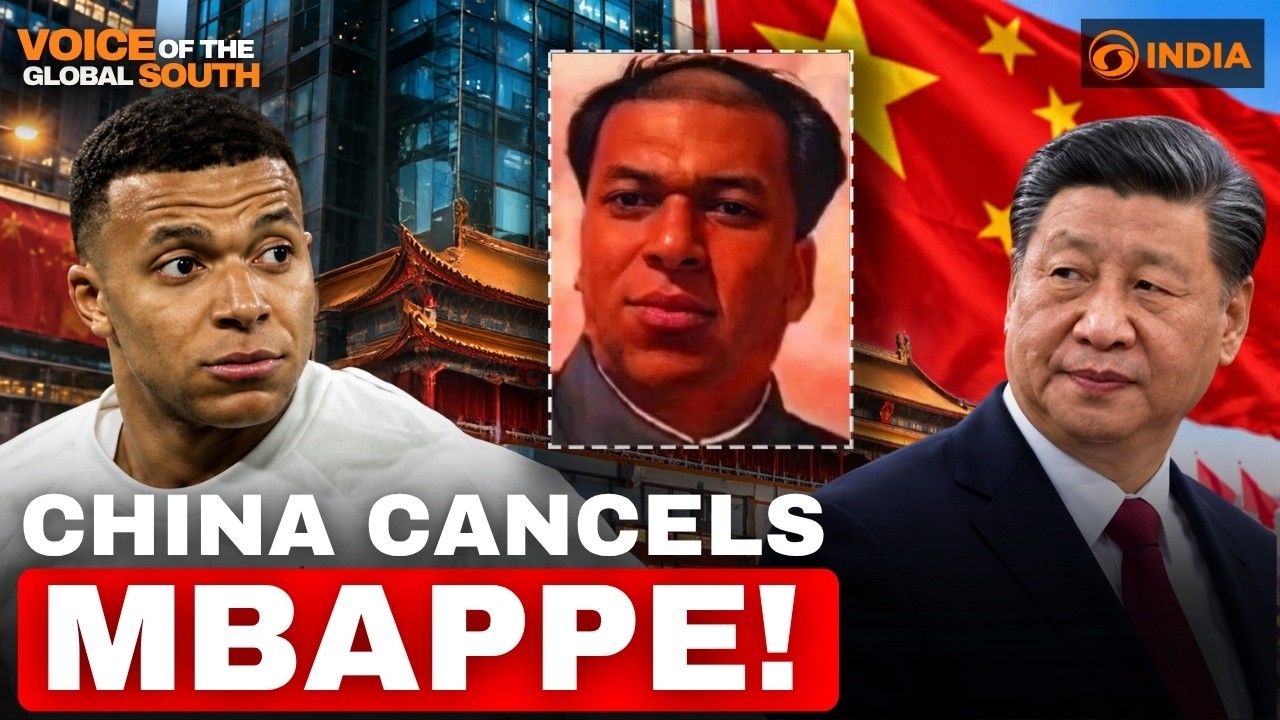
French football superstar Kylian Mbappe is facing a fierce corporate and public backlash in China after a casual comment about an internet meme ignited a massive commercial crisis. The controversy has triggered a wave of terminated sponsorships, digital censorship and severe broadcasting suspensions, highlighting the immense influence of the Chinese market over global sports and the high price icons pay when they cross Beijing’s political red lines.
The controversy stems from a resurfaced video clip from the French football talk show The Bridge. Filmed in April but trending rapidly in October, the footage shows the Real Madrid striker sitting in a makeup chair discussing his favourite online memes. Mbappe laughed as he pointed to a popular meme featuring his own face superimposed onto the historical image of former Chinese leader Mao Zedong. While Mbappe did not state Mao’s name, he referred to him directly as “some guy … a Chinese dictator”.
The reaction across Chinese social media was instantaneous. Users accused the superstar of disrespecting the country while simultaneously profiting from its massive fanbase.
The financial fallout for Mbappe was immediate. Major Chinese brands moved quickly to sever ties, ripping down promotional materials and ending high-profile endorsements. Major companies walking away from the star include:
— Dongpeng: The Chinese energy drink giant ended its partnership
— Mengniu: The massive dairy producer terminated its contract
— Shanghai Milkground: The prominent cheesemaker dropped the player immediately
— Dongpeng: The Chinese energy drink giant ended its partnership
— Mengniu: The massive dairy producer terminated its contract
— Shanghai Milkground: The prominent cheesemaker dropped the player immediately
Global luxury brands are also distancing themselves from the player to protect their standing in the region. Fashion house Dior and luxury watchmaker Hublot have systematically scrubbed Mbappe from their Chinese social media pages. Additionally, Mbappe’s personal verification and accounts on domestic platforms such as Weibo and Xiaohongshu have faced heavy restrictions.
The controversy caught the attention of the Chinese Government. Foreign Ministry Spokesperson Guo Jiakun issued a firm warning during a press briefing, saying: “We have noted the relevant reports. Acts and remarks that hurt Chinese people’s sentiment will naturally be resisted by all sectors of Chinese society.”
Local sentiment reflects this stance. Speaking to journalists, Zhang Jianqi, a Beijing resident, said, “Expressing views that are unsupportive of China or otherwise objectionable, I definitely cannot support them. I used to really enjoy watching Mbappe play on the pitch, but ever since this news broke … personally I didn’t like it very much.”
To understand the scale of this reaction, one must look at Mao Zedong’s complex legacy. While his radical policies like the Great Leap Forward and the Cultural Revolution are highly controversial globally, within China, Mao is fiercely protected as the sacred architect of the People’s Republic founded in 1949. His image is directly tied to national identity and the legitimacy of the ruling party. Consequently, mocking Mao is not perceived as a simple joke but as a direct insult to the State.
An aggressive containment strategy was launched almost immediately to mitigate the financial damage:
— Mbappe issued a formal apology, characterising his remarks as “ill-judged”
— Real Madrid released statements expressing deep, structural respect for Chinese history
— La Liga’s President travelled to meet with China’s ambassador to Spain to salvage League relations
— Mbappe issued a formal apology, characterising his remarks as “ill-judged”
— Real Madrid released statements expressing deep, structural respect for Chinese history
— La Liga’s President travelled to meet with China’s ambassador to Spain to salvage League relations
Despite these efforts, the broader commercial damage was already locked in. China Media Group suspended all La Liga broadcasts nationwide, and the streaming platform Migu abruptly pulled Real Madrid’s latest match against Racing Santander off the air.
This crisis mirrors past high-stakes standoffs between international sports figures and Beijing’s geopolitical boundaries:
— 2019 (The N.B.A.): In the U.S., the National Basketball Association faced an multi-million dollar television blackout after a Houston Rockets executive tweeted support for Hong Kong’s pro-democracy protests
— 2019 (Arsenal F.C.): Midfielder Mesut Ozil criticized China’s treatment of Uyghur Muslims, causing State broadcasters to instantly pull Arsenal matches from scheduled programming
With millions of dollars on the line across European football broadcasting, merchandise sales and corporate sponsorships, a prolonged boycott could devastate revenues for both Real Madrid and Spanish football at large. The escalating crisis serves as a stark reminder to global athletes: In an interconnected financial world, crossing China’s political red lines comes with an astronomical price tag.
Ramesh Ramachandran is a senior consulting editor with D.D. India


