






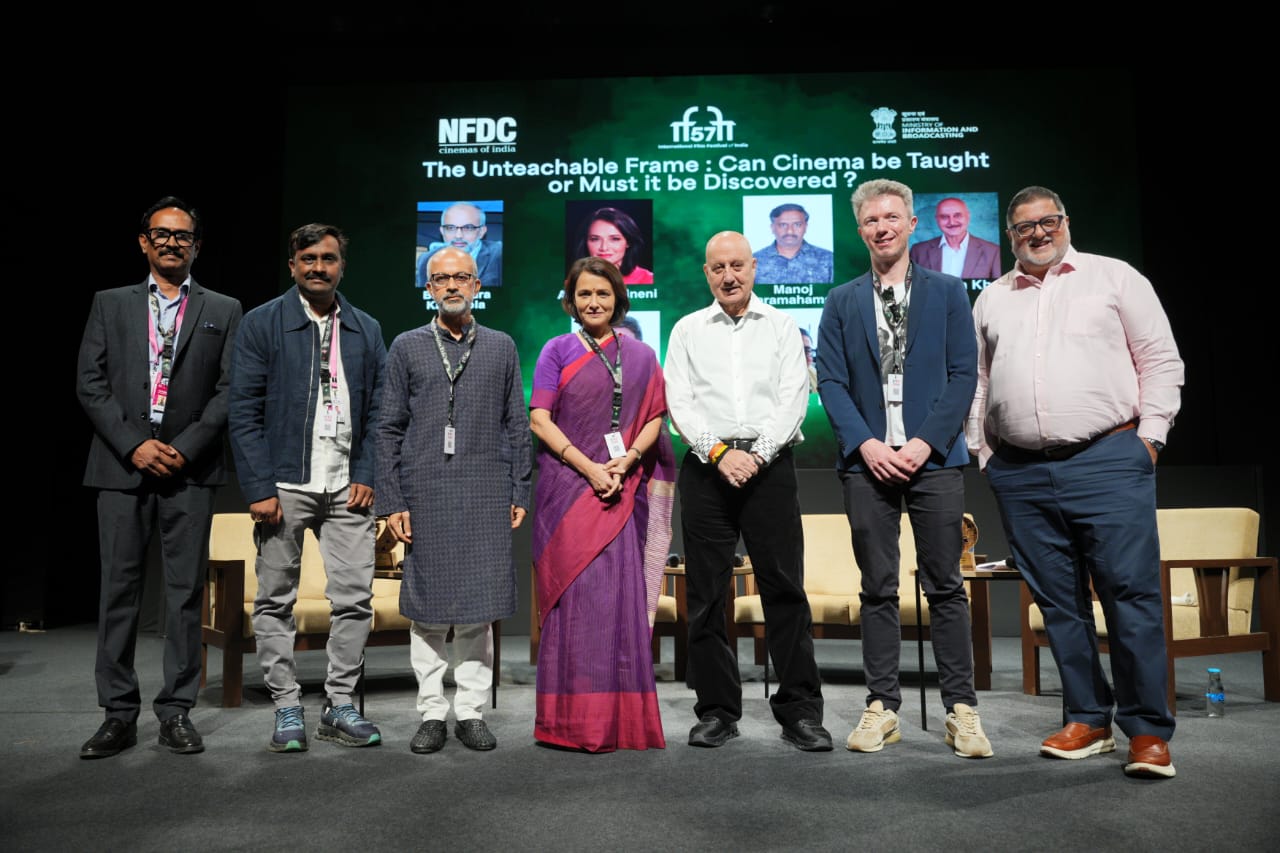
Film industry veterans on Sunday debated whether filmmaking can be taught or must be discovered, highlighting the role of formal education, practical experience and creative experimentation in nurturing aspiring filmmakers at the 57th International Film Festival of India (IFFI) in Goa.
The panel discussion, titled ‘The Unteachable Frame: Can Cinema Be Taught or Must It Be Discovered?’, featured actor Anupam Kher, actor and director Amala Akkineni, Warsaw Film School’s Artur Daborski, former Film and Television Institute of India (FTII) director Bhupendra Kainthola and cinematographer Manoj Paramahamsa. It was moderated by Vikramjit Roy, a former executive at Sony Pictures India and the National Film Development Corporation (NFDC).
Kher credited his training at the National School of Drama (NSD) with shaping his acting career, recalling how it helped him take on the role of a 65-year-old man in his debut film Saaransh at the age of 28.
” I would not have been sitting here had I not gone to National School of Drama,” Kher said, stressing the importance of observation, imagination and emotional memory in an actor’s craft.
He encouraged aspiring actors to draw from everyday experiences and continuously refine their skills, cautioning that competence can sometimes prevent artists from pursuing excellence.
Kainthola stressed the distinction between artistic instinct and technical knowledge, saying, “Art can be discovered, but craft has to be taught.”
He said formal training, discipline and professional processes help translate creative ideas into films, adding that institutions such as FTII have a responsibility to nurture students pursuing unconventional career paths.
Akkineni highlighted the collaborative nature of filmmaking, saying film schools help students understand how different disciplines work together. She also urged educators to challenge stereotypes and encourage more women to pursue professional filmmaking education.
Daborski, who is associated with Warsaw Film School and international film festivals, said aspiring filmmakers need regular practice, exposure to global cinema and opportunities to experiment in a supportive environment.
He said film festivals help students understand diverse cinematic traditions, while film schools should also prepare them for the business side of filmmaking, including pitching projects, securing funding and navigating the industry.
Paramahamsa said film schools provide a structured environment to learn technical fundamentals, teamwork and production management, skills that are difficult to develop fully on professional sets where time and resources are limited.
The panel also discussed the growing use of artificial intelligence (AI) in filmmaking, with Paramahamsa noting its role in streamlining repetitive tasks, storyboard development and visual production workflows.
Kher, however, stressed that human emotion remains central to acting and creative expression, arguing that technology cannot replace the emotional depth performers bring to their work.
The 57th IFFI is being held in Goa from Nov 20 to 28, bringing together filmmakers, industry professionals and cinema enthusiasts for screenings, discussions and masterclasses.
(PIB)


