






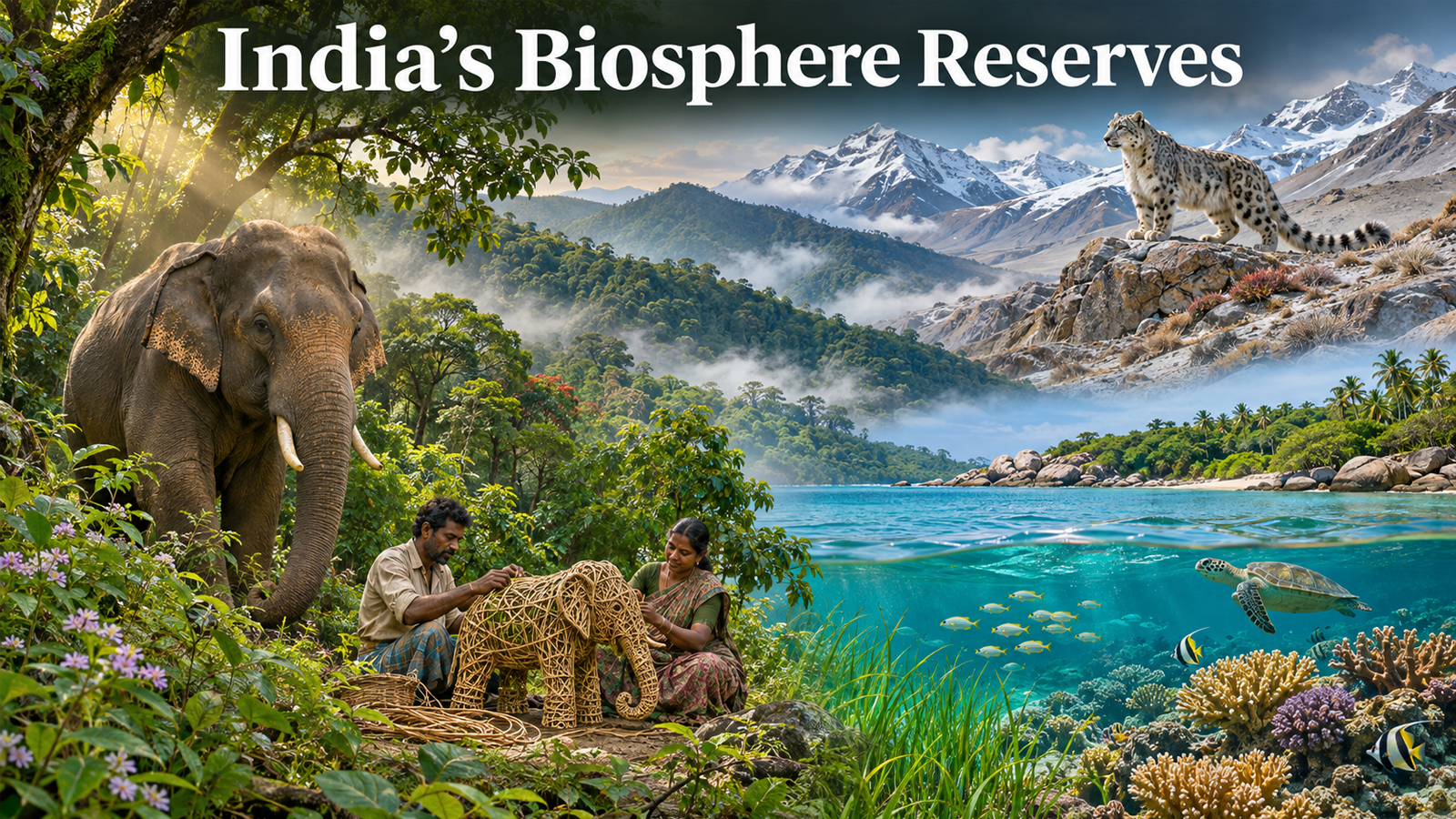
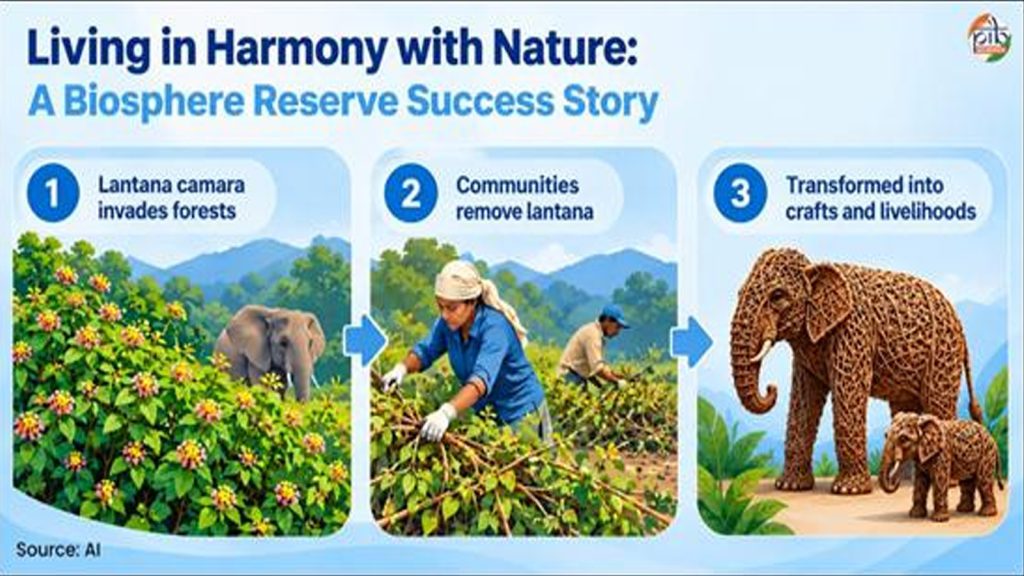
In the Nilgiri Biosphere Reserve, an invasive shrub is finding a second life as elephant sculptures, furniture and handicrafts. Indigenous artisans use uprooted Lantana vines to create objects that support livelihoods while drawing attention to the damage the plant causes to forests.
In 2021, 125 life-sized Lantana elephants were displayed in London, carrying a message of coexistence with wildlife. Similar sculptures have appeared at Bengaluru Airport, across Bengaluru and at Rashtrapati Bhavan.
The initiative illustrates the idea at the heart of biosphere reserves: protecting nature while creating opportunities for the people who depend on it.
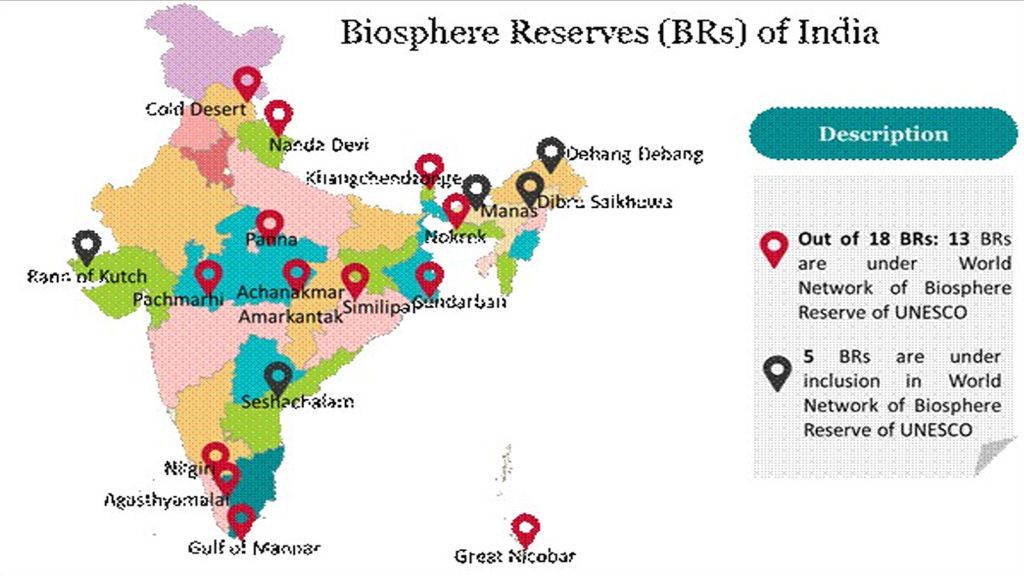
As the International Day for Biosphere Reserves is observed on November 3, India’s network of 18 notified reserves demonstrates how conservation, scientific research and sustainable livelihoods can work together. Thirteen of these reserves belong to UNESCO’s World Network of Biosphere Reserves, the highest number in South Asia.
The landscapes range from the forests of the Western Ghats and the mangroves of the Sundarbans to the coral reefs of the Gulf of Mannar and the high-altitude Cold Desert of Himachal Pradesh.
Conservation beyond protected boundaries
India is one of the world’s 17 mega-biodiverse countries. Despite occupying only 2.4 per cent of Earth’s land area, it accounts for approximately 7–8 per cent of recorded species worldwide.
Protecting this diversity requires attention to habitats, species and genetic variation, alongside the needs of communities that rely on natural resources.
Biosphere reserves provide a framework for bringing these objectives together. While national parks and wildlife sanctuaries primarily protect wildlife and habitats under India’s wildlife protection laws, biosphere reserves take a broader approach, connecting protected ecosystems with surrounding settlements and economic activities.
UNESCO’s Man and the Biosphere Programme, launched in 1971, promotes scientific approaches to improving relationships between people and their environment. Biosphere reserves serve as living laboratories where sustainable development practices can be tested and demonstrated.
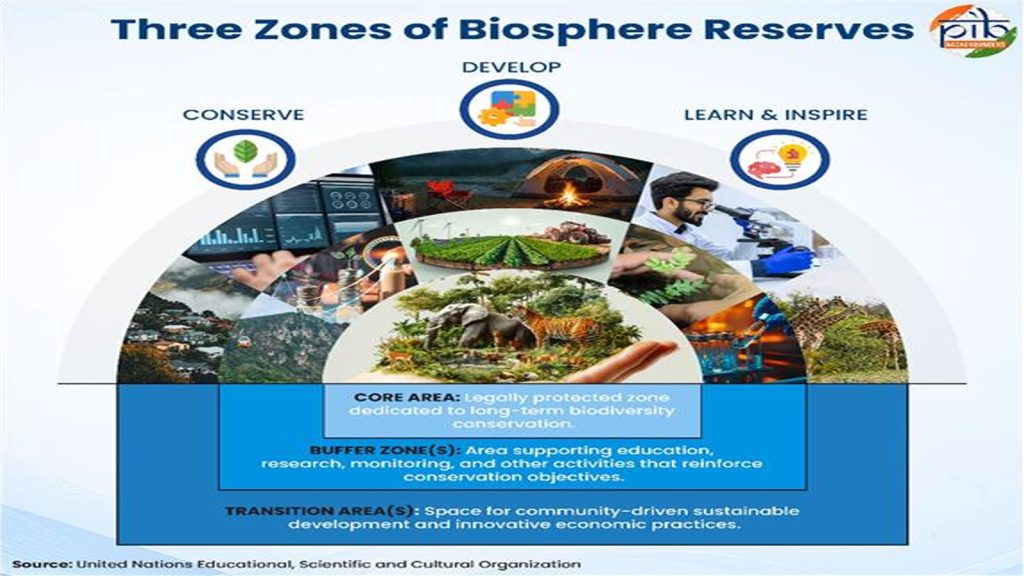
Their work combines three functions: conserving biodiversity and landscapes, supporting environmentally responsible economic development, and advancing research, monitoring, education and training.
Three zones, connected purposes
A biosphere reserve’s structure reflects this balance. Its core area provides the highest level of protection, conserving habitats, species and genetic resources. Human activity is strictly limited, with compatible research and monitoring supporting conservation.
The surrounding or adjoining buffer zone accommodates activities such as environmental education, scientific research and regulated ecotourism. These help build ecological understanding while reducing pressure on the core.
The transition area supports settlements and livelihoods, including responsible agriculture, sustainable forestry and locally appropriate tourism.
Globally, core areas account for an average of 18 per cent of biosphere reserves, buffer zones for 30 per cent and transition areas for 52 per cent. The distribution underlines the importance of inhabited, working landscapes within the conservation model.
A network spanning India’s ecological diversity
Nilgiri, designated in 1986, was India’s first biosphere reserve. It entered UNESCO’s World Network in 2000.
Spread across 5,520 square kilometres in Tamil Nadu, Kerala and Karnataka, the reserve includes tropical evergreen forests, montane shola forests and grasslands. Its wildlife includes the endangered lion-tailed macaque and Nilgiri tahr, as well as elephants, tigers, gaur, sambar and chital. The landscape supports more than 100 mammal species and 550 bird species.
At a different ecological extreme, Himachal Pradesh’s Cold Desert Biosphere Reserve covers 7,770 square kilometres at elevations between 3,300 and 6,600 metres. Included in UNESCO’s network in 2025, it supports snow leopards, Himalayan ibex and blue sheep, alongside 732 vascular plant species, including 30 endemics.
Around 12,000 people live in this demanding environment. Their livelihoods draw on pastoralism, yak and goat herding, barley and pea cultivation, and Tibetan herbal medicine.
Off Tamil Nadu’s southeastern coast, the Gulf of Mannar Biosphere Reserve brings together coral reefs, seagrass beds and mangroves across approximately 10,500 square kilometres. These linked ecosystems support 4,223 plant and animal species. The reserve sustains around 25 lakh people across a region that includes approximately 47 coastal villages.
The other Indian reserves recognised by UNESCO are Nanda Devi, Nokrek, Sundarbans, Great Nicobar, Similipal, Pachmarhi, Khangchendzonga, Agasthyamalai, Achanakmar-Amarkantak and Panna.
Manas, Dibru-Saikhowa, Dehang-Dibang, Great Rann of Kutch and Seshachalam complete India’s nationally notified network.
Supporting conservation on the ground
The Ministry of Environment, Forest and Climate Change supports reserve management through the centrally sponsored Biodiversity Conservation scheme, a sub-scheme under Conservation of Natural Resources and Ecosystems.
Grants are provided to states for conservation and development activities identified in management plans, with implementation undertaken by state forest departments. Funding is shared between the Centre and states in a 60:40 ratio for other states and 90:10 for northeastern and Himalayan states.
Since 2022–23, the Ministry has piloted five-year Integrated Management Plans for Nanda Devi, Pachmarhi, Dehang-Dibang and Agasthyamalai.
These plans bring together reserve authorities, research institutions and local communities, with priorities including habitat restoration, biodiversity monitoring, scientific research and sustainable livelihoods.
Community participation is particularly significant where conservation challenges also affect local economies. The Nilgiri Lantana craft initiative offers one example.
Lantana camara has spread across approximately 300,000 square kilometres of Indian forests. Its dense thickets suppress native plants, reduce biodiversity and alter natural fire patterns. Rapid regrowth makes removal difficult, while chemical secretions inhibit competing vegetation.
Turning removed Lantana into useful products gives the material economic value and creates opportunities for artisans. It also makes an ecological problem visible to audiences far beyond the forest.
Resilience in a changing climate
UNESCO’s global network comprises 797 biosphere reserves across 145 countries, directly benefiting around 300 million residents. These reserves cover approximately 5 per cent of Earth’s terrestrial surface yet sustain more than 60 per cent of terrestrial vertebrate species richness.
Their future, however, faces growing pressures. According to the World Network of Biosphere Reserves Map 2025–26, about 40 per cent may experience more extreme climate events by 2050.
For India, strengthening these landscapes will require continued investment in research, restoration and community-led conservation. Traditional knowledge, combined with modern monitoring, can help guide the management of ecosystems that support food security, water availability and livelihoods.
From artisans working with invasive plants in the Nilgiris to pastoral communities in the Cold Desert, the future of biosphere reserves is closely tied to the people who inhabit them. Their experiences show how protecting biodiversity can also sustain livelihoods and preserve cultural knowledge across generations.
(PIB)


