






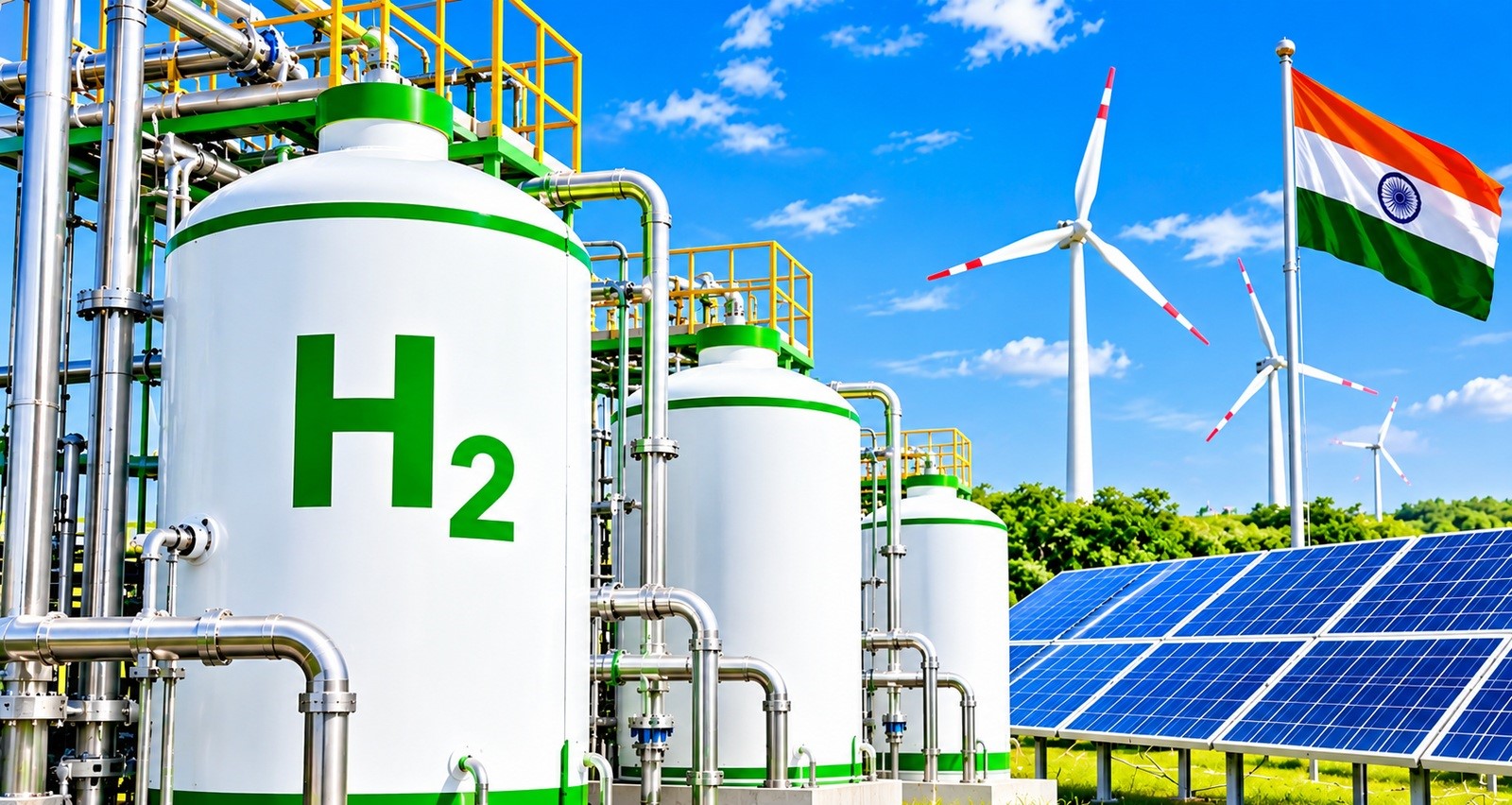
Green hydrogen is emerging as a key component of India’s clean energy transition, with the government stepping up efforts to boost domestic production, strengthen manufacturing capabilities and reduce dependence on fossil fuel imports under the National Green Hydrogen Mission (NGHM).
Produced by splitting water using electricity generated from renewable sources such as solar and wind, green hydrogen offers a clean energy alternative for industries where reducing carbon emissions remains challenging, including fertilisers, petroleum refining, steel manufacturing, heavy-duty transport and shipping.
The initiative also supports India’s commitment to achieving net-zero emissions by 2070 while creating opportunities for investment, employment and clean energy exports.
The Union Cabinet approved the National Green Hydrogen Mission in January 2023 with an outlay of Rs 19,744 crore. The mission aims to establish at least 5 million metric tonnes (MMT) of annual green hydrogen production capacity by 2030, potentially increasing to 10 MMT with additional export demand.
A major component of the mission is the Strategic Interventions for Green Hydrogen Transition (SIGHT) programme, which has an allocation of Rs 17,490 crore until 2029-30. The programme provides incentives for domestic electrolyser manufacturing and green hydrogen production.
According to government data, incentives have been awarded to 15 companies for an annual electrolyser manufacturing capacity of 3,000 MW. Incentives have also been approved for green hydrogen production capacity of 8.62 lakh tonnes annually.
By February 2026, approximately 8,000 tonnes of annual green hydrogen production capacity had been commissioned. As of October 2026, Indian companies had secured green hydrogen offtake commitments exceeding 5.5 lakh metric tonnes per annum, which the government described as the world’s largest such commitments.
Green hydrogen applications across industries
Green hydrogen is expected to play a significant role in reducing emissions from industries that currently depend heavily on fossil fuels.
In fertiliser manufacturing, it can replace hydrogen derived from natural gas to produce green ammonia, a key input for nitrogen-based fertilisers. Petroleum refineries can use green hydrogen in processes such as sulphur removal and fuel upgrading, while steel manufacturers can deploy it in direct reduced iron production to reduce carbon emissions.
The technology also has potential applications in road and rail transport, where hydrogen fuel cells generate electricity to power vehicles, producing water vapour as the primary emission at the point of use.
India’s first indigenous hydrogen-powered train was inaugurated on July 17, 2026, on the Jind-Sonipat section. The 10-coach trainset has a passenger capacity of approximately 2,600, while a facility at Jind can store nearly 3,000 kg of hydrogen.
In the shipping sector, green hydrogen derivatives such as green ammonia and green methanol could serve as alternatives to conventional marine fuels, subject to safety requirements, compatible engines and supporting port infrastructure.
Government expands pilot projects and hydrogen hubs
Under the National Green Hydrogen Mission, the government is supporting pilot projects in steel, mobility and shipping to assess technological feasibility, infrastructure requirements and commercial viability.
Five pilot projects have been sanctioned in the steel sector, including Rs 84 crore for testing 100 per cent hydrogen injection.
In the transport sector, 12 projects will deploy 70 hydrogen-powered vehicles, comprising 27 buses and 43 trucks. These projects also include 16 hydrogen refuelling stations across 21 routes, with financial assistance of Rs 41.58 crore released so far.
The V.O. Chidambaranar Port Authority has awarded a Rs 38.12-crore pilot project to develop green methanol bunkering and refuelling facilities, including an MNRE grant of Rs 35 crore.
The Ministry of New and Renewable Energy (MNRE) has also recognised Deendayal Port in Gujarat, V.O. Chidambaranar Port in Tamil Nadu and Paradip Port in Odisha as green hydrogen hubs.
An indigenously developed 1 MW green hydrogen plant was commissioned at Kandla Port in July 2025. Four Hydrogen Valley Innovation Clusters have also been awarded in Jodhpur, Odisha, Pune and Kerala to promote production, infrastructure development and technological innovation.
Policy measures to support green hydrogen production
The government has introduced several policy measures to encourage investment and reduce production costs.
Green hydrogen and green ammonia plants commissioned by December 31, 2030, are eligible for a 25-year exemption from Inter-State Transmission System charges.
The Green Hydrogen and Green Ammonia Policy also provides for open access to renewable electricity within 15 days and banking of surplus renewable power for up to 30 days, subject to applicable regulations.
Eligible standalone green hydrogen and green ammonia plants using renewable-powered water electrolysis have been exempted from prior environmental clearance requirements under the Environment Impact Assessment Notification, 2006.
Hydrogen releases no carbon dioxide when used, so its climate impact depends on how it is produced. In August 2023, the Ministry of New and Renewable Energy (MNRE) notified India’s Green Hydrogen Standard. Hydrogen qualifies as green if emissions do not exceed 2 kg of CO₂ equivalent per kg of hydrogen, on a well-to-gate basis, measured as a 12-month average. India thus became one of the first few countries to define green hydrogen formally.
The ministry subsequently launched the Green Hydrogen Certification Scheme of India in April 2025, followed by a dedicated certification portal in June 2026 to strengthen monitoring, verification and compliance.
Research, employment and international cooperation
The mission includes a Rs 400-crore allocation for research and development, with an initial roadmap worth Rs 113 crore supporting approved projects in hydrogen production, storage and safety technologies as of June 2026.
The government has also allocated Rs 100 crore to support start-ups developing green hydrogen technologies. Nine start-ups have received approval for funding totalling Rs 22 crore.
As part of skill development initiatives, 8,149 candidates have been trained and 7,248 certified in hydrogen-related qualifications across 14 states and Union Territories.
International cooperation remains another priority, with India pursuing partnerships with Australia, Finland, France, Germany, Saudi Arabia, the United Arab Emirates and Uzbekistan, among others.
An India-US Hydrogen Task Force has also been established under the Strategic Clean Energy Partnership to promote collaboration in emerging hydrogen technologies.
At the state level, Gujarat, Andhra Pradesh, Maharashtra, Uttar Pradesh, Rajasthan and West Bengal have notified dedicated green hydrogen policies, while several other states are developing similar frameworks.
Bharat Renewable Energy Summit highlights clean energy opportunities
The government’s green hydrogen push comes as the Bharat Renewable Energy Summit & Expo 2026 is being held at Bharat Mandapam in New Delhi from November 2 to 5 under the theme “Invest. Innovate. Inspire.”
The four-day event brings together participants from more than 130 countries, including over 40 ministers, policymakers, investors, financial institutions and industry representatives.
Nine countries and regional partners are participating as country partners, while 13 Indian states and Union Territories are showcasing renewable energy potential, investment opportunities and clean manufacturing capabilities.
The summit focuses on solar and wind energy, green hydrogen, energy storage, grid integration, domestic manufacturing and digital technologies, including artificial intelligence applications in the energy sector.
The event is being held alongside the ninth International Solar Alliance Assembly and the fourth International Conference on Green Hydrogen.
India targets Rs 8 lakh crore investment by 2030
The National Green Hydrogen Mission is expected to attract investments exceeding Rs 8 lakh crore and generate more than six lakh jobs by 2030.
According to government projections, the mission could reduce cumulative fossil fuel imports by approximately Rs 1 lakh crore by 2030, while the production and use of the targeted green hydrogen capacity could help avoid nearly 50 MMT of carbon dioxide emissions annually.
The government aims to position India as a global hub for green hydrogen production, consumption and exports, while strengthening energy security, supporting industrial decarbonisation and advancing the country’s net-zero emissions target for 2070.
-PIB


