






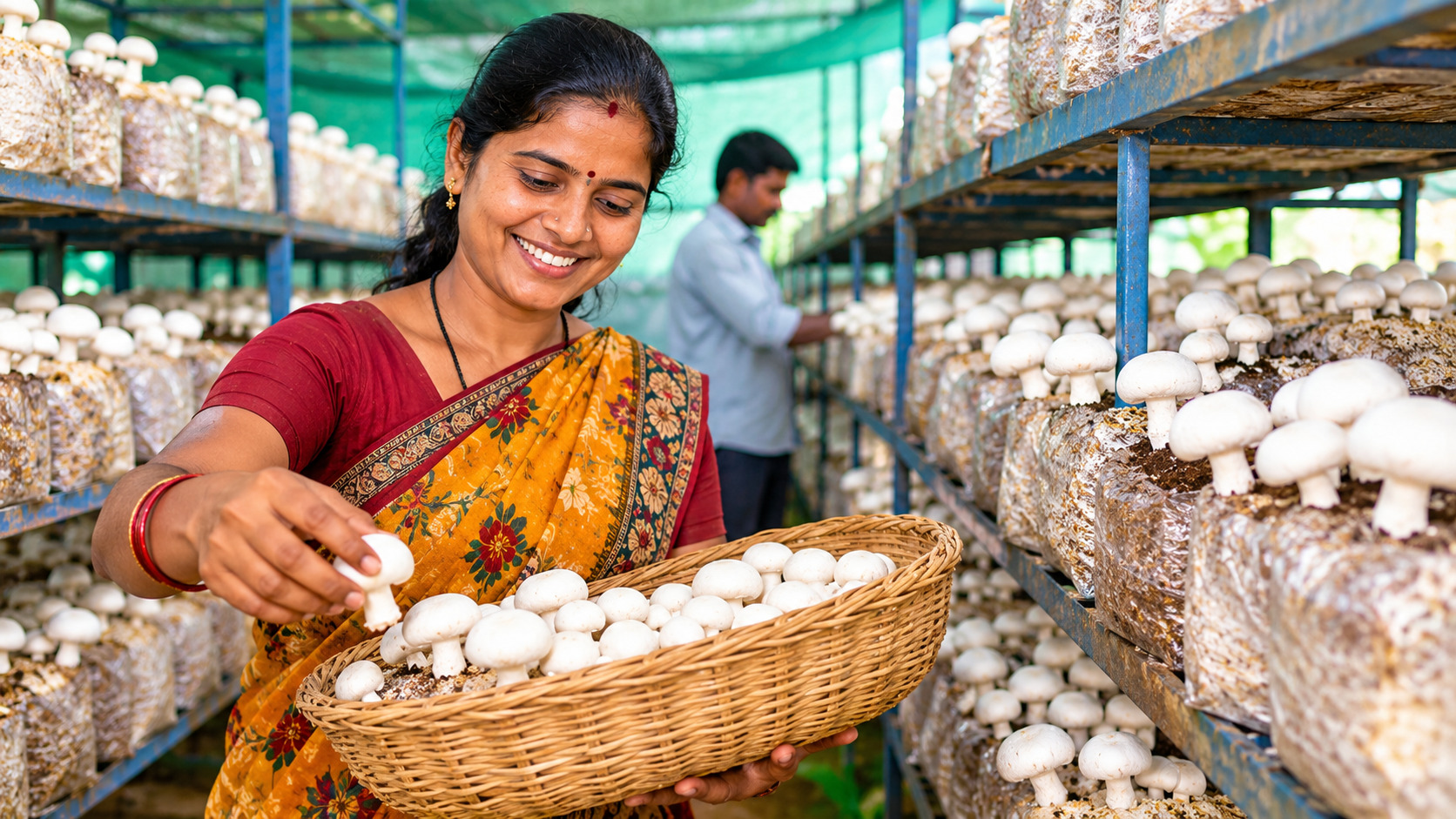
Mushroom cultivation is emerging as a promising livelihood and entrepreneurship opportunity across India, offering farmers, women and rural youth an additional source of income with relatively low investment and limited land requirements.
With growing interest in healthier diets, mushrooms are gaining importance in the country’s horticulture sector. They are generally low in calories, fat and carbohydrates while providing protein, dietary fibre, vitamins and minerals. Their cultivation also makes productive use of agricultural waste and can be undertaken in rural, urban and peri-urban areas.
Several success stories from different parts of the country highlight how skill development, institutional support and access to markets are helping individuals turn mushroom cultivation into sustainable livelihood ventures.
From Waste Picking to Mushroom Cultivation: Ruthu’s Journey in Andhra Pradesh
For 20-year-old Ruthu from Ippatam village in Andhra Pradesh’s Guntur district, mushroom cultivation offered an opportunity to move beyond waste picking and establish an independent source of income.
Her journey began with a short-term training programme under the Skill Training for Rural Youth (STRY) initiative. Krishi Vigyan Kendra (KVK), Guntur, provided practical training in mushroom production, covering composting, spawning, casing, pinning, cropping and harvesting. The programme was conducted with support from the State Agricultural Management and Extension Training Institute (SAMETI), Andhra Pradesh, and the National Institute of Agricultural Extension Management (MANAGE), Hyderabad.
Spawning involves mixing mushroom spawn with compost, while casing refers to applying a layer of casing soil over the compost to maintain moisture and support mushroom formation. Pinning is the stage when tiny mushroom structures, known as pinheads, begin to appear.
Applying the skills acquired during the training, Ruthu started cultivating milky mushrooms and established a regular supply to the local market. Her production reached approximately 8 kg per day, generating a monthly income of around Rs 35,000.
She also learned the importance of using disease-free paddy straw and quality spawn while maintaining appropriate temperature and moisture levels during cultivation.
Her progress encouraged three to four other community members to take up mushroom cultivation on a small scale, with Ruthu extending guidance and support to them.
Her experience highlights how targeted skill development and practical training can create income opportunities while encouraging knowledge-sharing within rural communities.
One Woman, Many Livelihoods: How Anita Devi Helped Build a Mushroom Village
In Anantpur village of Bihar’s Nalanda district, Anita Devi’s journey from mushroom cultivation to community leadership has helped create livelihood opportunities for rural women.
Her entrepreneurial journey began with the aim of earning an independent income. Training at Dr Rajendra Prasad Central Agricultural University and GB Pant University helped strengthen her knowledge, while her engagement with Krishi Vigyan Kendra (KVK) in Harnaut block in 2010 provided further direction.
Encouraged by KVK officials, Anita started cultivating oyster and milky white mushrooms, varieties suited to local conditions and suitable for production using agricultural waste.
Her initiative gradually inspired other women in Anantpur and neighbouring villages to take up mushroom cultivation. In 2012, the State Agriculture Department declared Anantpur a ‘Mushroom Village’.
Anita subsequently became known as the ‘Mushroom Mahila’ (Mushroom Lady) for her role in promoting the activity within the community.
As cultivation expanded, access to quality mushroom spawn emerged as a major requirement. With support from the National Horticulture Mission, she established a spawn production laboratory with a subsidy of Rs 15 lakh.
She also established Madhopur Farmers Producers Company Limited to support mushroom growers and sellers and help women access government schemes and markets.
By 2023, more than 250 women associated with Jeevika Self-Help Groups were involved in mushroom-based livelihood activities in Nalanda.
Anantpur’s recognition as the Mushroom Village of Bihar reflects how an individual initiative, supported by training and institutional assistance, can develop into a wider community-based enterprise.
From Civil Engineering to Mushroom Entrepreneurship: Anjanaben Gamit’s Story
Anjanaben Gamit, a civil engineer from Gujarat’s Tapi district, turned to mushroom cultivation after reading an article on oyster mushroom production published by KVK Tapi in its Agro-Sandesh publication.
Recognising the potential of the activity as an enterprise that did not require extensive land, she approached KVK Tapi and attended a four-day training programme on ‘Entrepreneurship Development through Mushroom Cultivation’.
With technical guidance from KVK scientists, she began cultivating oyster mushrooms in 2017.
Her initial unit was a modest 15 x 10 ft shed constructed using bamboo and green shade net. KVK supported her with mushroom spawn, polythene bags and other inputs, along with technical guidance.
Within two and a half months, her first crop yielded approximately 140 kg of mushrooms, generating Rs 28,000 against a production cost of Rs 11,000.
Encouraged by the results, Anjanaben expanded her unit in 2019 by increasing the size of her mushroom house to 23 x 80 feet, investing an additional Rs 1.72 lakh.
Between April and December that year, she used 250 kg of spawn to produce 1,234 kg of mushrooms. The harvest generated a gross income of Rs 3.09 lakh and a net profit of Rs 2.20 lakh after production costs.
Alongside expanding production, she developed local market linkages to reach consumers. She packaged mushrooms in 100-200 gram packs and supplied them through Anganwadi workers, retailers and vegetable vendors in Vyara.
Telephone-based bookings helped facilitate sales, while the district’s organic market provided another channel for direct consumer sales.
Her experience demonstrates how technical training, institutional support and locally adapted marketing strategies can help individuals establish mushroom-based enterprises.
From 25 Bags to a Mushroom Enterprise: Hiresha Verma’s Success in Uttarakhand
Hiresha Verma, an IT professional from Charba village in Dehradun, began her mushroom cultivation journey in 2013 with just 25 bags of oyster mushrooms in a servant quarter.
An initial investment of Rs 2,000 generated returns of approximately Rs 5,000, encouraging her to pursue the activity as a business. She subsequently established Han Agrocare, a mushroom enterprise based in Dehradun.
Her entrepreneurial journey was strengthened by training at Krishi Vigyan Kendra (KVK), Dehradun, and the ICAR-Directorate of Mushroom Research (DMR), Solan. She also engaged with the Department of Mushroom in Dehradun to access compost and spawn and sought financial assistance through the National Horticulture Mission and National Horticulture Board.
As a pilot initiative, she established three bamboo cultivation huts, each with a capacity of 500 mushroom bags.
Today, Han Agrocare has a production capacity of approximately one tonne of mushrooms per day and employs 15 people. The enterprise has expanded from seasonal production of around 20 kg per day to year-round cultivation, supported by 10 air-conditioned rooms and a technology-equipped production facility.
Beyond commercial production, Hiresha has trained more than 2,000 women and farmers in the hill regions, helping them explore mushroom cultivation as a livelihood option.
Her enterprise has also diversified into specialty varieties such as shiitake and Ganoderma, along with value-added products including pickles, cookies, nuggets, soup, protein powder, tea and papad.
She also provides technical assistance to growers from Tehri, Pauri and Garhwal, extending the benefits of her experience to other farming communities.
How Mushroom Cultivation Is Creating Opportunities in the Hills
In Uttarakhand’s Bageshwar district, Madan Mohan’s experience highlights the potential of mushroom cultivation and protected farming in challenging hill conditions.
At a farmers’ meeting in Uderkhani village, Madan Mohan expressed interest in protected vegetable and mushroom cultivation despite having no prior experience in either activity.
The opportunity emerged through the ICAR-Directorate of Mushroom Research (DMR), Almora, which was working in the village under the Scheduled Caste Sub Plan (SCSP) during 2020-21.
Although he was keen to begin mushroom cultivation, limited financial resources initially prevented him from taking up the activity.
Programme support helped address this constraint. In 2022, a portable polyhouse was established on his farm, along with the provision of five quintals of pasteurised compost for mushroom production. KVK Kafligair in Bageshwar district provided training and continued technical guidance.
A portable polyhouse is a low-cost, movable protected cultivation structure designed for hill and smallholder farming conditions.
By following recommended cultivation practices and maintaining regular contact with KVK experts, Madan Mohan harvested one quintal of marketable button mushrooms.
The 62.4-square-metre polyhouse also produced 7.5 quintals of vegetables, including tomato, capsicum, cabbage, cauliflower and French bean.
Harvesting during the off-season provided an additional market advantage, as local retailers had limited supplies from Haldwani mandi.
Together, mushroom and vegetable cultivation generated an income of Rs 41,250, nearly doubling his earlier farm income. His progress also encouraged other farmers to explore similar livelihood opportunities.
His efforts were recognised at the ICAR-DMR, Almora Kisan Mela, where he was felicitated.
Mushroom Cultivation: A Growing Avenue for Rural Entrepreneurship
These experiences from Andhra Pradesh, Bihar, Gujarat and Uttarakhand highlight the potential of mushroom cultivation as more than an additional agricultural activity.
With relatively low land and water requirements, the use of agricultural waste as a growing medium and opportunities for value addition, mushroom farming can support livelihood diversification and rural entrepreneurship.
The success stories also underline the importance of skill development, institutional assistance, access to quality spawn, suitable infrastructure and reliable market linkages.
With appropriate training and continued technical support, mushroom cultivation can help small and marginal farmers, women and rural youth make better use of available resources while creating additional income and employment opportunities.
-PIB


