






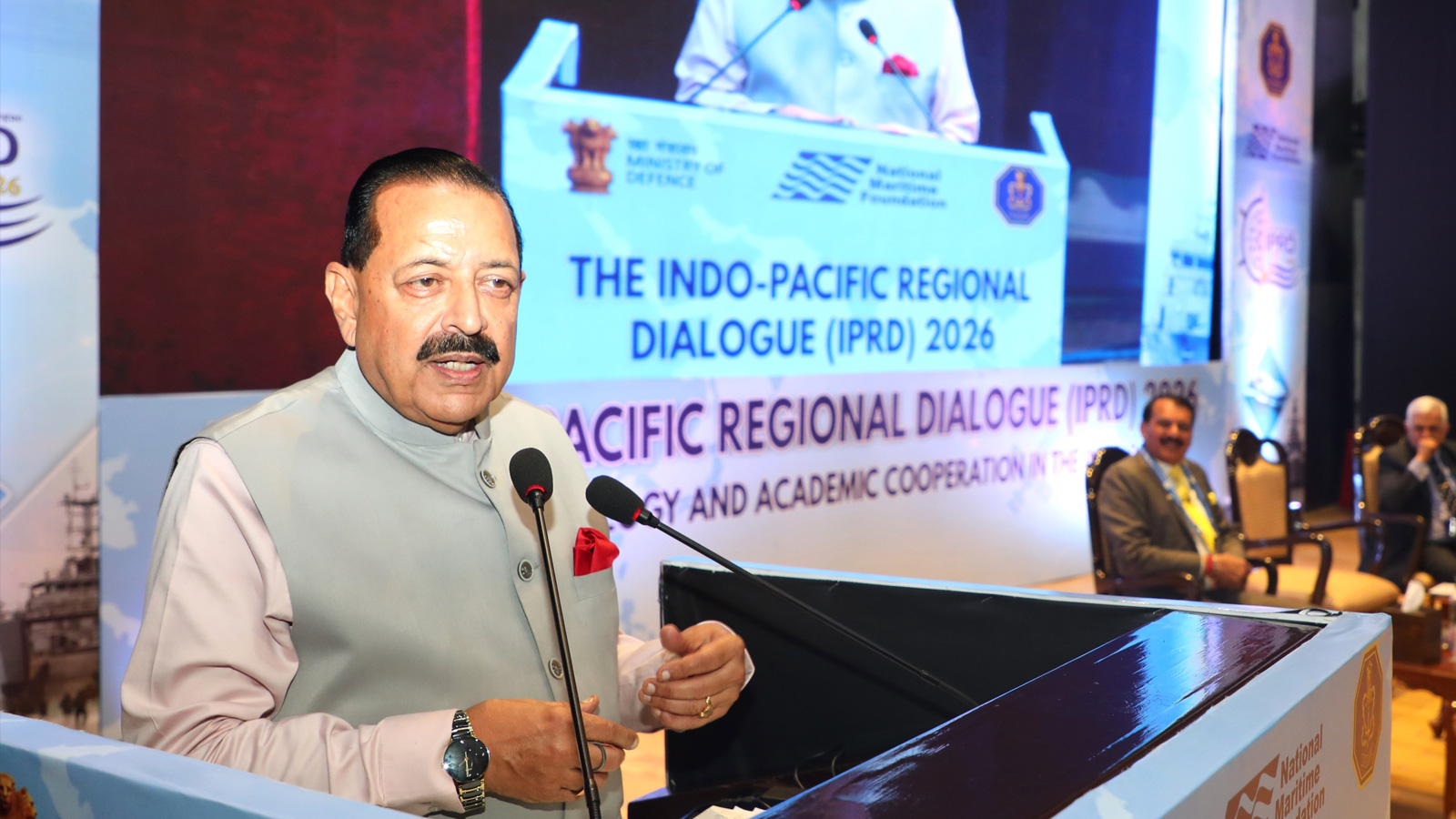
India is progressing towards sending its first human deep-sea mission to a depth of up to 6,000 metres by 2028, Union Minister of State (Independent Charge) for Science & Technology and Earth Sciences and MoS PMO, Personnel, Public Grievances, Pensions, Atomic Energy and Space, Dr. Jitendra Singh said on Wednesday, highlighting indigenous technology and international cooperation as central to the country’s ocean exploration ambitions.
Addressing the Indo-Pacific Regional Dialogue (IPRD) 2026, Singh said the Matsya submersible under the Samudrayaan Mission was designed to carry three aquanauts to depths of 5,000–6,000 metres.
He said the National Institute of Ocean Technology in Chennai had developed capabilities to conduct trials at these depths in the Central Indian Ocean Basin. He also highlighted the Ocean Mineral Explorer, which enables high-resolution exploration of hydrothermal sulphide deposits, several of which have been identified.
Drawing a parallel with Gaganyaan, the minister expressed the vision of an Indian undertaking a deep-sea journey while another travelled into space, reflecting the country’s expanding scientific and technological capabilities.
Singh said India was seeking global competitiveness in ocean research through domestic capabilities, international partnerships and joint development of technologies. Scientific missions increasingly brought together departments and institutions working in ocean science, space technology, nuclear science, geology, electronics and robotics, he added.
He said Prime Minister Narendra Modi’s references to the Deep Ocean Mission in two Independence Day addresses reflected the strategic priority accorded to ocean resources.
The Minister highlighted the contribution of satellites to ocean research through observations of ocean colour, sea-surface temperature and wind vectors. Such capabilities were expanding ocean monitoring and could support exploration of renewable energy opportunities, he said.
He also cited desalination facilities at Kalpakkam, supported by the Bhabha Atomic Research Centre, and low-temperature desalination facilities in Lakshadweep as examples of scientific collaboration addressing drinking water needs in coastal and island regions.
Calling for stronger international cooperation, Singh said marine pollution and changes in ocean temperatures crossed national boundaries and required collective responses.
He proposed partnerships involving joint scientific missions, reciprocal access to research facilities and data sharing, guided by the principle of “One Ocean, Shared Knowledge and Equitable Prosperity”.
Regional priorities should include closing gaps in ocean observations, improving forecasts of extreme events, developing climate services for coasts and islands, expanding access to responsible ocean technologies, and promoting conservation and equitable resource use, he said.
Linking deep-ocean exploration to Viksit Bharat 2047, Singh said India would need new sources of economic value addition, with unexplored and underexplored ocean resources offering significant potential.
He referred to the Anusandhan National Research Foundation and the Rs 1 lakh crore Research, Development and Innovation Fund as measures to expand research and encourage private-sector participation.
Singh said the RDI Fund provided for a 50:50 equity-based approach and urged government departments, scientific institutions, businesses and investors to work together in emerging areas of technology.
Responding to a question on nuclear-powered vessels and clean maritime energy, he referred to private participation in the nuclear sector under the SHANTI Act and India’s target of 100 GW of nuclear energy capacity by 2047.
The Deep Ocean Mission was also examining renewable energy possibilities involving solar power, ocean winds and temperature or energy gradients, he said.
On marine pollution, Singh said an ocean-cleanliness campaign launched during the commemoration of 75 years of Independence had become an annual exercise involving coastal administrations, the Navy, Coast Guard, NGOs and other stakeholders.
He called for the peaceful, sustainable and equitable use of ocean resources, saying indigenous capabilities and responsible sharing of scientific knowledge would strengthen India’s contribution to global ocean research.
(PIB)


