






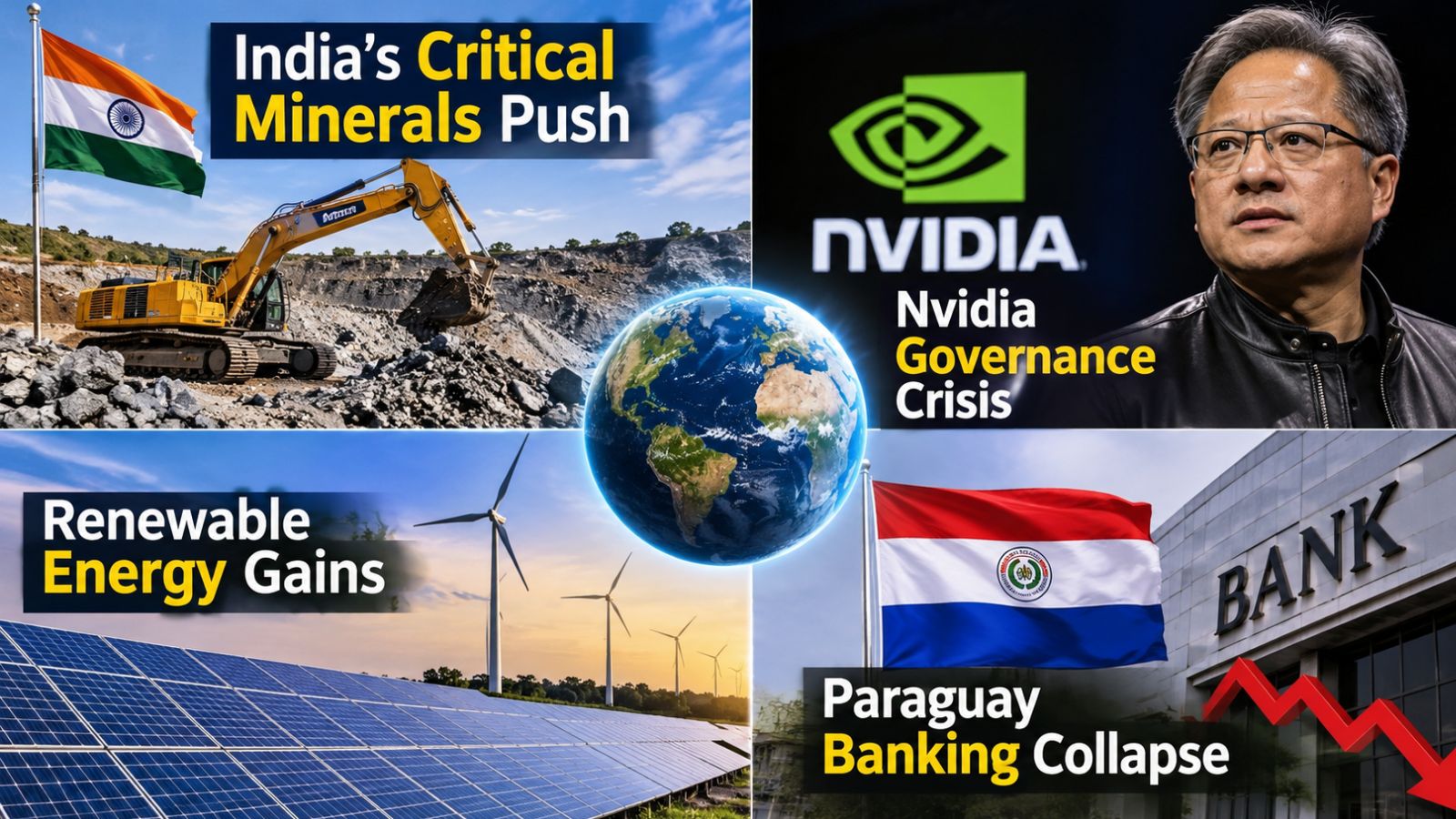
This week’s edition of The Economic Brief on DD India examined four major developments: the Centre’s ₹2,814 crore subsidy scheme to boost domestic critical mineral processing, governance and succession concerns at US chipmaker Nvidia, the economic benefits of India’s renewable energy expansion, and the collapse of Paraguay’s largest digital bank, which led to the removal of President Santiago Peña.
The programme featured Dr Charan Singh, CEO of the Economic Growth and Research Foundation, who has previously worked with the Reserve Bank of India (RBI) and the International Monetary Fund (IMF), and served as a professor at IIM Bangalore.
India Approves ₹2,814 Crore Scheme to Boost Critical Mineral Processing
India has approved a capital expenditure support scheme to promote domestic processing of critical minerals, with an implementation period from FY2026-27 to FY2030-31.
Lithium and nickel are among the 24 minerals identified by India as critical for sectors such as electric vehicles, energy storage, defence, electronics and telecommunications, as well as the global transition to a low-carbon economy.
India currently depends on imports for processed battery materials, while processing capacity remains concentrated in a few countries, including China, Indonesia, Japan and South Korea, exposing the country to potential supply chain disruptions.
The scheme provides a 30 per cent capital subsidy, with a total outlay of ₹2,814 crore, or approximately $302 million, to support the establishment of four processing plants. These will include two lithium processing units with a minimum capacity of 30,000 tonnes each and two nickel processing units with a minimum capacity of 50,000 tonnes each.
Financial assistance will be capped at around ₹500 crore per lithium beneficiary and ₹900 crore per nickel beneficiary. The scheme allocates ₹1,000 crore for lithium processing and ₹1,800 crore for nickel processing, with the remaining amount earmarked for administrative expenses.
Beneficiaries will be selected through competitive bidding after meeting prescribed technical criteria. Financial assistance will be released in three instalments linked to project milestones.
The government expects the scheme to attract investments of around ₹10,000 crore and create processing capacity of approximately 60,000 tonnes of lithium and 1 lakh tonnes of nickel by 2030.
The initiative is expected to reduce import dependence, strengthen domestic supply chains, retain more value within the country and support manufacturing in the battery, electric vehicle and specialty steel sectors. It is also expected to generate employment opportunities.
The scheme complements the National Critical Mineral Mission, launched last year, which aims to strengthen the entire critical mineral value chain, including exploration, mining, recycling and processing.
Dr Charan Singh described the 30 per cent subsidy as a positive starting point and a clear indication of the government’s commitment to developing domestic processing capacity. However, he stressed the need to build a broader ecosystem, including infrastructure investment under the PM Gati Shakti initiative and support for smaller companies that may find it difficult to mobilise the remaining 70 per cent of project funding.
Referring to supply chain disruptions during the COVID-19 pandemic, the Russia-Ukraine war and conflicts in the Middle East, Singh said India, given its size and transition from oil-based energy to electric vehicles and lithium batteries, could not afford to remain vulnerable to global supply chains. He said critical minerals would be essential to achieving the vision of Viksit Bharat 2047.
He also noted that India is among the world’s major producers of bauxite, manganese, chromite, zinc, limestone and iron ore, but remains at an early stage in critical mineral exploration, with lithium exploration underway in Jammu and Kashmir.
Building domestic processing capacity, he said, would not only strengthen India’s industrial base but also improve its geopolitical position, particularly as countries such as the United States remain vulnerable to dependence on China for critical minerals.
Nvidia Lawsuit Raises Corporate Governance and Succession Concerns
A shareholder class-action lawsuit filed in California has brought Nvidia under scrutiny over corporate governance, leadership succession and potential national security risks.
The lawsuit alleges that Nvidia and its co-founder, Jensen Huang, failed to disclose information concerning Huang’s alleged relationship with a suspected Chinese intelligence asset. It claims the alleged failure exposed the company to reputational and national security risks. The allegations have not been established, and the case remains at an early stage.
Huang, who co-founded Nvidia in 1993, is credited with transforming the company from a graphics chip manufacturer into a leading supplier of processors used in artificial intelligence systems and data centres.
Nvidia shares closed at a record high of $239.24 on October 6, 2026, but fell to $168.89 by November 10, marking a decline of around 29 per cent and wiping out approximately $1.6 trillion in market capitalisation.
The company’s board has initiated an independent investigation led by external legal counsel and independent directors. Huang resigned as CEO on November 12, bringing renewed attention to the company’s dependence on his leadership and the risks associated with succession planning.
Dr Charan Singh noted that Nvidia had reported a 126 per cent increase in net profit in August and was scheduled to announce its results on November 17. However, he said financial markets were forward-looking and investors were assessing whether the investigation would uncover any transfer of information in violation of US restrictions on artificial intelligence chip exports to China.
Drawing lessons for companies, including those in India, Singh emphasised the importance of corporate governance, succession planning, investor protection and national security considerations.
He also pointed to the absence of a clearly established second- or third-tier leadership structure at Nvidia over an extended period, warning that the developments could trigger a broader reassessment of the artificial intelligence industry.
IEA Report: India’s Renewable Energy Expansion Saves Over $100 Billion in Fuel Imports
India’s expansion of renewable energy has generated substantial economic benefits by reducing its dependence on imported fossil fuels, according to a report by the International Energy Agency (IEA).
The report estimates that solar, wind and bioenergy generation helped India avoid more than ₹9.4 lakh crore in coal and natural gas import costs between 2011 and 2025.
Without the additional renewable energy capacity, India would have needed to import around 110 million tonnes of extra coal in 2025 alone. The cumulative savings could rise to ₹22.6 lakh crore by 2030, helping reduce exposure to global energy price fluctuations and strengthening energy security.
India’s renewable energy capacity has nearly quadrupled over the past decade, crossing 300 gigawatts in 2026 and positioning the country among the world’s fastest-growing clean energy markets.
In 2025, India achieved the milestone of deriving 50 per cent of its installed electricity capacity from non-fossil fuel sources, meeting its 2030 target five years ahead of schedule.
Competitive bidding and policy support have also helped bring solar power tariffs to around 40 per cent below the average cost of coal-based electricity, making renewable energy increasingly competitive.
The report highlighted the role of government initiatives such as the PM Surya Ghar Muft Bijli Yojana, which has encouraged rooftop solar adoption by enabling households to generate electricity, reduce power bills and supply surplus energy to the grid.
The PM-KUSUM scheme has also supported the adoption of solar-powered irrigation pumps among farmers.
Together, these initiatives have expanded renewable energy adoption beyond large-scale power projects, extending its benefits to households and the agricultural sector.
Paraguay’s Largest Digital Bank Collapse Triggers Political Crisis
The collapse of Ueno, Paraguay’s largest digital bank, has triggered a financial and political crisis in the South American country, ultimately leading to the removal of President Santiago Peña.
The bank had approximately 3 million customers in a country with a population of around 6.5 million, representing nearly 46 per cent of the population. It also handled around $850 million in public funds, including money belonging to state institutions and pension-related bodies.
The bank’s collapse was primarily attributed to risky lending to companies linked to its owners, inadequate financial documentation and a significant capital shortfall.
Paraguay’s central bank took control of the institution on November 3 after determining that it lacked sufficient capital to cover its financial risks. The collapse disrupted access to banking services for millions of customers who relied on digital transactions.
The financial crisis soon escalated into a political confrontation. Peña had business links with the conglomerate that owns Ueno until March 2025. Questions were also raised over his 2023 appointment of the bank’s former head as the country’s central bank chief.
Opposition lawmakers accused the government of failing to safeguard public funds. Although Peña offered to resign, lawmakers proceeded with impeachment proceedings, and the Senate voted to remove him from office on November 6. He has denied wrongdoing and is facing criminal investigations.
The government has since intervened through a state-backed deposit guarantee fund, introducing measures to accelerate reimbursements and transfer deposits to other banks.
As of November 11, more than $640 million had been returned to 1.81 million depositors. A further phase covering deposits of up to 75 times the minimum wage was scheduled to begin shortly.
The authorities now face the challenge of recovering public and pension funds, addressing regulatory shortcomings and restoring confidence in the country’s banking system.
(Mark Lynn , All India Radio & Doordarshan)


