






Inside This Week’s Economic Brief
This week’s Economic Brief covers Finance Minister Nirmala Sitharaman’s account of India’s decade-long poverty reduction, gold’s rebound from a 14-month low and what it means for investors, and the wage protests disrupting Bangladesh’s garment exports.
This week’s edition of The Economic Brief on DD India examined three major stories: Finance Minister Nirmala Sitharaman’s article on India’s transformation “from deprivation to opportunity,” gold’s rebound from a 14-month low amid rising US interest rates, and continuing wage protests in Bangladesh’s garment industry despite a government-approved pay hike. The episode featured Dr. Nilanjan Banik, Professor of Economics and Finance at the School of Management, Mahindra University.
From Deprivation to Opportunity: India’s Poverty Turnaround
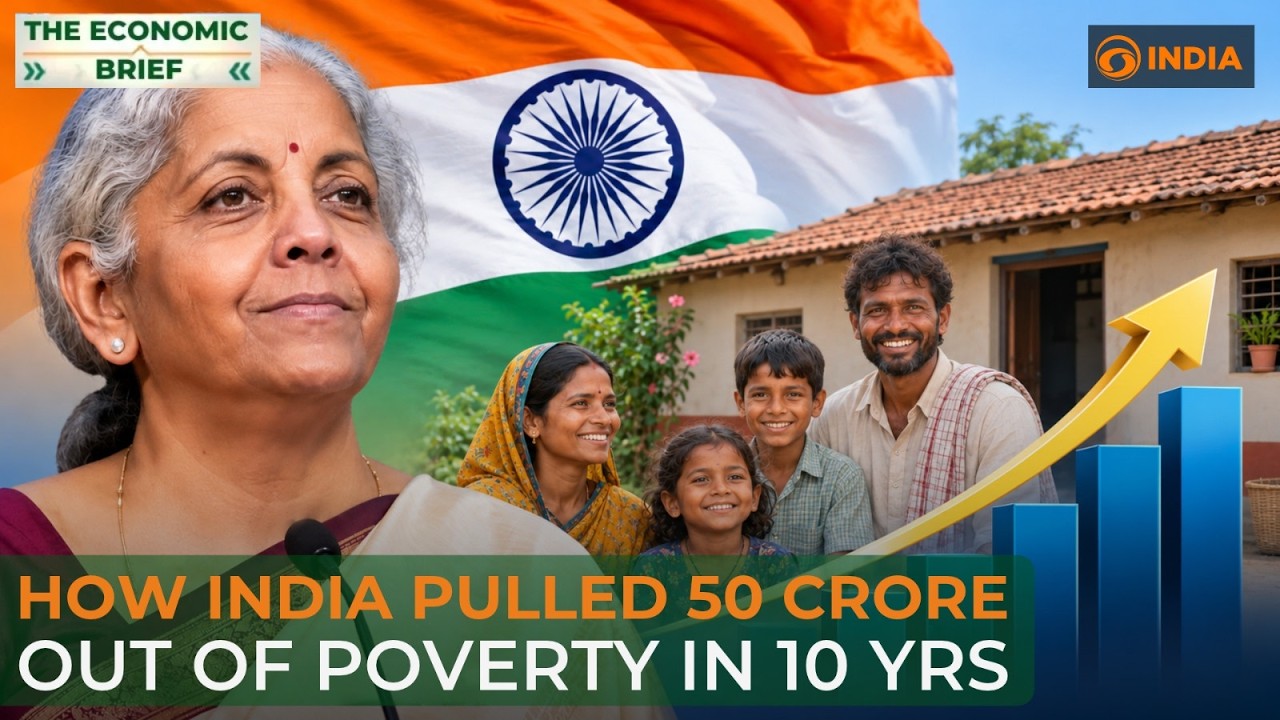
In a recent article, Finance Minister Nirmala Sitharaman argued that poverty is multidimensional: a family may earn more, but without a toilet, safe drinking water, healthcare, a secure home or access to financial services, it remains vulnerable and can easily slip back into poverty. Whereas earlier approaches often focused on transferring money to the poor, she said the Modi government’s strategy has been to identify specific deprivations household by household and address them directly through dedicated schemes, shifting from temporary relief to removing the root causes of poverty. This approach, she noted, has helped nearly 50 crore Indians move out of poverty over the past decade.
Her article set out two stages:
• Securing basic needs. Schemes such as Swachh Bharat, Jal Jeevan Mission, PM Awas Yojana, Ujjwala and Ayushman Bharat were designed to remove the vulnerabilities that trap households in poverty: toilets improve sanitation and health, tap water saves time and reduces disease, clean cooking fuel improves household health, a pucca home provides stability and dignity, and health insurance protects families from large medical bills. Together they act as a safety net, freeing people to focus on work, education and upward mobility.
• Creating opportunity. Jan Dhan accounts and direct benefit transfers brought millions into the formal financial system; Mudra provided collateral-free loans to small businesses; PM SVANidhi offered working capital loans to street vendors; and PM Vishwakarma provided skill training and credit to artisans and craftspeople. The Finance Minister highlighted self-help groups and Lakhpati Didis as evidence that women are becoming job creators. The goal is to move people from receiving support to generating income, building businesses and employing others, a key pillar of the Viksit Bharat 2047 vision.
Dr. Nilanjan Banik explained that poverty can be measured by daily income, for example the World Bank’s line of $3 per day at 2021 purchasing power parity, or $4.20 for middle-income countries, as well as by calorie intake and consumption expenditure. With consumption contributing around 60% of India’s growth, rising spending on food, healthcare, education and living conditions has helped reduce multidimensional poverty. He said women’s labour force participation roughly doubled between 2017 and 2023, with significant implications for human development.
He credited the JAM trinity of Jan Dhan accounts, Aadhaar and mobile connections with “democratising” access to finance and business, pointing to near-universal mobile access and India’s share of around 49% of the world’s digital payments, while Mudra has given MSMEs access to formal credit. Food security schemes such as the Antyodaya Anna Yojana, which provides 35 kg of food grain to the poorest households, proved especially valuable during COVID, and the Finance Minister has noted that around 800 million people receive some form of government support. Swachh Bharat’s reduction of open defecation has had direct health benefits.
On governance, Dr. Banik said Aadhaar-enabled disbursement has curbed the leakages that once plagued government transfers, ensuring funds reach the targeted population. He added that internet connectivity has risen by around 150% since 2017 and that 99% of India’s villages now have electricity. Together, connectivity, financial inclusion and easier access to business are formalising the economy, sustaining consumption and bringing down poverty.
Gold Rebounds from a 14-Month Low
Gold, long seen as the ultimate safe-haven asset, recently fell to its lowest level in 14 months, briefly touching levels last seen in September 2025 after dropping more than 8% this month. The decline was driven by rising US bond yields as markets priced in another Federal Reserve rate hike, making non-yielding gold less attractive, and by a stronger dollar that made the metal costlier for overseas buyers. Some investors also sold gold to raise cash during broader market volatility. In India, a strengthening rupee added further pressure on gold and silver prices, which have been falling since Diwali.
Gold has since rebounded strongly as buyers returned after the steep correction, helped by a pause in the dollar’s rally and hopes that the Federal Reserve may eventually ease its tightening. Industry voices described the fall, with gold down 30–35% and silver 55–60% from their highs, as an opportunity for end users and investors. Longer-term supports also remain in place: central banks continue to accumulate gold, concerns over government debt persist and geopolitical uncertainty is elevated. One industry voice argued that a well-regulated gold monetisation framework, in which households lend out some of the 5,000–6,000 tonnes of gold they hold, could generate income for consumers, provide capital to the employment-intensive jewellery industry and boost exports. Analysts caution, however, that upcoming inflation data and Federal Reserve decisions will determine whether this is a sustained recovery or merely a temporary bounce.
Dr. Banik said gold and silver are highly cyclical. Demand surges during crises such as the Lehman Brothers collapse, COVID and the start of the Russia-Ukraine war, when central banks cut rates and US Treasuries lose appeal, but the metals tend to underperform when rates rise. With the US economy growing at 4.3% in the latest quarter and inflation above the Fed’s 2% target, he expects another 25-basis-point hike at the December meeting after September’s increase, drawing investors back to US Treasuries. In India, which imports about 85% of its precious metals, the rupee’s roughly 4% appreciation over the past month, from around 97 to about 93 to the dollar on the back of foreign institutional buying, has further lowered domestic prices.
On whether the correction is a buying opportunity, he said it depends on timing. Gold rose by almost 400% between 2008 and 2012 after the Lehman crisis, then corrected sharply once the US economy recovered, and a similar pattern followed the COVID-era rally. He noted that much of the long-term rise in Indian gold and silver prices reflects the rupee’s average annual depreciation of about 3.5–3.75%, while in dollar terms prices have changed far less relative to long-term averages, and despite central bank buying, gold has not broken decisively above its historical trend.
Bangladesh Garment Wage Protests Disrupt Exports
Bangladesh’s garment industry is facing mounting losses as workers continue wage protests despite the government’s approval of a 36% pay hike. Protests began in late October and spread across major manufacturing hubs, including Dhaka and Gazipur, with workers demanding that the monthly minimum wage be raised to 30,000 taka (about $240) from around $100, an increase of roughly 140%. They say rising food, housing, transport and healthcare costs have made it difficult to meet basic household expenses. Labour representatives said they are submitting a revised proposal and expect factory owners to return with a revised offer.
The demonstrations have often turned violent, with clashes between police and protesters, factory suspensions and road blockades disrupting transport in key industrial areas. The economic toll has been heavy:
• Production losses of more than $420 million, with over 600 factories affected.
• Export orders worth $254 million shifted to other countries, with 59 million garments affected by order diversions.
• Shutdowns of up to 16 days at some factories.
The ready-made garment sector is the backbone of Bangladesh’s export economy, generating about $38 billion in annual export earnings, roughly 80% of total export receipts and around 10% of GDP, and employing about 4 million people, many of them women from rural communities. The unrest highlights a growing tension between keeping manufacturing costs competitive and meeting workers’ demands for better living standards.
Key Takeaways
India’s poverty reduction strategy has shifted from income transfers to tackling specific deprivations and then building pathways to opportunity, supported by digital infrastructure and targeted delivery. Gold’s rebound is encouraging, but with the Federal Reserve still tightening and the rupee strengthening, it is not yet clear that prices have bottomed. And the wage protests in Bangladesh show how labour unrest can quickly threaten a country’s most important export industry.


