






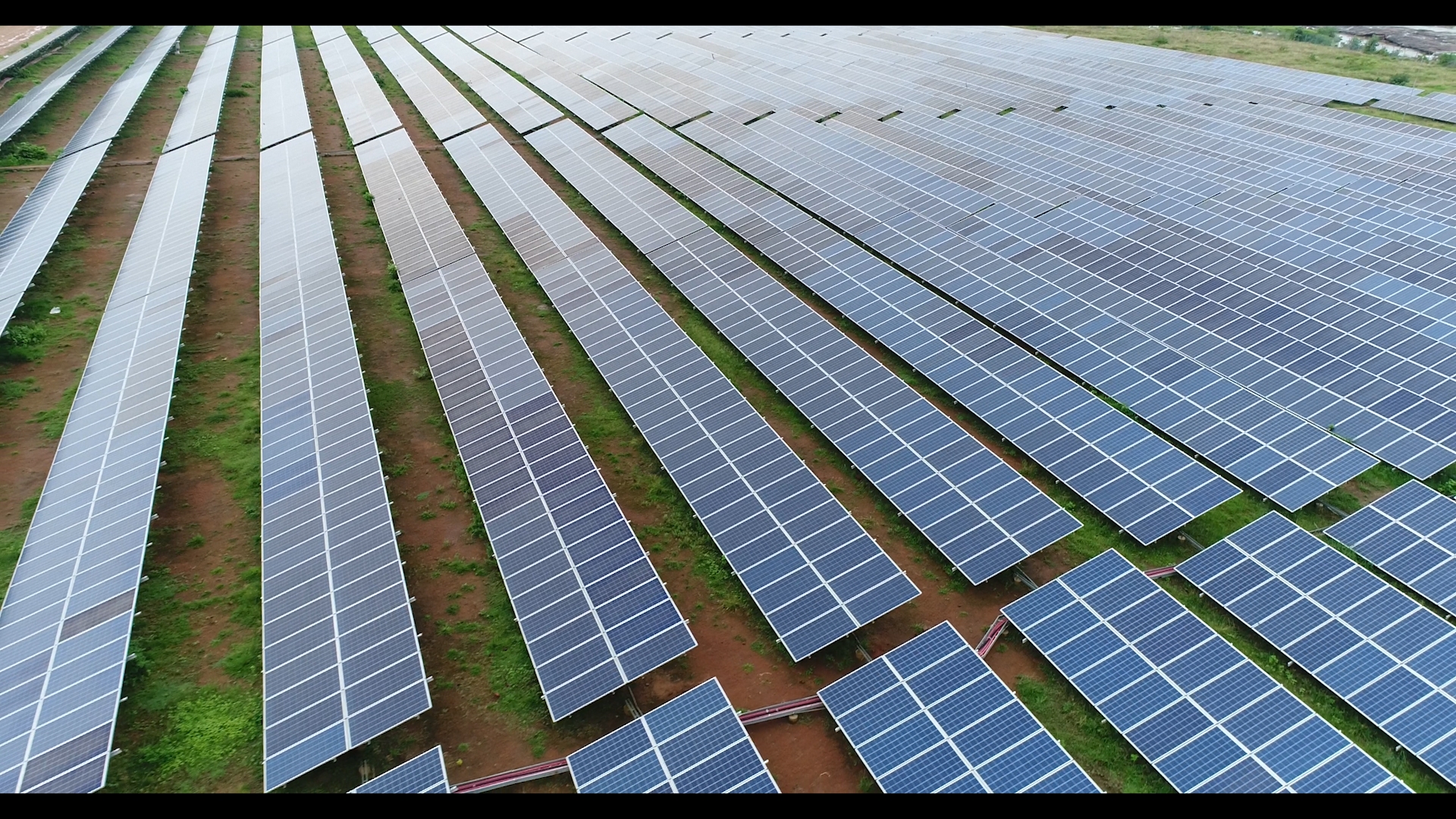
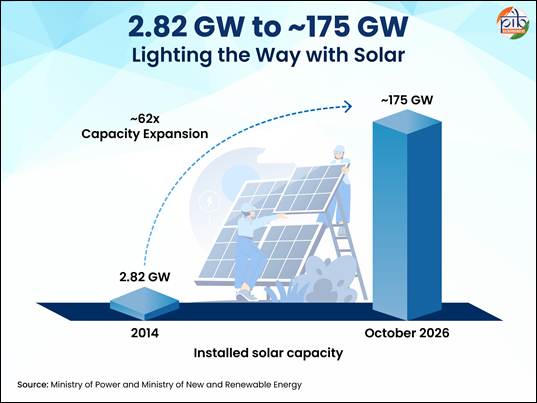
India’s solar energy sector has undergone a remarkable transformation over the past decade, emerging as a major pillar of the country’s renewable energy expansion. From an installed capacity of just 2.82 GW in 2014, solar power capacity has grown approximately 62-fold to around 175 GW as of October 31, 2026.
The expansion reflects a combination of government policies, large-scale infrastructure development, domestic manufacturing, competitive tariffs and growing participation by households and farmers. Solar power is no longer limited to large utility-scale projects; rooftop installations, solar agricultural pumps and off-grid systems are extending its benefits to communities across the country.
India’s growing solar capacity, manufacturing strength and international engagement were among the key themes at the Bharat Renewable Energy Summit & Expo (BRESE) 2026, held at Bharat Mandapam, New Delhi, from November 2 to 5.
From a small contributor to a major source of renewable energy
A decade ago, solar power occupied a relatively small place in India’s electricity mix. Today, it accounts for the largest share of the country’s renewable energy capacity.
India added 37 GW of solar capacity in 2025, surpassing the United States in annual additions and emerging as the world’s second-largest solar growth market.
The growth has accelerated in recent years. During FY 2025–26, India added a record 44.61 GW of solar capacity, almost double the 23.83 GW added in FY 2024–25. In the current FY 2026–27, another 24.29 GW had already been added at the time of the release.
The expansion is part of a broader increase in non-fossil fuel capacity. As of September 30, 2026, India’s total non-fossil fuel installed capacity stood at 308.03 GW. This included 299.25 GW of renewable energy capacity and 8.78 GW of nuclear power capacity.
India also recorded its highest-ever annual addition of non-fossil fuel capacity in FY 2025–26, at 55.29 GW. On July 29, 2025, renewable energy sources met 51.5 per cent of the country’s electricity demand, the highest monthly share recorded up to that point.
How India’s solar capacity is distributed
Solar power deployment has expanded across different geographical and climatic regions, with Rajasthan, Gujarat, Karnataka, Tamil Nadu, Andhra Pradesh and Maharashtra accounting for significant portions of installed capacity.
Large-scale solar projects contribute around 133 GW of installed capacity, including the solar component of hybrid projects. Grid-connected rooftop solar systems account for another 34.97 GW, while the remaining capacity comes from off-grid installations.
Some of India’s prominent solar projects include Bhadla Solar Park in Rajasthan, Pavagada Solar Park in Karnataka, Ananthapuramu and Kurnool Solar Parks in Andhra Pradesh, and Rewa Ultra Mega Solar Park in Madhya Pradesh.
Hybrid projects combine solar power with battery storage or other energy sources, helping improve the availability and reliability of electricity. Off-grid solar systems, meanwhile, provide power in areas that are not connected to the electricity grid.
Policy framework behind the solar expansion
India’s solar growth has been supported by a combination of long-term climate commitments, national missions, renewable energy purchase obligations, competitive bidding and infrastructure development.
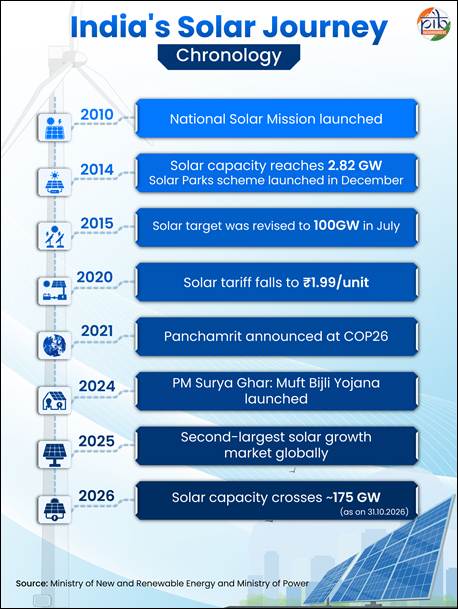
The National Solar Mission, launched in 2010, provided an early policy foundation for large-scale solar deployment. It was followed by initiatives such as the Solar Parks Scheme, the Green Energy Corridor Programme and competitive bidding mechanisms.
At the COP26 climate conference in Glasgow, India announced its Panchamrit commitments, including achieving 500 GW of non-fossil fuel energy capacity by 2030 and net-zero emissions by 2070. These commitments were subsequently reflected in India’s updated Nationally Determined Contributions under the Paris Agreement.
Mission LiFE (Lifestyle for Environment) complements these efforts by encouraging citizens to adopt sustainable consumption patterns and environmentally responsible practices.
Renewable Purchase Obligations create sustained demand
Renewable Purchase Obligations (RPOs) have played an important role in expanding demand for renewable electricity. Under this framework, electricity distribution companies and other obligated entities must procure a specified share of their electricity from renewable sources.
The obligations provide long-term market certainty for developers and investors while encouraging greater renewable energy adoption. The RPO trajectory has been notified through 2029–30, with the target for FY 2026–27 set at 35.95 per cent.
Government schemes have further expanded demand beyond electricity utilities and large project developers. PM Surya Ghar: Muft Bijli Yojana encourages households to install rooftop solar systems, while PM-KUSUM promotes solar-powered irrigation and solarisation of agricultural feeders.
Competitive bidding makes solar power more affordable
One of the most significant developments in India’s solar sector has been the sharp decline in electricity tariffs over the past decade.
Competitive bidding through the e-Reverse Auction mechanism allows developers to compete by offering the lowest tariff for supplying electricity. Procurement agencies such as the Solar Energy Corporation of India (SECI) have played an important role in expanding this transparent process.
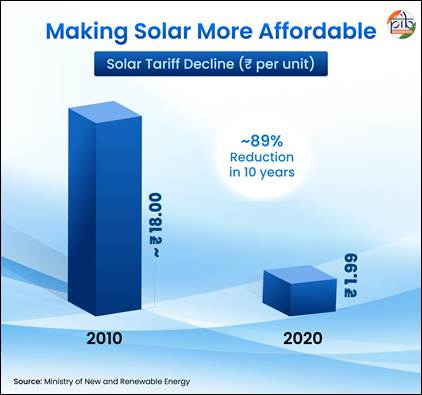
Solar tariffs have fallen from around ₹18 per unit in 2010 to a record-low ₹1.99 per unit, achieved by Gujarat Urja Vikas Nigam Limited in 2020.
The reduction has made solar power increasingly affordable and helped India emerge as one of the world’s lowest-cost solar electricity markets.
In 2025, the Levelised Cost of Electricity (LCOE) from utility-scale solar photovoltaic projects in India stood at USD 35 per MWh, compared with the global average of USD 44 per MWh.
Solar parks and transmission infrastructure
Large solar parks have provided developers with access to land, transmission facilities and common infrastructure, accelerating the development of utility-scale projects.
The Solar Parks Scheme was initially launched with a target of 20 GW, which was subsequently expanded to 40 GW in 2017. As of October 2026, 56 solar parks with a combined sanctioned capacity of 39,461 MW had been approved across the country, according to the release.
Rajasthan leads with 11 parks and a sanctioned capacity of 10,726 MW, followed by Gujarat with seven parks and 12,150 MW. Andhra Pradesh has five parks with 4,200 MW, while Madhya Pradesh has nine parks with 4,208 MW. Uttar Pradesh has eight parks with 3,740 MW.
Other participating States include Bihar, Chhattisgarh, Jharkhand, Karnataka, Kerala, Maharashtra, Mizoram and Odisha. One inter-state floating solar park spans Jharkhand and West Bengal.
Bhadla Solar Park: Turning desert land into a clean energy hub
Located in Rajasthan’s arid Bhadla region, Bhadla Solar Park is among the world’s largest solar power complexes. Its development began in 2015 under the Solar Parks Scheme and was completed in phases by 2020.
Spread across nearly 5,700 hectares, or 56 square kilometres, the park has an installed capacity of 2,245 MW.
The region’s high solar irradiation, low rainfall and sparse vegetation make it suitable for large-scale solar generation. Common infrastructure, including land preparation and transmission facilities, enabled faster project development and attracted substantial private investment.
Competitive bidding at the park also contributed to some of India’s lowest solar tariffs, demonstrating how the solar park model can support large-scale deployment while reducing project costs.
Green Energy Corridors strengthen grid connectivity
Generating renewable electricity is only one part of the transition. It must also be transmitted efficiently from resource-rich regions to centres of demand.
The Green Energy Corridor (GEC) Programme addresses this requirement by strengthening transmission networks and facilitating the evacuation of renewable power.
As of February 2026, the programme had enabled the evacuation of 24,567.8 MW of renewable energy through strengthened transmission infrastructure. Projects across ten States are planned to support the evacuation of around 44 GW of renewable energy.
These transmission networks are essential for integrating increasing volumes of solar and other renewable electricity into the national grid.
Floating solar and energy storage open new opportunities
India is also expanding solar deployment through floating photovoltaic projects, which use reservoirs and other suitable water bodies instead of conventional land-based installations.
The Government approved the Pradhan Mantri Surya Sarovar Yojana (PM-SSY) on July 31, 2026, with an outlay of ₹5,070 crore.
The scheme aims to support 5,000 MW of floating solar photovoltaic projects with co-located Energy Storage Systems. The storage component will have a minimum capacity of two hours, equivalent to 10,000 MWh, helping States manage peak electricity demand.
By utilising existing reservoirs and industrial ponds, the initiative seeks to reduce pressure on scarce land resources while improving grid reliability through integrated energy storage.
The scheme will be implemented from FY 2026–27 to FY 2030–31 and will be available to all States and Union Territories.
An assessment by the National Institute of Solar Energy estimates India’s floating solar potential at approximately 102.18 GWp across reservoirs and suitable inland water bodies.
The initiative is expected to reduce around 10 million tonnes of carbon dioxide emissions annually and generate 16,000–17,000 full-time equivalent jobs. It is also expected to encourage domestic manufacturing of floating systems, photovoltaic cells, modules and energy storage equipment.
The scheme will increase India’s floating solar capacity by 5,000 MW from its existing level of around 800 MW.
Domestic manufacturing strengthens India’s solar ecosystem
Alongside expanding solar installations, India has focused on building domestic manufacturing capacity to reduce import dependence and strengthen the entire solar value chain.
Solar module manufacturing capacity has increased from 2.3 GW in 2014 to approximately 172 GW as of March 31, 2026, and further to 192 GW by June 2026.
Two major policy interventions have supported this expansion: the Production Linked Incentive (PLI) Scheme for High-Efficiency Solar PV Modules and the Approved List of Models and Manufacturers (ALMM).
Production Linked Incentive Scheme
Launched in 2021 with an initial outlay of ₹4,500 crore, the PLI Scheme for High-Efficiency Solar PV Modules was expanded in 2022 with an additional ₹19,500 crore.
The scheme aims to promote domestic manufacturing, reduce import dependence and encourage value addition across the solar manufacturing chain.
By October 2024, it had attracted investments of around ₹35,000 crore and generated direct employment for approximately 10,000 people.
Approved List of Models and Manufacturers
Introduced in 2019, the ALMM framework serves as a quality assurance mechanism for solar photovoltaic modules and cells.
It specifies the manufacturers and models eligible for use in designated government-supported and competitively bid solar projects. The framework aims to ensure that solar equipment meets prescribed quality and performance standards while encouraging the use of domestically manufactured products.
Together, the PLI scheme and ALMM have helped strengthen India’s solar manufacturing ecosystem, promote self-reliance and provide greater confidence to consumers and project developers.
Bringing solar power to households
India’s solar transition is increasingly reaching individual households through the PM Surya Ghar: Muft Bijli Yojana.
Launched on February 13, 2024, with an outlay of ₹75,021 crore, the scheme aims to expand residential rooftop solar installations by providing financial assistance to eligible households. Collateral-free loans also facilitate adoption, while a dedicated national portal supports registration, installation and subsidy disbursement.
The scheme is described as the world’s largest domestic rooftop solar programme.
As of November 2026, approximately 65 lakh households had been solarised under the initiative. Central Financial Assistance of ₹28,024 crore had been disbursed up to July 2026, while more than 21 lakh households had received zero electricity bills as of November 2026.
By generating their own electricity, households can reduce their dependence on grid power and lower monthly electricity expenses.
From high electricity bills to solar savings
The experience of Sudhanshu Dubey, a resident of Jawar Colony in Gwalior, illustrates the household-level benefits of rooftop solar.
After learning about PM Surya Ghar, he opted to install a rooftop solar system. The installation and subsidy process were completed smoothly, and the subsidy was credited directly to his bank account.
Earlier, his household electricity bill often exceeded ₹10,000. Following the installation, the monthly bill became almost negligible. His experience demonstrates how rooftop solar can help households reduce electricity expenses while gaining greater control over their energy consumption.
Solar energy transforms agriculture
Agriculture is another important area of India’s distributed solar expansion. The Pradhan Mantri Kisan Urja Suraksha evam Utthaan Mahabhiyan (PM-KUSUM), launched in 2019, promotes the use of solar energy for irrigation and decentralised power generation.
The scheme supports three broad interventions: installation of decentralised solar power plants, standalone solar agricultural pumps, and solarisation of grid-connected agricultural pumps and feeders.
It aims to provide reliable daytime electricity for irrigation, reduce dependence on diesel-powered pumps and create additional income opportunities for farmers.
Under the scheme, farmers can use solar pumps for irrigation and, where eligible, sell surplus electricity to distribution companies.
PM-KUSUM targets the addition of around 34,800 MW of solar capacity by FY 2026–27, with Central financial support of ₹34,422 crore.
As of September 30, 2026, nearly 11.91 lakh standalone off-grid solar pumps had been installed. More than 17.18 lakh agricultural pumps were covered through feeder-level solarisation, while around 2,426 MW of decentralised solar power capacity had been commissioned on farmers’ land.
The scheme had benefited more than 21.77 lakh farmers across the country as of December 31, 2025.
Together, PM Surya Ghar and PM-KUSUM are expanding the reach of solar power beyond large power plants and strengthening the role of households and farmers in India’s energy transition.
In FY 2025–26, distributed solar solutions contributed 16.3 GW, or 36 per cent, of the total 44.61 GW of solar capacity added during the year. Of this, 7.6 GW came from PM-KUSUM and 8.7 GW from rooftop solar installations.
India’s growing role in global solar cooperation
India’s solar ambitions also extend beyond its domestic energy market. The country is strengthening international cooperation through technology exchange, capacity building and multilateral partnerships.
International Solar Alliance
Co-founded by India and France at the COP21 climate conference in Paris in 2015, the International Solar Alliance (ISA) has emerged as an important platform for international solar cooperation.
It brings together countries from different regions, including the Maldives, Greece, Germany, Italy, Bhutan, Luxembourg and Argentina, to accelerate solar deployment and promote the sharing of knowledge and technology.
The ISA is also helping advance solar energy adoption across developing countries, particularly in the Global South.
One Sun One World One Grid
India proposed the One Sun One World One Grid (OSOWOG) vision in 2018 to promote an interconnected global renewable energy network.
To advance the initiative, India and the United Kingdom launched the Green Grids Initiative–One Sun One World One Grid (GGI–OSOWOG) at COP26 in 2021, with support from Australia, France, the United States and the International Solar Alliance.
The initiative seeks to promote cross-border renewable energy trade through interconnected electricity grids, strengthening energy security and supporting the global clean energy transition.
During its G20 Presidency, India also helped build consensus on the goal of tripling global renewable energy capacity by 2030.
BRESE 2026: Advancing investment and innovation
India’s expanding renewable energy ecosystem was showcased at the Bharat Renewable Energy Summit & Expo 2026, held from November 2 to 5 at Bharat Mandapam, New Delhi, under the theme ‘Invest. Innovate. Inspire.’
The event brought together participants from more than 130 countries, including policymakers, industry leaders, investors and researchers.
Held alongside the 9th International Solar Alliance Assembly and the 4th International Conference on Green Hydrogen, the summit hosted high-level discussions, ministerial meetings and business engagements. Its exhibition featured more than 400 organisations, while 13 States participated as Partner States to showcase their renewable energy potential and investment opportunities.
The summit also recognised winners of the Bharat Renewable Energy Hackathon 2026, which featured solutions to ten real-world challenges in the renewable energy sector.
The road ahead
India’s solar expansion reflects the combined impact of long-term policy commitments, competitive power tariffs, domestic manufacturing, infrastructure development and wider public participation.
The increase in installed capacity from 2.82 GW in 2014 to around 175 GW in October 2026 demonstrates the scale of the country’s transformation. At the same time, rooftop solar, agricultural solarisation, floating solar projects and energy storage are creating new avenues for growth.
As India advances towards its target of 500 GW of non-fossil fuel capacity by 2030 and its net-zero emissions goal by 2070, solar energy will remain a central pillar of the country’s energy strategy.
Beyond increasing electricity generation, the sector is expected to play an important role in strengthening energy security, creating employment, supporting domestic industry, reducing emissions and expanding access to affordable and reliable power. Through continued investment, innovation and citizen participation, solar power is becoming an increasingly important driver of India’s transition towards a sustainable and developed economy.
(PIB)


