






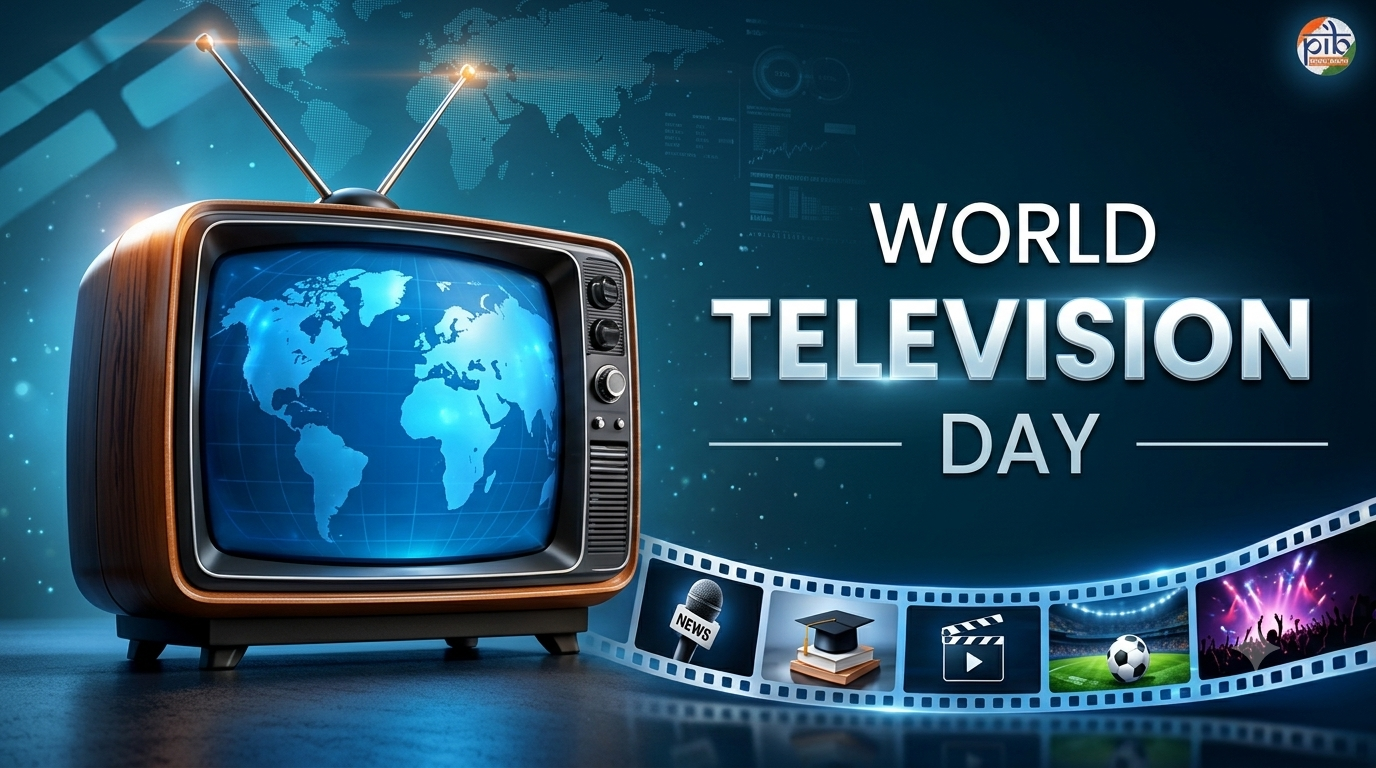
Television broadcasting refers to the systematic transmission of audio and video content to a large audience through electronic communication networks. By combining sound and moving images, television has become an important medium for delivering news, information, education and entertainment. Technological advancements over the decades have expanded its reach through terrestrial, satellite, cable and internet-based platforms.
In India, television broadcasting has played a significant role in connecting diverse communities across geographical and linguistic boundaries. It has contributed to socio-economic development through educational programmes, agricultural information, health awareness initiatives and public service campaigns. Television has also become a major source of entertainment, bringing films, serials and sports into millions of households while promoting India’s cultural and linguistic diversity.
The medium has further strengthened public administration by facilitating the dissemination of government policies, welfare schemes, development initiatives and emergency information, improving public awareness and access to essential information.
Recognising television’s growing influence on public opinion, global communication and cultural exchange, the United Nations General Assembly proclaimed November 21 as World Television Day in 1996. The observance highlights television’s role in informing, educating and connecting societies, while emphasising the importance of responsible broadcasting in promoting informed public discourse.
Television has evolved from a conventional broadcasting medium into a multi-platform communication network, allowing audiences to access information and entertainment beyond geographical boundaries.
The Changing Technologies of Television
Television broadcasting in India has evolved alongside advancements in communication and transmission technologies. Each phase of this transformation has improved the transmission and distribution of programmes, expanding television’s reach and accessibility.
The Early Broadcast Era: Terrestrial Television (1959–1975)
India’s television journey began with an experimental broadcast in Delhi on September 15, 1959. The initiative was launched by All India Radio (AIR) under the Ministry of Information and Broadcasting. Initially, programmes were transmitted from a makeshift studio using a small transmitter, with coverage limited to areas around Delhi.
The experimental service developed into a regular television service in 1965. Doordarshan began broadcasting a daily Hindi news bulletin on August 15, 1965. Television services were subsequently extended to Mumbai and Amritsar in 1972, followed by seven other cities by 1975.
During this period, television remained part of All India Radio. On April 1, 1976, Doordarshan became a separate department under the Ministry of Information and Broadcasting.
Television broadcasting during this phase primarily relied on analogue terrestrial transmission. The system used ground-based transmitters to send television signals through radio waves. Signals were transmitted from antennas installed on elevated towers and received by household television sets through indoor or outdoor antennas.
However, terrestrial broadcasting had geographical and technical limitations. Signal reception depended on the distance between households and transmitters, while hills, buildings and other physical obstructions could weaken or block signals. Consequently, reception quality varied across locations.
Analogue transmission also had limited channel capacity, as each assigned television frequency generally carried one programme. Expanding services required additional frequencies, transmitters and supporting infrastructure.
These limitations highlighted the need for a broadcasting system capable of covering larger geographical areas. Satellite communication emerged as an alternative, offering the potential to transmit television signals across wider regions and extend services to remote locations.
Satellite and Colour Broadcasting: Expanding Television’s Reach (1975–1988)
The mid-1970s marked a significant turning point in India’s television history. By 1976, the country’s terrestrial network had eight stations, covering 45 million people across 75,000 square kilometres. Satellite technology and colour broadcasting subsequently transformed television’s geographical reach and viewing experience.
One of the major developments was the Satellite Instructional Television Experiment (SITE), conducted between August 1975 and July 1976. The experiment used satellite technology to broadcast educational programmes directly to villages across six states. It aimed to use television as a tool for education and socio-economic development.
SITE demonstrated how satellite communication could overcome geographical barriers and established television’s potential as an instrument of public communication and development.
Another major development was the introduction of India’s Indian National Satellite (INSAT) system. INSAT-1A, launched in April 1982, was the country’s first-generation operational domestic communications satellite. It enabled a common programme feed to be transmitted from Delhi to regional stations. However, the satellite was abandoned in 1983.
INSAT-1B, launched in August 1983, strengthened the emerging national broadcasting network and achieved full operational capability in October 1983. It supported television broadcasting and other communication services, improving connectivity among Doordarshan’s regional stations.
Colour Broadcasting: A Major Milestone
Alongside satellite expansion, colour broadcasting transformed the television viewing experience. Doordarshan’s first colour telecast took place on August 15, 1982, coinciding with the launch of its National Programme. Later that year, colour television gained wider public attention through the live coverage of the Asian Games in New Delhi in November 1982.
This marked India’s transition from black-and-white transmissions to colour broadcasting.
Unlike terrestrial broadcasting, which relies on ground-based transmitters with geographically limited coverage, satellite communication enables signals to reach much wider areas. A single satellite can serve multiple regions through its communication footprint, helping extend television services to remote and previously underserved locations.
A satellite communication system has two main components: the ground segment and the space segment. The ground segment includes Earth stations and associated transmission and reception equipment, while the space segment consists of the satellite and its onboard transponders, which receive and retransmit communication signals.
The broadcasting process involves three stages. First, an Earth station transmits television signals to a satellite through an uplink. The satellite’s transponder receives the signals, amplifies them and converts them to a different frequency before retransmitting them towards Earth through a downlink.
Receiving Earth stations then capture the downlinked signals and distribute them to television transmitters or cable networks. At the subscriber’s premises, a dish antenna can receive satellite signals directly. Thus, satellite communication provides long-distance connectivity, while terrestrial transmitters and cable networks facilitate final distribution.
The combination of satellite connectivity and colour broadcasting significantly expanded television’s reach and improved the viewing experience. The next phase of this transformation began with the entry of private satellite channels in the early 1990s and the subsequent expansion of cable television networks.
The Multi-Channel Era: Cable and Satellite Television (1990–2005)
The period between 1990 and 2005 witnessed a major transformation in India’s television landscape. International satellite channels began reaching Indian audiences, starting with CNN. The launch of Star TV and Zee TV further accelerated the growth of satellite television. Domestic broadcasters, including Sun TV, also entered the expanding multi-channel market.
The arrival of satellite channels provided a major boost to cable television. Broadcasters transmitted programme signals to satellites through uplink facilities. The satellites retransmitted these signals towards Earth, where local cable operators received them through dish antennas installed at their head ends.
Cable operators then processed and organised the channels before distributing them to households through cable networks. This combination of satellite transmission and local cable distribution brought a wider range of news, entertainment, sports and regional-language programming into Indian homes, expanding viewing choices beyond Doordarshan’s terrestrial services.
However, cable television depended on physical infrastructure connecting operators with households. Extending these networks to remote and geographically challenging areas remained difficult.
Direct-to-Home (DTH) broadcasting emerged as an alternative distribution platform. Unlike cable television, DTH services deliver satellite signals directly to dish antennas installed at subscribers’ premises, eliminating the need for a local cable network.
Direct-to-Home and Digital Broadcasting (2003–2017)
The next phase of India’s television evolution was marked by the expansion of DTH services and the transition from analogue to digital broadcasting.
Dish TV launched India’s first commercial DTH service in October 2003. In December 2004, Prasar Bharati launched Doordarshan’s DD Direct Plus, now known as DD Free Dish. The platform introduced a free-to-air DTH service without a monthly subscription requirement, expanding access to satellite television, particularly in areas with limited cable connectivity.
DTH broadcasting delivers television signals directly from satellites to individual households. Broadcasters first convert television content into digital signals and compress them for efficient transmission. These signals are sent to satellites using designated radio frequencies, generally in the Ku-band.
The satellites receive and retransmit the signals towards Earth across designated coverage areas. Small dish antennas installed at subscribers’ premises capture these signals, while digital set-top boxes process and decode the selected content to make television channels available for viewing.
Subscription-based DTH services use encryption and authorised access systems to restrict viewing to subscribed channels. In contrast, free-to-air services such as DD Free Dish do not require a monthly subscription.
What is Ku-band?
The Ku-band is a portion of the radio frequency spectrum commonly used for satellite-based television services, including DTH broadcasting. It generally operates within the frequency range of 12–18 GHz. DTH services commonly use frequencies around 10.7–12.75 GHz for downlink transmission, depending on the system and regional allocation.
Its relatively high frequencies allow satellite signals to be received using smaller dish antennas at subscribers’ premises. However, Ku-band signals can be affected by heavy rainfall, potentially causing temporary interruptions in reception.
Modern Broadcasting: Emerging Technologies and New Frontiers (2018–Present)
Since 2018, India’s broadcasting landscape has undergone further transformation with the expansion of internet connectivity, digital platforms and connected devices. Television viewing is no longer restricted to conventional television sets or scheduled programmes. Audiences can now access content through smartphones, computers and Smart TVs.
Over-the-top (OTT) platforms have enabled viewers to access on-demand content across devices and locations. In November 2024, Prasar Bharati launched WAVES, its OTT digital streaming platform, bringing public service broadcasting content to digital audiences. By November 2026, the platform had recorded approximately 1.6 crore registered users.
Unlike conventional terrestrial broadcasting, which transmits signals through ground-based towers, and satellite broadcasting, which uses communication satellites, OTT platforms deliver audio and video content through the internet.
The content is hosted on servers in data centres and accessed through broadband connectivity. Content Delivery Networks (CDNs) use geographically distributed servers to cache content closer to users, helping reduce latency and improve delivery.
Another emerging technology is Direct-to-Mobile (D2M) broadcasting. It uses terrestrial broadcasting infrastructure to transmit video, audio and data directly to compatible mobile devices without requiring a SIM card or mobile data connection.
Unlike OTT streaming, which relies on internet connectivity, D2M uses broadcast transmission to deliver content to multiple devices simultaneously.
Developments in D2M Broadcasting
Prasar Bharati signed a Memorandum of Understanding (MoU) with IIT Kanpur to develop a next-generation broadcasting roadmap. IIT Kanpur subsequently completed a proof of concept for D2M broadcasting.
Trials also examined hybrid transmission using High Power High Tower (HPHT) and Low Power Low Tower (LPLT) transmitters. In November 2025, Prasar Bharati published test results covering telecom interference and the thermal impact of D2M reception on mobile devices. The tests included an ATSC 3.0-based broadcast system.
Shaping the Future of Broadcasting
India’s television ecosystem has evolved from a single experimental service into a diverse, multi-platform broadcasting network. The expansion of public and private broadcasting services reflects the growing reach and changing nature of the country’s television sector.
Doordarshan now operates 35 channels, compared with 17 in 2010. DD Free Dish carries 482 channels, including educational channels, up from 59.
Private satellite television has also expanded significantly, from 603 channels in 2010–11 to 917 permitted channels as of March 2026. Of these, 908 channels were available for downlinking in India, comprising 342 pay channels and 566 free-to-air (FTA) channels. The pay channels included 238 standard-definition (SD) and 104 high-definition (HD) channels.
Private pay DTH services had 49.05 million active subscribers as of March 31, 2026. Doordarshan’s DTH service provides 100 per cent geographical and population coverage across the country.
Collectively, terrestrial, satellite, cable, DTH and digital platforms have expanded television access across urban, rural and remote areas. The future of broadcasting will increasingly be shaped by technological convergence, improved digital infrastructure and wider access to internet-based services.
High-definition transmission, digital delivery and OTT platforms are changing how audiences access and experience content. Broadcasting is also moving beyond conventional television networks towards more flexible and connected delivery systems.
Public and private broadcasters will continue to play an important role in this transition. With expanding infrastructure, technological innovation and greater integration of broadcasting platforms, India’s television ecosystem is evolving to meet the needs of diverse audiences and changing viewing preferences.
-PIB


