







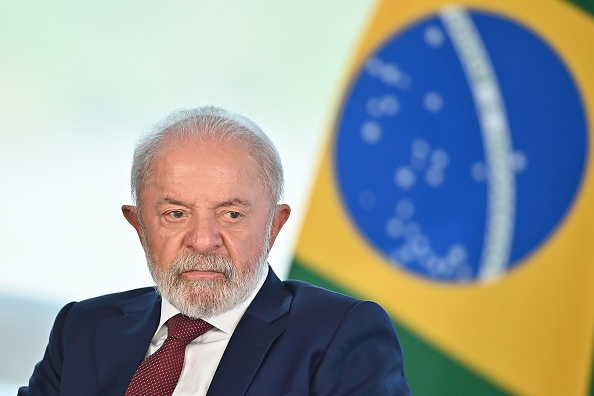
A political earthquake in South America has defied the polls, shattered precedents and rewritten the rules of modern democracy.
In a historic turn of events, 81-year-old Leftist politician Luiz Inacio Lula da Silva has made a stunning political comeback, securing a record-shattering fourth term as President of Brazil.
However, the headline extends far beyond the ballot box. The aftermath has thrown the nation into a chaotic fallout as Lula’s far-right rival, Flavio Bolsonaro, fled the country. Defying an order from Brazil’s top court to surrender his passports, Bolsonaro has landed in Miami in the U.S. state of Florida, triggering a fresh wave of political drama.
To understand the magnitude of Lula’s victory, one must look back at where the race stood just weeks ago. Following the first round of voting on 4th October, Lula’s political obituaries had practically already been written.
Flavio Bolsonaro, the eldest son of jailed former president Jair Bolsonaro, defied major opinion polls to win the first round with roughly 47 per cent of the vote, leaving Lula trailing at 45 per cent. Under Brazil’s 1988 Constitution and its two-round system, no candidate trailing after the first round had ever come back to win the runoff. Progressive Brazilians were thrown into three weeks of absolute despair as momentum firmly favoured the right wing.
Yet, Lula completely flipped the script. In the 25th October runoff, he secured 51.79 per cent of the vote to defeat Bolsonaro’s 48.21 per cent — a razor-thin margin of about 4.4 million votes.
Analysts are calling it a “miracle” victory driven by four distinct pillars:
- Overturning a first-round deficit: Lula broke a historical pattern, reversing a deficit of more than 2 million votes in just three weeks
- Massive voter mobilisation: A grassroots, social-media-driven effort centered on a WhatsApp channel known as “Lula’s Army” swelled from tens of thousands of followers to approximately 11 million by election day. This historic drive pushed the national abstention rate down from 21 per cent to roughly 19 per cent
- Bucking the regional trend: Across Latin America, conservative movements had been on a significant post-pandemic winning streak. Lula effectively slammed the brakes on that regional momentum
- Overcoming institutional headwinds: Lula won despite significant right-wing gains in concurrent legislative elections, fierce opposition from economic elites, and election-day transport disruptions that forced a last-minute, two-hour nationwide polling extension
The drama shifted immediately from the ballot box to the border. While Flavio Bolsonaro’s legal team alleged voting irregularities and refused to formally concede, the candidate himself made a run for it.
Following a post-election court order, police cancelled Bolsonaro’s Brazilian travel documents and ordered him to surrender all passports within 24 hours. However, Bolsonaro holds multiple passports, utilising a complex international background to evade authorities. As a sitting lawmaker, he holds an official diplomatic passport alongside his standard Brazilian citizen passport. Crucially, he also holds a third passport issued by Italy, having formally obtained dual Italian citizenship in 2023 through his family’s Venetian ancestry.
Bolsonaro crossed the land border into Argentina using only his national identity card — a path permitted under the rules of Mercosur, the South American regional trade bloc that allows passport-free travel for citizens. From Argentina, he used his Italian passport to board a private flight through Ecuador to the U.S.
Upon landing in Miami on 28th October, Bolsonaro reportedly presented his Brazilian diplomatic documentation alongside a U.S. visa granted by the Trump Government.
Taking to social media from U.S. soil, he initially declared himself the “legitimate president-elect” of Brazil, before quickly editing the text to style himself the nation’s “rightful leader,” claiming to be the victim of a judicial “witch hunt.”
U.S. President Donald Trump later confirmed that his Government had granted visas to Bolsonaro and his family, publicly labelling the Brazilian election “very strange and terrible.”
The escape is a striking echo of recent history. Flavio’s father, the patriarch Jair Bolsonaro, famously fled to the U.S. after losing the presidency to Lula in 2022. The elder Bolsonaro’s subsequent return did not end well; he was eventually sentenced to 27 years in prison for plotting a coup to stay in power — a sentence he is currently serving under house detention. With Flavio Bolsonaro set to lose his parliamentary immunity when his legislative term ends in early 2027, analysts say that he fled specifically to evade his father’s fate.
The international ripple effects of this election are profound. Internationally, the outcome is viewed as a significant loss of face for Trump, whose Government actively backed the Bolsonaros to expand U.S. influence in the region. Instead, Lula’s triumph provides strong political reassurance to the BRICS alliance, keeping Latin America’s largest economy firmly anchored in a multipolar framework.
Lula, who turned 81 on 27th October, enters his fourth term as one of the oldest democratically elected heads of state in the world. By the time his new term concludes, he will have governed Brazil for a combined 16 years — the longest democratically elected tenure in the country’s modern history.
Addressing roaring crowds in Sao Paulo, Lula championed his traditional platform of social welfare expansion, cost-of-living relief, and environmental protection, calling his political resurrection a “defeat for denialism.”
However, while the comeback is historic, the octogenarian President faces an uphill battle. With an overall fiscal deficit sitting in the high single digits of G.D.P. and a deeply hostile, conservative-led legislature waiting for him, the hardest work for Brazil’s future begins now.
Ramesh Ramachandran is a senior consulting editor with D.D. India


