






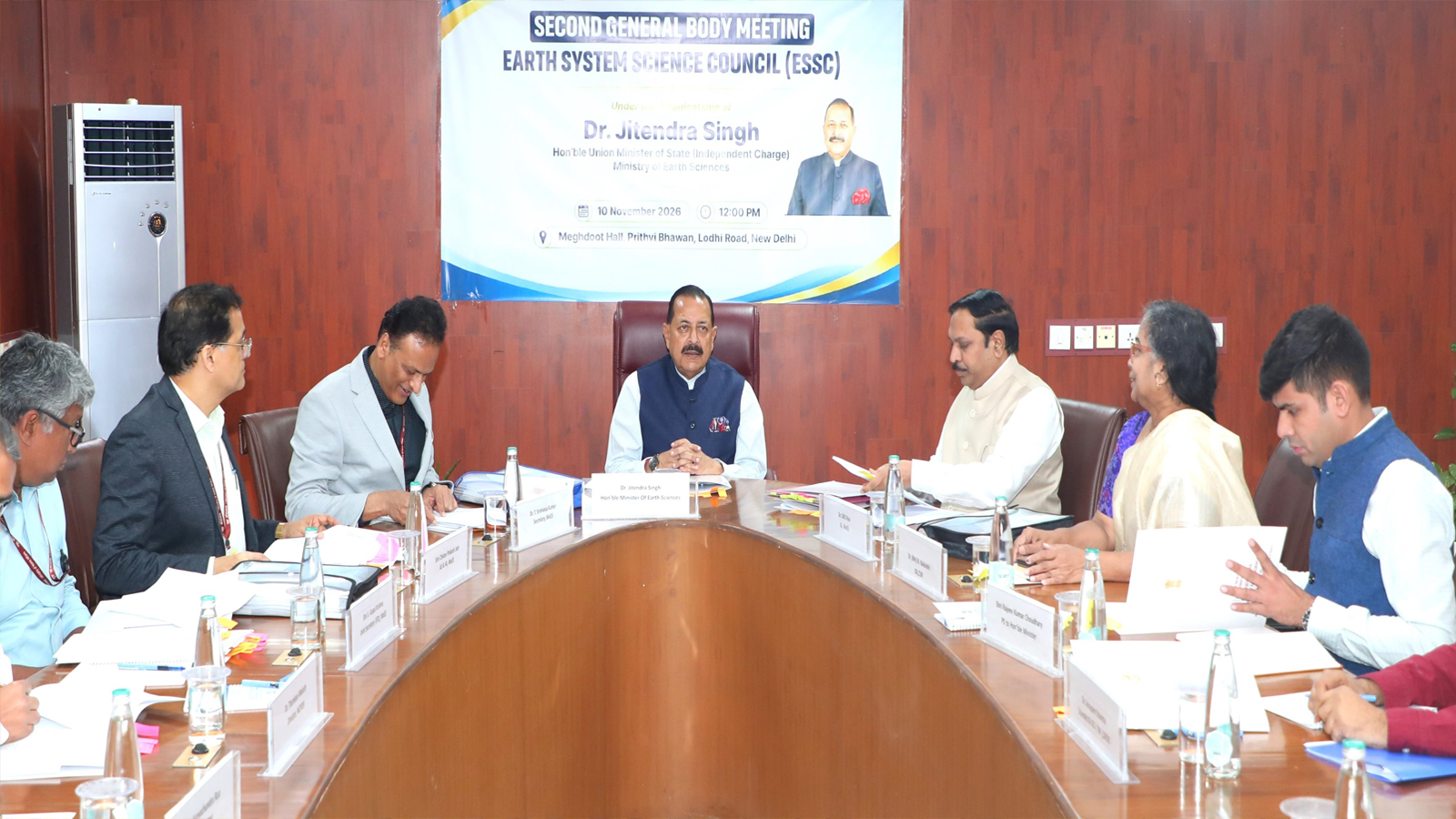
Union Minister of State (Independent Charge) for Science & Technology and Earth Sciences, and MoS PMO, Personnel, Public Grievances & Pensions, Atomic Energy and Space, Dr. Jitendra Singh on Tuesday called for stronger citizen-centric communication of India’s scientific achievements, stressing that research breakthroughs and technological innovations must be presented in simple and accessible language to help the public understand their relevance.
Chairing the Second General Body Meeting of the Earth System Sciences Council (ESSC), the Minister emphasised the need to combine scientific expertise with professional communication skills to make research outcomes and their applications more visible to society.
Singh encouraged closer coordination among communication teams across institutions, regular engagement with media professionals and the use of creative formats to explain scientific developments and public services. He said India’s scientific achievements should be transformed into compelling narratives that ordinary citizens can easily understand and appreciate.
The meeting reviewed the annual reports and audited accounts for FY 2025-26 of the five institutions under the ESSC: the National Institute of Ocean Technology (NIOT), Indian National Centre for Ocean Information Services (INCOIS), National Centre for Earth Science Studies (NCESS), Indian Institute of Tropical Meteorology (IITM) and National Centre for Polar and Ocean Research (NCPOR).
Secretary, Ministry of Earth Sciences, Dr. T. Srinivasa Kumar; Director General, CSIR, Dr. N. Kalaiselvi; Joint Secretary, MoES, Dr. G.R.S. Rao; Additional Secretary and Financial Adviser, MoES, Chetan Prakash Jain; and senior scientists and officials from the Ministry and its institutions attended the meeting.
Deep Ocean Mission and MATSYA-6000 Progress Reviewed
Reviewing the progress of the Deep Ocean Mission, Singh was briefed on advances in India’s human deep-sea exploration programme, particularly the development of MATSYA-6000, the country’s human submersible designed to operate at depths of up to 6,000 metres.
Indian aquanauts successfully completed dives to depths of 4,025 metres and 5,002 metres during the Indo-French expedition aboard the submersible Nautile. The achievement marks a significant step forward in India’s deep-sea exploration capabilities and international scientific collaboration.
NIOT also reported progress in indigenous ocean technologies, including desalination solutions for Lakshadweep, offshore fish cage technologies, oceanographic instruments, deep-sea mineral exploration and ocean thermal energy conversion. These initiatives are aimed at strengthening India’s ocean research capabilities and supporting the sustainable utilisation of marine resources.
Weather Forecasting and Ocean Advisory Services Under Review
The Minister also reviewed scientific advances under Mission Mausam and the PRITHVI programme, including developments in the Bharat Forecasting System, advanced numerical weather prediction and atmospheric observation networks.
Research at IITM is contributing to improved weather and climate forecasting through enhanced modelling systems, expanded observation infrastructure and the application of Artificial Intelligence and Machine Learning. These developments are expected to strengthen India’s preparedness for weather- and climate-related challenges.
INCOIS presented its expanding ocean information and advisory services for fishing communities, coastal populations and maritime stakeholders. These include multilingual marine advisories, fishing-related information, swell-surge inundation forecasts and ocean observation products, helping translate ocean science into practical public services and improved coastal preparedness.
Earth Science and Polar Research Capabilities Expanded
NCESS highlighted its contributions to earth science research, including studies on landslides, tectonic processes, ocean structures, atmospheric aerosols and rainfall patterns over the Western Ghats. The institution also reported progress in developing scientific laboratories and research facilities.
Singh reviewed NCPOR’s achievements in polar and ocean research, including the 45th Indian Antarctic Expedition, involving 95 members, and the 16th Indian Arctic Expedition. The institution’s work also covers glacier monitoring in the Himalayas and scientific investigations in the Southern Ocean.
Research on polar environments, glacier dynamics, ocean-atmosphere interactions and carbon cycling is helping improve understanding of climate change and global environmental processes, while strengthening India’s contribution to international polar research.
Mission-Mode Approach Proposed for Polar and Solid Earth Sciences
During the meeting, Singh proposed adopting a mission-mode approach for polar and solid Earth sciences to accelerate research outcomes and strengthen scientific capabilities in these areas.
In his concluding remarks, he welcomed suggestions from members and assured that the Ministry would follow up on the issues raised. He encouraged continued engagement with him, the Secretary and concerned officials beyond formal meetings, describing the institutions as an extended scientific family working collectively to advance India’s Earth sciences capabilities.
(PIB)


