





The Hindi feature film Krishnavataram (Krishnavataram Part 1: The Heart) offers a contemporary cinematic interpretation of Lord Krishna’s life, narrated through the perspective of Satyabhama. Screened in the Indian Panorama Feature Films section at the 57th International Film Festival of India (IFFI) 2026, the film is the first instalment of a planned three-part series exploring Krishna’s life and teachings.
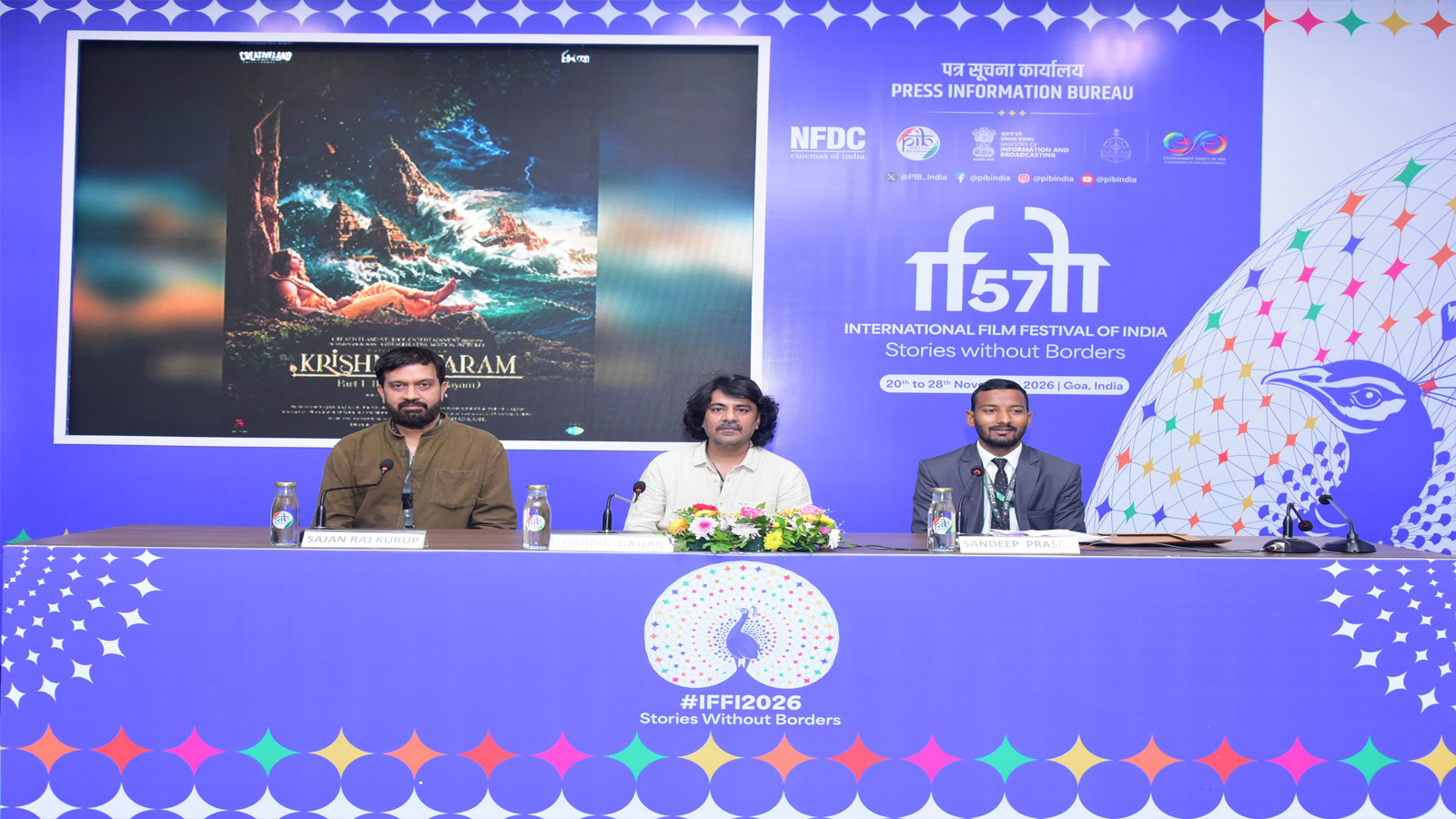
Director Hardik Gajjar and producer Sajan Raj Kurup shared insights into the film at a press conference organised by the Press Information Bureau (PIB), discussing their efforts to present the story through visually enriched storytelling while retaining its spiritual and cultural significance.
Speaking about the central idea behind the film, producer Sajan Raj Kurup said Lord Krishna cannot be confined to the category of mythology in India. “Krishna in India is beyond mythology. This is faith, an emotion, and a living part of our history,” he said.
Recalling his upbringing in a cultural tradition centred around Adikeshava, Kurup referred to the belief that “everything comes from Krishna”. He said the filmmakers had made a conscious effort to portray Krishna’s life with sincerity and deep respect.
Krishnavataram is conceived as a trilogy structured around three themes: Heart, Mind and Soul. Adapted from Raam Mori’s novel Satyabhama, the first part has a screenplay by Prakash Kapadia, Raam Mori and Hardik Gajjar, and draws on the Srimad Bhagavatam and Harivamsa.
Narrated through Satyabhama’s perspective, the opening chapter traces Krishna’s journey from Vrindavan and Mathura to his rule in Dwarka. Centred on love, sacrifice, separation and devotion, the film also brings lesser-known episodes from Krishna’s life to the screen. The subsequent instalments will explore his statecraft and strategy in The Mind, followed by the teachings of the Bhagavad Gita in The Soul.
The film features Siddharth Gupta, Sanskruti Jayana, Sushmitha Bhat and Nivaashiyni Krishnan in key roles.
Explaining the filmmakers’ approach to connecting traditional narratives with contemporary audiences, director Hardik Gajjar said the film was designed particularly to help younger generations discover and relate to their cultural history through an engaging cinematic language.
The makers emphasised that storytelling methods can evolve with changing times and that modern technology offers opportunities to create visually enriched cinematic experiences. Drawing on Gajjar’s background in visual effects, the film was developed on a massive 7.5-acre set, with a team of experienced visual effects professionals contributing to its presentation. It has also been made in multiple languages, including English, with the aim of reaching young audiences across the world.
Music forms an important part of the film’s emotional storytelling. Gajjar spoke about the collaboration with music director Prasad S and the effort to combine classical traditions with a contemporary sound. Under the guidance of renowned maestro Dr. Bharat Balvalli, the team incorporated classical music extensively to retain its traditional purity while making the soundtrack accessible to modern audiences.
Through its three-part narrative, Krishnavataram seeks to present different dimensions of Lord Krishna’s life, combining faith, literature, music and contemporary cinematic techniques to bring the enduring story to audiences in India and abroad.
The session was moderated by Sandeep Prasad.
(PIB)


