






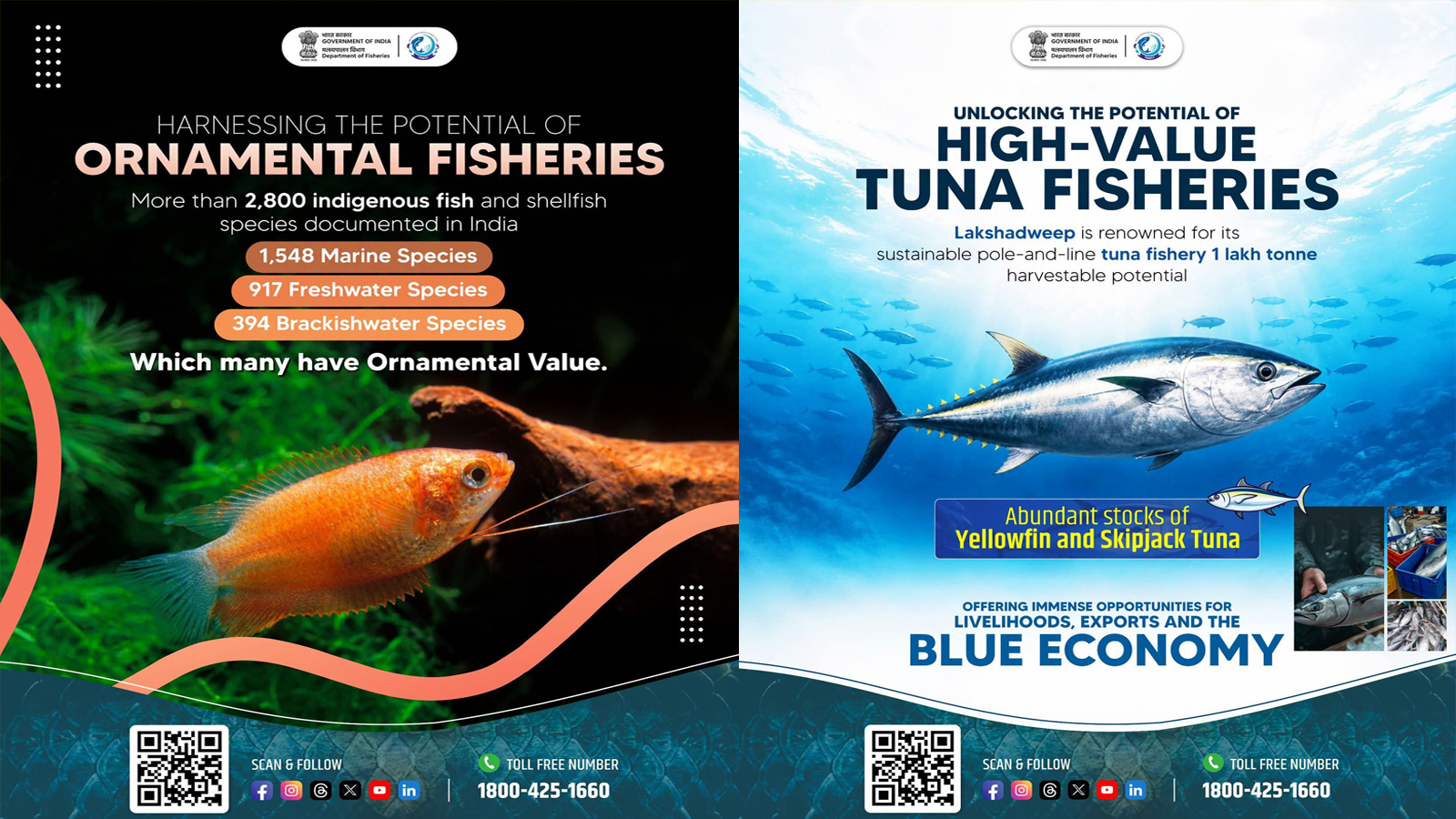
India is stepping up efforts to position Lakshadweep and the Andaman and Nicobar Islands as key centres of its Blue Economy strategy, with a focus on expanding high-value tuna fisheries, promoting seaweed cultivation and developing ornamental fisheries. The initiative aims to unlock the vast marine resources of the island territories while creating livelihood opportunities, strengthening seafood exports and ensuring sustainable use of ocean resources.
India has a coastline of approximately 11,099 km and an Exclusive Economic Zone (EEZ) spanning nearly 24 lakh sq. km, with an estimated marine fisheries potential of 58.6 lakh metric tonnes. The fisheries sector supports the livelihoods of nearly 50 lakh fishers and contributes significantly to food security, nutrition, employment, income generation and export earnings.
India is among the world’s leading fisheries and aquaculture-producing nations. Seafood exports were valued at around ₹73,890 crore in FY 2025-26, highlighting the sector’s growing contribution to the national economy and international seafood trade.
The Government has committed ₹39,272 crore to fisheries development through various schemes and programmes since 2015. Under the Pradhan Mantri Matsya Sampada Yojana (PMMSY), investments of ₹218 crore have been allocated to the Andaman and Nicobar Islands and ₹175 crore to Lakshadweep to strengthen fisheries infrastructure and development.
The Union Budget 2025-26 also outlined an enabling framework for the sustainable utilisation of fisheries resources in the EEZ and the High Seas, with particular emphasis on the two island territories. The approach seeks to tap underutilised marine resources while placing scientific management and ecological sustainability at the centre of fisheries expansion.
Island territories offer significant marine fisheries potential
Lakshadweep and the Andaman and Nicobar Islands together account for nearly 40 per cent of India’s EEZ, giving them access to rich oceanic fishing grounds and major tuna migration routes across the Arabian Sea and the Bay of Bengal.
Lakshadweep’s lagoons, coral reefs and surrounding deep-sea waters offer favourable conditions for tuna fishing, seaweed cultivation and reef-based livelihoods. The Andaman and Nicobar Islands, with their extensive coastline, diverse marine habitats and proximity to Southeast Asian maritime routes, have considerable potential for sustainable fisheries, mariculture and value-added seafood production.
Tuna fisheries to anchor high-value growth
Tuna development is emerging as a central component of the Government’s strategy for high-value marine fisheries. The waters around both island groups contain substantial underutilised stocks of Yellowfin, Skipjack and Bigeye tuna, offering opportunities to expand sustainable, export-oriented fishing.
The strategy envisages a science-based approach covering modern deep-sea fishing vessels, selective fishing methods such as hook-and-line and pole-and-line fishing, improved onboard handling, cold-chain facilities, processing and canning infrastructure, and stronger export linkages.
In Lakshadweep, a five-year plan aims to double tuna production to 50,000 tonnes. The initiative will be supported by the induction of deep-sea vessels and mother vessels, alongside the promotion of the islands’ traditional and ecologically sound pole-and-line fishing practices.
In the Andaman and Nicobar Islands, a dedicated Tuna Cluster under PMMSY is facilitating fleet modernisation and infrastructure development. Plans include the introduction of new vessels, upgrading existing fishing fleets and expanding cold-storage capacity. The strengthened presence of the Marine Products Export Development Authority (MPEDA) is also expected to improve market access and facilitate direct exports from the islands.
Seaweed and ornamental fisheries to diversify livelihoods
Alongside tuna development, the Government is promoting seaweed cultivation and ornamental fisheries to diversify the island economies beyond capture fisheries.
The clean lagoon systems of Lakshadweep and the coral-rich marine ecosystems of the Andaman and Nicobar Islands provide favourable conditions for sustainable seaweed cultivation. Seaweed has applications in food, nutraceuticals, cosmetics, pharmaceuticals and bio-industrial products.
Lakshadweep has been notified as a dedicated Seaweed Cluster, with plans for large-scale cultivation, seed banks, hatcheries and capacity-building initiatives to establish a reliable seaweed value chain.
Ornamental fisheries represent another high-value opportunity, particularly in Lakshadweep, which is home to more than 300 reef-associated ornamental species. The proposed strategy includes medium-scale rearing units, conservation-based and regulated collection practices, and improved market access for sustainably sourced aquarium species. These measures are expected to create additional livelihood opportunities while protecting fragile marine ecosystems.
Infrastructure investment to strengthen the fisheries value chain
Modernisation of fisheries infrastructure is another key element of the development strategy. Investments are being directed towards fish landing centres, ice plants, cold-chain networks, onboard preservation systems, fish aggregating devices, boat-building yards, value-addition units and export facilitation systems.
The infrastructure push is intended to strengthen local processing and marketing capacity, reduce post-harvest losses and improve the ability of island-based fisheries to access domestic and international markets.
By integrating tuna fisheries, seaweed cultivation, ornamental fisheries, infrastructure development, research support and market access, the Government aims to transform the island territories into important centres of India’s marine economy.
The broader strategy seeks to move the fisheries sector beyond resource extraction towards greater value creation within the islands. Its long-term success will depend on balancing production growth with ecological safeguards and ensuring that fishers, local enterprises and island communities benefit from the expanding domestic and export value chains.
(PIB)


