






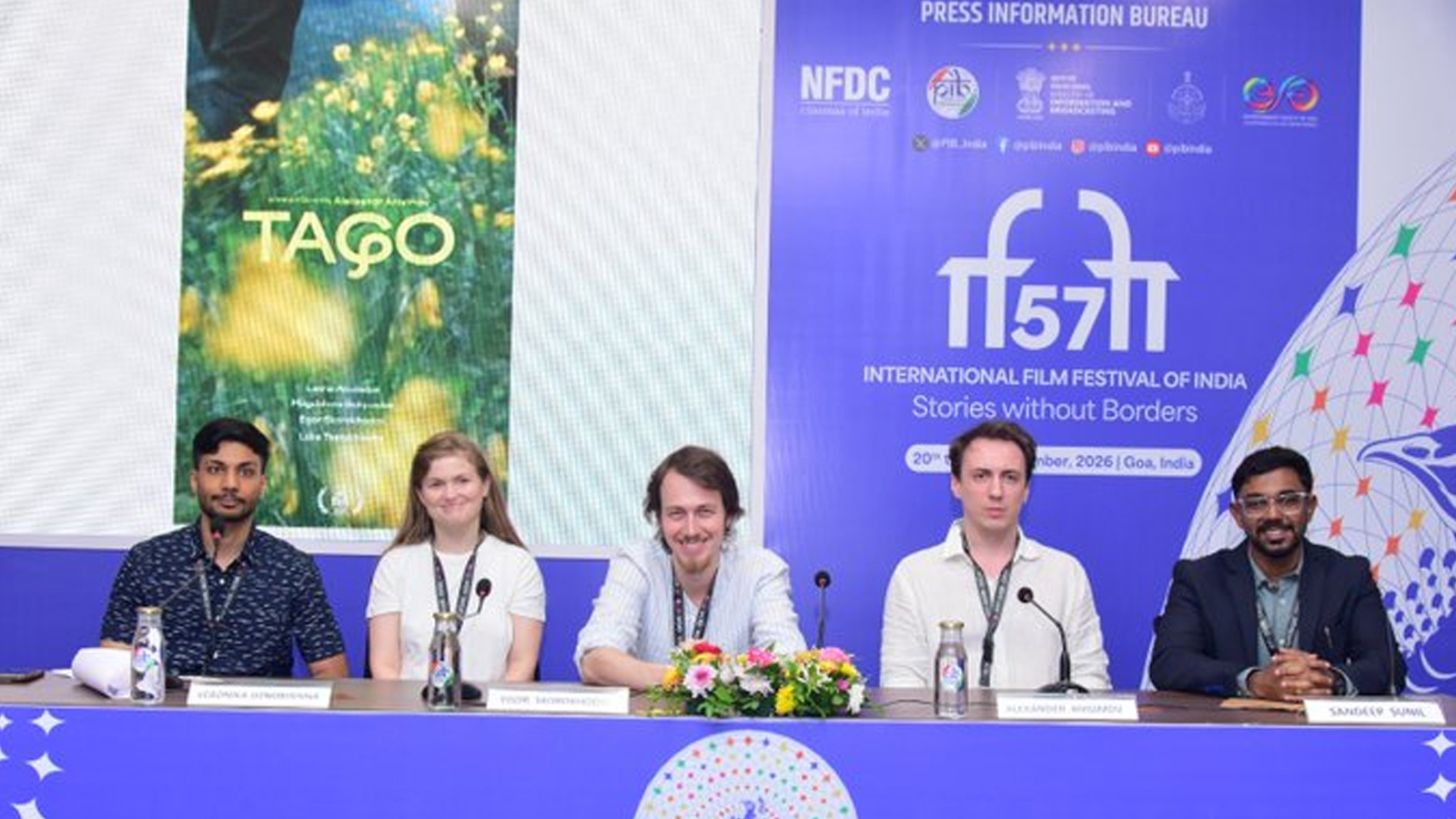
The film Tago, directed by Aleksandr Anisimov, explored the search for home and belonging, human fragility, gender dynamics and the consequences of resolving conflict through force at the 57th International Film Festival of India (IFFI) 2026 in Goa. The film had its World Premiere in the Cinema of the World section.
Addressing a press conference organised by the Press Information Bureau (PIB), director Aleksandr Anisimov and co-screenplay writer Veronika Oznobishina discussed the film’s themes, creative process and the involvement of local communities in its making.
Set in a remote Georgian village surrounded by mist-covered mountains, Tago begins when a local man discovers the body of a young stranger on a riverbank and takes him home to his wife and young son. The unexpected arrival disrupts the family’s already fragile existence, triggering a series of events that forces its members to make difficult and extreme choices.
Speaking about the film’s portrayal of gender dynamics and the emotional confinement of its female protagonist, Oznobishina said, “The very first thing we wanted to show was that the woman lives in a cage within her own house, while the man fails to understand the predicament she faces in her everyday life.”
She explained that the story also follows the turmoil confronting the male protagonist, whose response is driven by an overwhelming surge of energy that prevents him from making sound decisions. Oznobishina highlighted the importance of inner resilience and the strength needed to face unfavourable circumstances.
Anisimov spoke about the protagonist’s tendency to resolve conflicts through force, describing it as an old-fashioned approach to dealing with problems. Drawing parallels with human behaviour across societies, he observed that people often resort to force when confronted with difficult situations. The film examines the consequences of such decisions and questions whether force can offer solutions to life’s complex problems.
The film’s story took shape during Anisimov’s travels across Georgia, where he observed ordinary people’s lives, motivations and circumstances. During one of these journeys, he met a Georgian theatre actor, and the two decided to work together to bring the story to the screen. They chose to cast non-professional actors from local communities, making local participation central to the filmmaking process.
Anisimov discovered the film’s female lead, Magdalena Bolqvadze, at a bus stop. He said something in her persona suggested a tragic story to him, prompting him to imagine how the camera could capture that emotion without filters. The chance encounter eventually led to her casting in the film.
The team recorded hundreds of videos of local residents before finalising the cast. Working with a modest budget, the filmmakers gradually brought more people from the surrounding communities into the project. Anisimov expressed gratitude to the people of Georgia for their generosity and support, including providing costumes and assisting the crew with logistical arrangements.
Actor Egor Skorokhodov, who also comes from a non-professional acting background, said he connected with the director by chance and subsequently became part of the filmmaking journey.
The team welcomed the opportunity to present Tago at IFFI, noting that the festival offered a platform to watch films from across the world and engage with diverse cinematic voices.
The press conference was moderated by Sandeep Sunil.
(PIB)


